


Living with load‑shedding and rising bills can be exhausting. A reliable AC DC fan often feels less like a luxury and more like a survival tool in Pakistan’s climate 🌤️. Yet many buyers still feel confused about how these fans work, which brands to trust, and how much they should really cost.
This guide explains everything in clear, simple language. You will learn how the motors work, which situations need AC, DC, or hybrid fans, and what to expect from Taimoor and Khursheed models, including realistic price ranges.
Fact 1: AC and DC fans work on the same physics, but different motor designs ⚙️
All electric fans, whether AC or DC, follow one basic idea:
electricity creates magnetism, and magnetism creates motion.
Inside every fan:
- A stationary part creates a magnetic field.
- A rotating part feels a force from that field and starts turning.
- The blades attached to the rotor push air and create airflow.
The difference between AC and DC fans is how they create that magnetic field and how the motor is built.
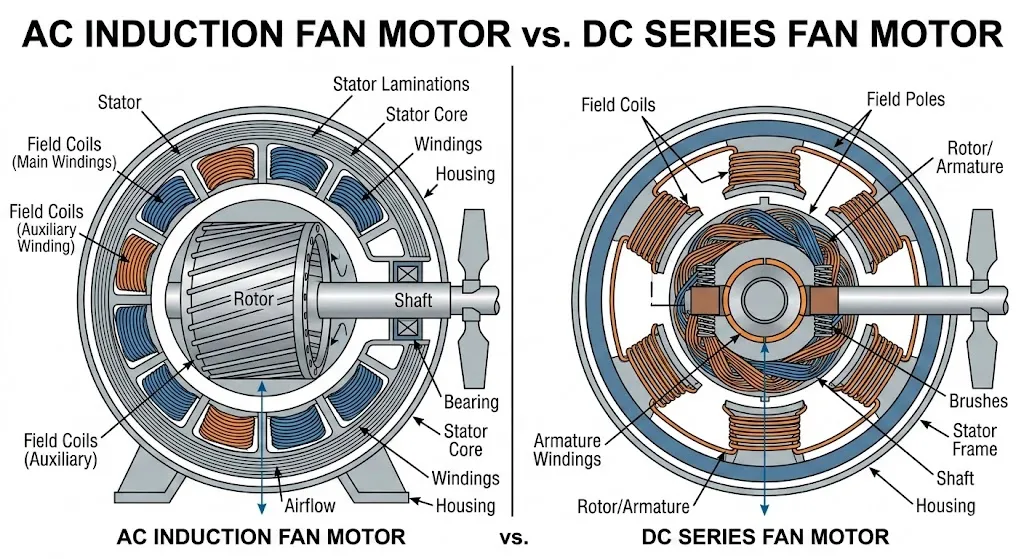
How DC fans work (DC series motor)
Many DC fans use a DC series motor. Its key parts are:
- Armature: rotating part connected to the fan blades.
- Field coils: stationary windings around the armature.
- Series connection: armature and field coils share the same current path.
When direct current flows:
- Current passes through the field coils, creating a magnetic field.
- The same current flows into the armature windings.
- The interaction between the armature current and the field’s magnetic lines produces a turning force.
- The armature rotates, turning the blades and moving air.
Because the armature and field share current, torque is strong, especially at startup. That is why DC fans can start quickly and run well on lower voltages, including batteries.
How AC fans work (single‑phase induction motor)
Most household AC fans use a single‑phase induction motor. Here, the parts are:
- Stator: the stationary part with coils connected to AC supply.
- Rotor: the rotating part sitting inside the stator.
Common types are:
- Shaded pole motors: simple, cheap, used in small fans or exhaust fans.
- Capacitor‑run motors: more efficient, used in ceiling and pedestal fans.
These motors work on induction:
- AC in the stator windings produces a rotating magnetic field.
- This changing field induces current in the rotor.
- The interaction between induced rotor current and the stator’s magnetic field creates torque.
- The rotor spins, moving the blades and air.
So both AC and DC designs rely on electromagnetic forces. The design details, however, change how efficiently they start, run, and handle voltage variations.
Fact 2: Universal “AC/DC” fans use one motor that can handle both supplies 🔌
When you see a fan advertised as “AC/DC” or “hybrid,” it often uses a universal motor.
A universal motor is built with:
- Armature and field winding connected in series (similar to DC series motor).
- Special construction so it can run on AC or DC without damage.
What happens in each mode?
- On DC supply: it behaves like a typical DC series motor.
- On AC supply: both the armature and field reverse polarity together each cycle, so the direction of torque stays the same.
That means one fan can:
- Run directly from the grid when AC power is available.
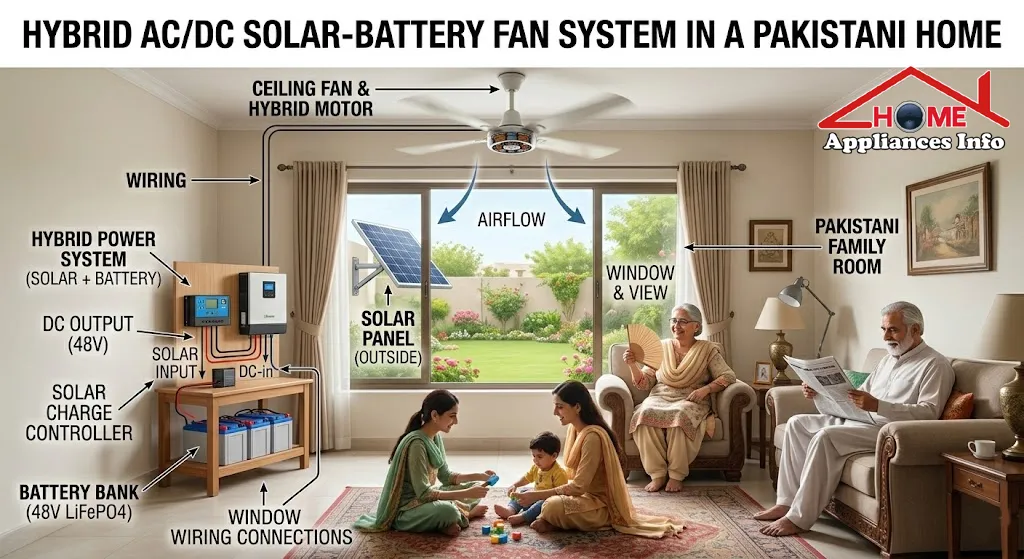
- Run from a battery, UPS, or solar system when AC fails.
This hybrid ability is why universal‑motor fans are popular in areas with daily outages.
Fact 3: DC fans are ideal for batteries and solar systems ☀️
If your main goal is backup cooling during load‑shedding, DC fans deserve special attention.
Why DC fans suit backup setups
DC fans are especially helpful because they:
- Work directly with batteries and solar panels.
- Often require lower voltage and less current.
- Start quickly and keep spinning reliably at reduced voltage.
In practical terms:
- A DC pedestal fan can often run several hours on a modest battery.
- A DC ceiling fan paired with solar panels can cool a room even without grid power.
DC motors can also be controlled electronically. Many modern models use electronically commutated (EC) designs for higher efficiency and smoother speed control.
Everyday example
Imagine you live in a city like Lahore with frequent summer outages. A DC ceiling fan wired to a small solar‑battery kit can keep your main bedroom tolerably cool during the hottest hours, even when the grid is out. You may not notice full “AC‑level” comfort, but you avoid the suffocating still air.
Fact 4: AC fans remain the everyday workhorses in most Pakistani homes 🏠
Despite the hype around hybrid and DC fans, classic AC fans still dominate the market.
Reasons:
- Affordable: AC induction motors are cheaper to produce.
- Robust: They handle voltage fluctuation reasonably well.
- Easy to service: Technicians understand them and find parts easily.
Common styles include:
- AC ceiling fans: The standard fan in most rooms.
- AC pedestal fans: Used in lounges, shops, and offices.
- AC exhaust fans: Installed in kitchens and bathrooms.
However, a standard AC fan usually needs:
- A UPS or inverter to run during outages.
- More power than a DC fan with similar airflow.
So while AC fans are practical and reliable, they may not be the best choice if your priority is long backup time on batteries.
Fact 5: AC/DC universal fans give you flexibility during load‑shedding 🔁
Think of a universal AC DC fan as a “bridge” between classic AC and pure DC designs.
How a universal fan fits your home
It can:
- Run on AC mains when the grid is on.
- Switch to DC battery or solar when power fails.
- Use the same motor and housing for both modes.
Typical setups in Pakistan:
- Home uses AC mode most of the day.
- At outage, the fan automatically or manually switches to DC backup.
- The same fan keeps the room usable without needing a separate DC‑only unit.
Pros and cons
Advantages
- One fan instead of two separate units.
- Simplifies wiring and space.
- Suitable for families who cannot invest in full solar for every room.
Limitations
- Purchase price is often higher than a basic AC fan.
- Backup time still depends on battery quality and capacity.
Hybrid fans are especially attractive if you are planning gradual upgrades. You can start with grid power only and add battery or solar when your budget allows.
Fact 6: Energy efficiency directly affects your electricity bill 💡
Electricity tariffs in Pakistan keep rising. Fans run for many hours a day, so efficiency matters.
How fan motor type affects consumption
- Traditional AC induction fans
Consume more watts for the same airflow. - Efficient DC or EC fans
Can cut consumption by 30–60% in many cases. - Universal AC/DC models
Vary by brand; you need to check their rated power.
Always read the wattage rating on the nameplate or box. Example:
- Standard AC ceiling fan: 70–80 W.
- Efficient DC ceiling fan: around 35–45 W for similar airflow.
Why efficiency helps during backup too
Lower wattage has two payoffs:
- Lower bills when running from the grid.
- Longer backup time from the same battery size.
For instance:
- A 40 W DC fan on a 12 V, 100 Ah battery can theoretically run longer than a 75 W AC fan using an inverter on the same battery, because inverter losses add extra load.
Fans may feel like “small” appliances, but across an entire summer, their energy use adds up.
Fact 7: Khursheed AC/DC fans focus on hybrid reliability for tough conditions 🌬️
The khursheed ac dc fan range, based on catalogue information, seems designed for households facing frequent power issues.
Likely product range
Khurshid’s AC/DC offerings typically include:
- Ceiling fans with hybrid AC/DC operation.
- Pedestal fans suitable for rooms and small shops.
- Models supporting grid, battery, or solar inputs.
Their catalogue usually highlights:
- Power ratings in watts.
- Blade sizes (often 48″ for ceilings, smaller for pedestals).
- Claims of energy efficiency or lower power draw.
- Information on running the same fan on AC and DC.
Who benefits most from Khursheed fans?
These fans are especially relevant if:
- You live in areas with regular load‑shedding.
- You already own a battery backup or solar system.
- You want one fan that can run on multiple sources.
Khursheed AC/DC fan price expectations
Exact prices change with time and region, but khursheed ac dc fan price often falls in:
- Rs. 8,000 – Rs. 16,000 for typical hybrid ceiling or pedestal models, depending on features.
Premium models with better design, improved blade aerodynamics, or smarter electronics can cost more.
Retailers may bundle these fans with compatible batteries or solar kits, so always compare standalone fan cost versus package deals.
Fact 8: Taimoor AC/DC fans emphasize durability and design 🧱
The taimoor ac dc fan lineup appears on the brand’s website as part of a broader fan portfolio. Even though the site content is not fully accessible here, we can infer their focus from typical Pakistani fan brands.
Likely product categories
Taimoor’s range usually includes:
- Ceiling fans in modern and classic styles.
- Pedestal fans for flexible placement.
- Exhaust fans for kitchens and bathrooms.
- Selected AC/DC hybrid models, especially in ceiling and pedestal categories.
Branding and marketing themes
The Taimoor site tends to highlight:
- Durability: strong motor construction and robust bearings.
- Energy efficiency: lower wattage claims for key models.
- Modern designs: colors and blades that match contemporary interiors.
- Dealer network: availability through distributors across Pakistan.
Taimoor AC/DC price band
The ac dc fan price in pakistan for Taimoor models typically sits in:
- Rs. 7,500 – Rs. 15,000 for many hybrid or efficient fans, though flagship designs can cost more.
Prices vary with:
- Blade size.
- Motor technology.
- Decorative finishes.
- Whether the fan is optimized for backup use or premium looks.
If you are comparing Taimoor and Khursheed side by side, pay attention to:
- Wattage ratings.
- Backup compatibility.
- Actual airflow performance, often expressed in CFM (cubic feet per minute), when available.
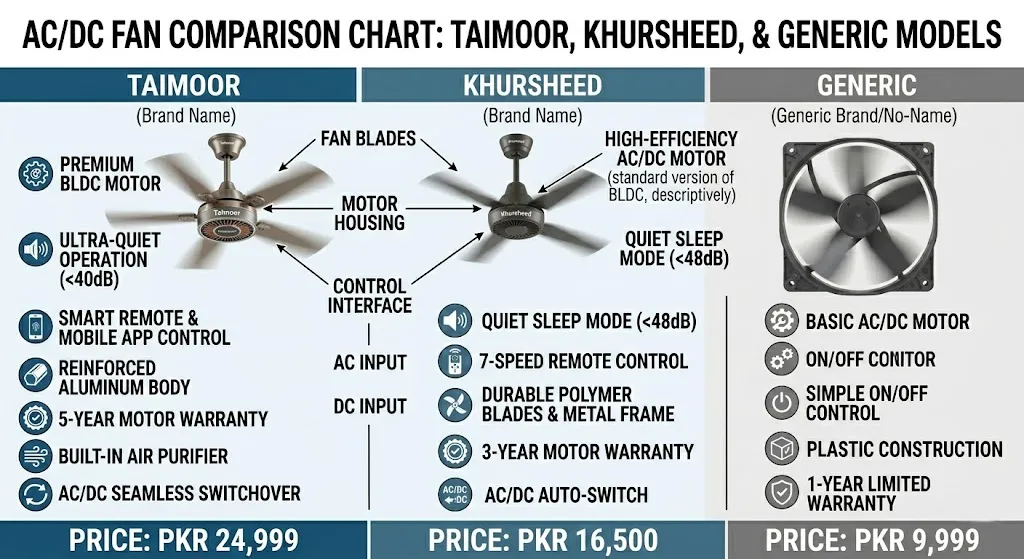
Fact 9: Practical price guide – comparing Taimoor & Khursheed in Pakistan 💰
Here is a simplified look at price ranges and use‑cases. These figures are estimates based on typical market behavior and may differ in your local shop.
Estimated AC/DC fan price comparison
| Brand | Common Types | Typical Use Case | Approx. Price Range (PKR) | Notes on Backup Use |
|---|---|---|---|---|
| Khursheed | AC/DC ceiling, AC/DC pedestal | Homes with frequent load‑shedding | 8,000 – 16,000 | Many models designed for grid + battery |
| Taimoor | AC/DC ceiling, AC/DC pedestal | Style‑conscious homes, shops, offices | 7,500 – 15,000 | Focus on durability and design |
| Generic | Basic AC induction ceiling fan | Budget homes, rental properties | 4,000 – 8,000 | Usually needs UPS/inverter for backup |
| Generic | DC pedestal / table fan | Small rooms, study areas, spot cooling | 5,000 – 12,000 | Good on small batteries or solar kits |
These ranges give you an orientation, not exact figures. Always confirm locally, check for promotions, and compare warranty and after‑sales service.
How to judge value for money
When you see ac dc fan price in pakistan, do not just chase the lowest number. Instead, weigh:
- Wattage vs airflow: A slightly pricier but more efficient fan may cost less in the long run.
- Build quality: Cheaper plastic parts might rattle or fail earlier.
- Warranty: Extra one or two years can signal confidence from the manufacturer.
- Spare parts access: Important for rural areas or smaller towns.
It often makes sense to invest a bit more in a fan that will run daily for years, especially in peak summer.
Fact 10: Key buying checklist before you choose a hybrid fan ✅
A careful checklist reduces regret later. Before buying any hybrid or AC DC fan, consider the following points.
1. Your primary power situation
Ask yourself:
- Do you face daily load‑shedding, or only occasional outages?
- Do you already have a UPS, battery bank, or solar panels?
- Are you planning to upgrade your backup system soon?
If outages are rare, a high‑quality AC fan may be enough. If they are frequent, a hybrid or DC option can bring much more comfort.
2. Fan type vs room size
Match the fan to the space:
- Ceiling fan (48″): standard bedrooms and lounges.
- Larger ceiling fan: wide lounges or halls.
- Pedestal fan: flexible, good for rentals or focused airflow.
- Exhaust fan: essential for kitchens and bathrooms, but separate from comfort cooling.
For best comfort, choose a fan diameter and airflow rating appropriate to your room size. If not stated, compare weight and blade design; heavier, well‑shaped blades often suggest better airflow.
3. Wattage and efficiency
Check:
- Rated power in watts.
- Whether the fan is advertised as “energy saving” or uses DC or EC technology.
As a simple rule of thumb:
- Under 50 W for a full‑size ceiling fan is generally efficient.
- Pedestal fans should clearly mention wattage and airflow.
4. AC vs DC vs universal
Clarify what you are really buying:
- AC fan only: needs inverter/UPS to use batteries.
- DC fan only: ideal for direct battery or solar use, may need adaptor for grid.
- Universal AC/DC fan: one unit operates with both grid and backup sources.
Be sure the box or specification sheet explains the supported voltages and wiring.
5. Brand reputation and support
When choosing between Taimoor, Khursheed, and other brands, look at:
- Customer reviews where available.
- Availability of authorized dealers.
- Warranty duration and conditions.
- Ease of contacting customer support.
For broader context on solar‑ready appliances, many homeowners find it helpful to read overviews like the fan and solar combinations discussedc, which complement what you are planning locally.
6. Noise level and comfort
A fan can be efficient yet noisy. Try to:
- Visit a showroom and listen to the fan at multiple speeds.
- Ask about noise ratings if provided.
A quiet fan can significantly improve sleep quality during hot nights 🛌.
FAQs about AC/DC fans, Khursheed, and Taimoor in Pakistan ❓
1. What is the main benefit of an AC/DC fan in Pakistan?
It can run on both grid electricity and backup power like batteries or solar. That flexibility helps you stay comfortable during frequent power cuts without needing separate fans for each power source.
2. Are Khursheed AC/DC fans worth the price?
For homes with regular load‑shedding, a khursheed ac dc fan can justify its cost. Their hybrid models are built with backup compatibility in mind, so you can use the same fan on AC mains and DC backup. The value improves if you already own a battery or solar setup.
3. How does Taimoor compare to other brands?
A taimoor ac dc fan usually emphasizes durability and design. If you want a fan that looks stylish in your lounge and also works with backup sources, Taimoor can be a strong candidate. Always compare specific models, wattage, and warranties, not just the brand name.
4. What is a typical khursheed AC/DC fan price?
A realistic khursheed ac dc fan price often sits between Rs. 8,000 and Rs. 16,000 for common ceiling or pedestal models. Higher‑end designs or larger sizes may cost more. Always confirm current prices in local markets or from official dealers.
5. Is an AC/DC fan better than a normal AC fan?
It depends on your situation. If you rarely lose power, a standard AC fan may be enough and cheaper. If you face frequent cuts or use solar, an AC/DC or DC fan gives you more comfort and better use of your backup investment.
6. How long can an AC/DC fan run on a battery?
It depends on:
- Fan wattage.
- Battery capacity.
- Inverter efficiency (if used).
As a rough example, a 40 W DC fan on a 12 V, 100 Ah battery can theoretically run many hours. Real‑world time will be lower because of losses and other connected loads, but it still outperforms many heavier AC fans.
Conclusion: Choose the right AC/DC fan to make summers bearable 🌡️
You have seen how AC and DC motors work, how universal fans bridge both worlds, and how brands like Taimoor and Khursheed position themselves in Pakistan’s challenging power landscape. A well‑chosen AC DC fan can turn long, hot outages into something much more manageable.
To recap briefly:
- AC induction fans are affordable and proven, but less efficient on backup.
- DC and hybrid fans offer better performance with batteries and solar.
- Taimoor focuses strongly on design and durability.
- Khursheed targets reliable hybrid performance under tough conditions.
- Realistic ac dc fan price in pakistan ranges from budget‑friendly to premium, depending on features, efficiency, and brand.
As you plan your next purchase, match the fan to your room size, power situation, and budget. Consider efficiency, backup compatibility, and brand support as carefully as the price tag. With the right choice, every unit of electricity – from grid, battery, or sun – will keep you and your family more comfortable, even through the harshest summer days. 🌞
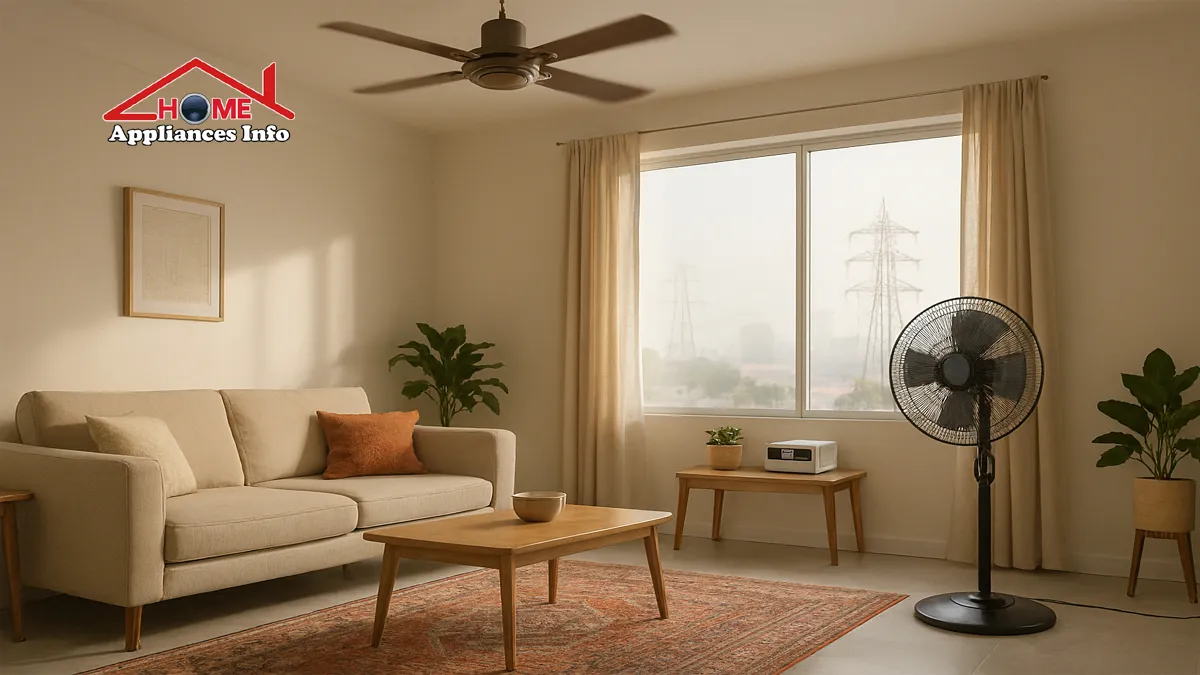
IMAGE PROMPT: A cozy Pakistani bedroom at night, lit softly, with a hybrid AC/DC ceiling fan spinning overhead while power lines outside hint at frequent outages.
Caption: A carefully chosen AC/DC fan keeping the family comfortable through summer load‑shedding.