


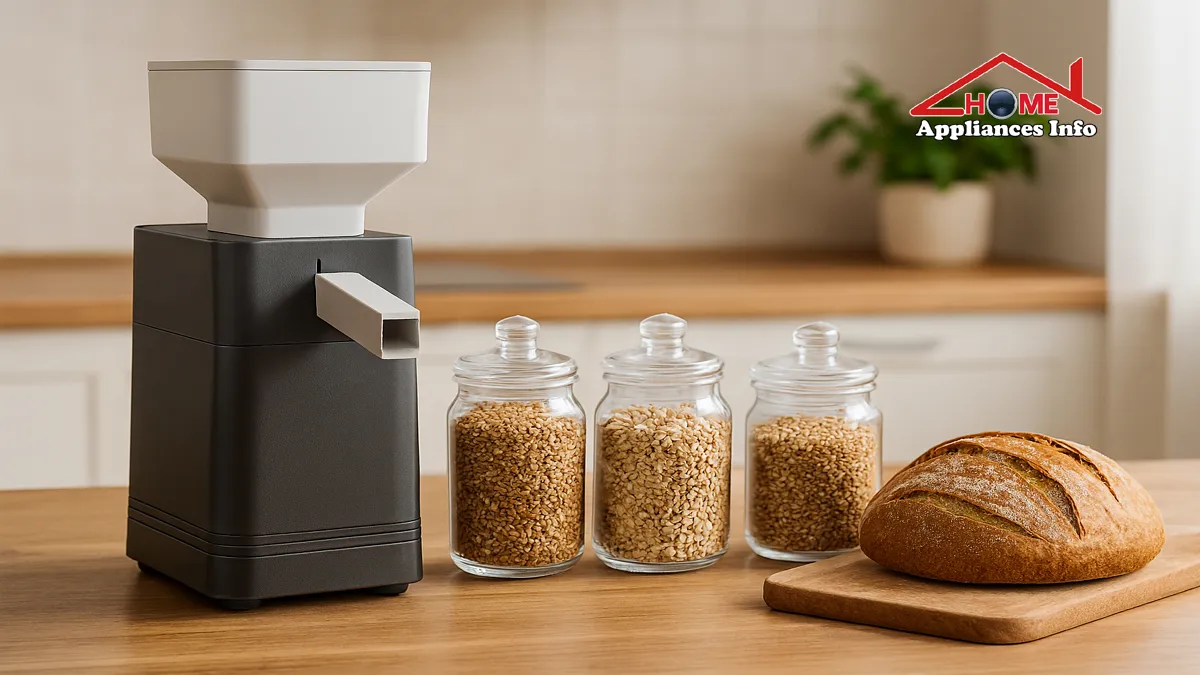
If you bake even occasionally, a grain mill can feel like discovering a secret level in your kitchen. Suddenly, you are not limited to store‑bought flour. You control freshness, texture, and even which grains go into your food.
Many people start looking at mills after learning how fast ground flour can lose flavor and nutrients. Others want more control over gluten, textures, or specialty grains. Then the questions appear:
- Manual or electric?
- How loud will it be?
- Will it create dust?
- Which model is best for my home?
This guide walks you through seven powerful reasons to upgrade, while also helping you choose the right style and model for your needs. We will look at popular options like the nutrimill grain mill, wondermill grain mill, nutrimill harvest grain mill, the kitchenaid grain mill attachment, and several trusted manual mills.
1. Fresher Flour Means Better Flavor and Nutrition 🥖
Most flour in the store was milled weeks or even months ago. Once grain is ground, its oils and vitamins start to break down. That affects both taste and nutrition.
When you mill just before baking:
- Your bread tastes sweeter and more complex.
- Whole grains stay rich in natural oils and vitamins.
- You enjoy more texture and aroma in every bite.
Think of it like coffee. Pre‑ground coffee works. But freshly ground beans smell and taste far better. Flour is similar.
What Freshly Milled Flour Changes in Your Baking
With your own home mill, you can:
- Bake whole‑grain bread that stays moist and flavorful.
- Create pastry flour with enough delicacy for cakes.
- Experiment with grains like spelt, einkorn, or rye.
Many bakers notice their first loaf with fresh flour rises better and has a richer aroma. One home baker, for example, swapped store flour for fresh wheat in her weekly sandwich bread. Her family finished the loaf in half the usual time and asked what she had “changed in the recipe.” She had only changed when the grain was milled. 😊
Research also suggests that keeping the bran and germ intact can support heart and digestive health. You can see a good overview of whole‑grain benefits by Harvard T.H. Chan School of Public Health.
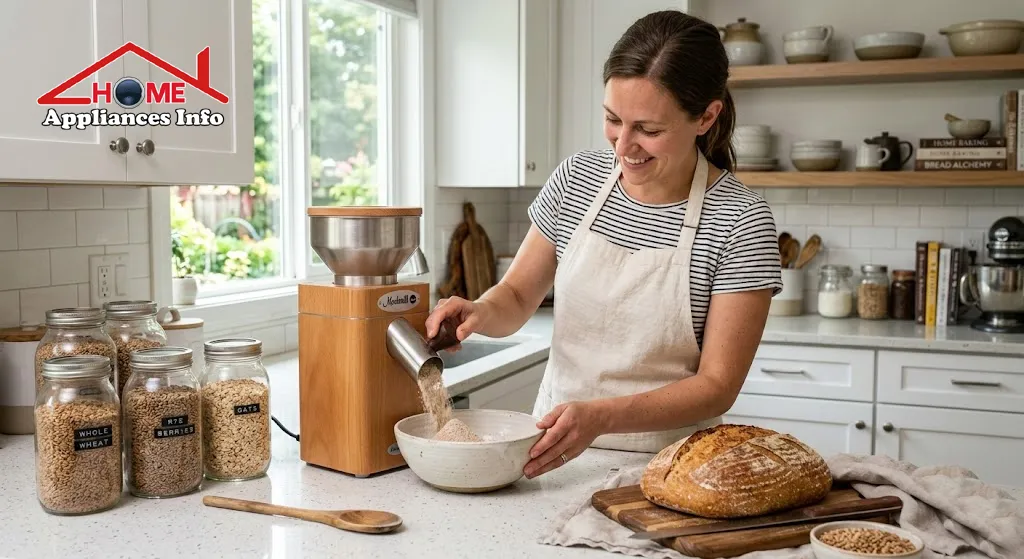
2. You Can Choose the Perfect Power Source: Manual vs. Electric ⚙️
Before you buy, ask yourself how you want to power your mill. This choice affects daily convenience, texture, noise, and even how much you enjoy using it.
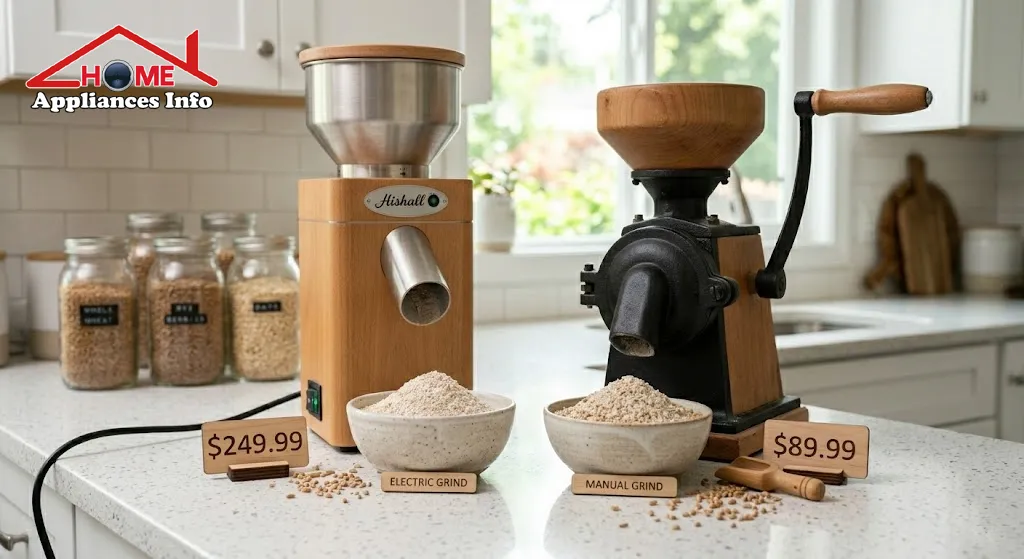
Manual Mills: Quiet, Hands‑On, and Versatile
Manual mills use a hand crank. They:
- Require physical effort.
- Are much quieter than impact electric models.
- Tend to produce coarser flour, though good models can go quite fine.
- Work anywhere, even off‑grid or during power outages.
Manual mills suit you if:
- You like the idea of slower, mindful food preparation.
- You make smaller batches of flour.
- You want a backup during emergencies.
We will look closely at the Marcato Marga Mulino and Wonder Junior Deluxe later. Both are strong options if you prefer manual milling.
Electric Mills: Fast and Fine, Ideal for Busy Bakers ⚡
An electric grain mill grinds flour quickly with minimal effort. These:
- Produce very fine flour, perfect for pastry and soft bread.
- Handle larger batches for serious bakers.
- Can be louder, especially impact‑chamber designs.
- Often create more dust than manual mills.
Some electric models can be paired with optional manual accessories, but most are designed for powered use only. They are ideal if you:
- Bake several times a week.
- Want consistent, bakery‑style texture.
- Prefer convenience over physical effort.
When you weigh manual vs. electric, think honestly about your rhythm in the kitchen. The best choice is the one you will happily use often.
3. Control Over Texture: From Pastry‑Fine to Hearty Cereal 🥣
Not every recipe needs the same grind. Some breads love a bit of rustic texture. Cakes need fine, silky flour. Hot cereals may need a coarser grind.
One of the most empowering parts of owning your own mill is texture control.
Why Grind Consistency Matters
Different recipes call for:
- Fine flour
Ideal for cakes, pastries, pancakes, and soft sandwich loaves. - Medium grind
Great for hearty bread, muffins, and waffles. - Coarse grind
Perfect for hot cereals, muesli, and rustic loaves.
Electric mills like the nutrimill grain mill and wondermill grain mill excel at producing consistently fine flour. They often include knobs or settings that allow some adjustment, from fine to a more coarse output.
Manual mills, especially higher‑quality ones, can also offer several texture settings. They may not reach the ultra‑fine consistency of impact electric mills, but they often cover everything from cereal to regular baking flour.
Real‑Life Example: One Bag of Wheat, Many Uses
Imagine keeping a single bucket of hard wheat berries in your pantry. With the right mill you can:
- Grind fine flour for sandwich bread.
- Mill slightly coarser flour for a rustic, crunchy crust.
- Create cracked grain for porridge.
Instead of buying multiple specialty flours, you adjust your own grind and use a single ingredient in many ways.
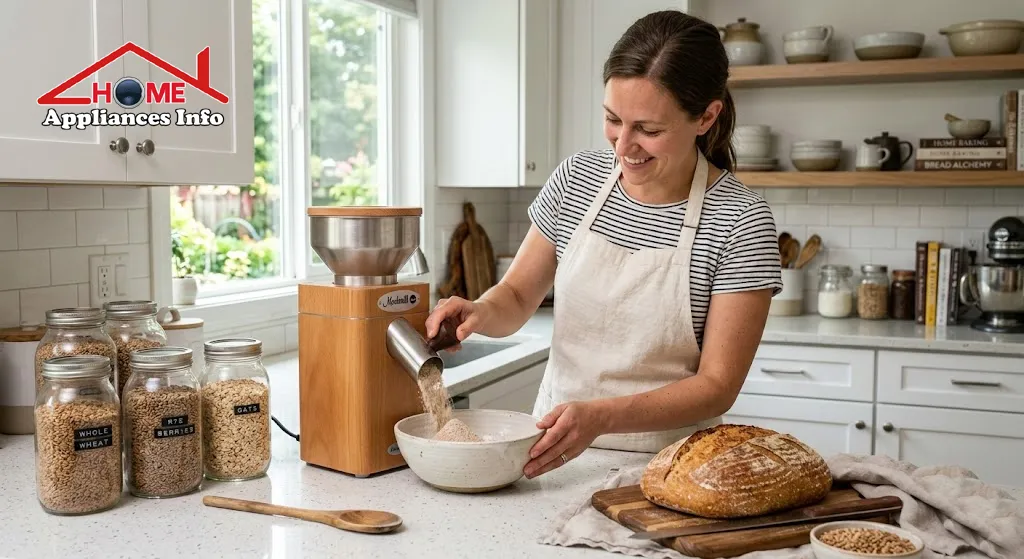
4. Reasonable Noise and Dust Levels for a Healthier Home 🌬️
Noise and dust are often overlooked until the first time someone flips on a new mill in a small kitchen. Understanding what to expect helps you choose comfortably.
Noise: Especially Important in Shared Spaces
Impact‑chamber electric mills, like some popular models, are loud by design. The high‑speed action that produces ultra‑fine flour also produces a strong sound. This can matter if:
- You live in a small apartment.
- You have sleeping children.
- You share walls with neighbors.
Manual mills, and some stone‑based electric models, are far quieter. You still hear the grinding, but it is more of a low mechanical sound.
Dust: A Real Concern for Kids and Sensitive Lungs
Not all mills create the same level of airborne flour dust. Dust can be irritating, especially for:
- Children.
- Anyone with asthma.
- People with allergies or chronic respiratory issues.
Manual mills generally produce less dust because they run slower and often direct flour neatly into a container.
Some electric mills add features to manage dust:
- Sealed milling chambers.
- Flour canisters that latch tightly.
- Filtration stages to capture particles.
The wondermill grain mill, for example, is designed as a self‑contained system. It is virtually dust‑free and self‑cleaning, with minimal small parts to misplace. That makes it a strong choice if anyone in your home is sensitive to airborne flour.
Health organizations commonly emphasize the benefits of whole grains, and these hold true regardless of your mill choice. You can see a helpful overview of whole grain and heart health, according to article from Mayo Clinic.
5. There’s a Mill for Every Budget and Kitchen Size 💸
A home milling setup does not have to be extravagant. But it should match both your budget and how you cook.
Typical Price Ranges
Most home mills fall between about 100and100and500:
- Around 100–100–200
Entry‑level manual mills and smaller electric options.
Suitable for light use and occasional baking. - Around 200–200–350
Mid‑range electric models and premium manual mills.
Good balance of performance, convenience, and durability. - Around 350–350–500+
Higher‑power electric models, larger capacity, and extra features.
Best for frequent bakers and families who go through a lot of flour.
Entry‑level grinders may handle only small amounts at a time or have fewer texture options. Premium models often add features like:
- Larger hoppers.
- Stronger motors.
- Better filtration systems.
- More precise texture control.
Capacity: How Much Flour Do You Really Need?
Your weekly baking habits guide how much capacity you need:
- Baking once a week for two people?
A small manual or compact electric unit is fine. - Baking several times a week for a family?
A mid‑range to large electric unit saves time. - Regularly baking in bulk or for events?
High‑capacity models, like the NutriMill Plus, make sense.
The key is to avoid both extremes: under‑buying and becoming frustrated, or over‑spending on features you never use.
Quick Comparison Table: Key Buying Considerations
| Factor | Manual Mills | Electric Mills |
|---|---|---|
| Power source | Hand crank | Plug‑in (some with limited backup options) |
| Effort level | Moderate to high | Very low |
| Noise level | Low to moderate | Moderate to high (impact styles are loud) |
| Typical texture | Coarse to medium‑fine | Fine to very fine, with some coarse settings |
| Dust production | Low | Varies; some models are nearly dust‑free |
| Ideal user | Occasional or off‑grid baker | Frequent baker needing speed and fine flour |
| Price range | Usually lower to mid‑range | Mid‑range to premium |
6. Standout Electric Options: NutriMill and WonderMill 🔌
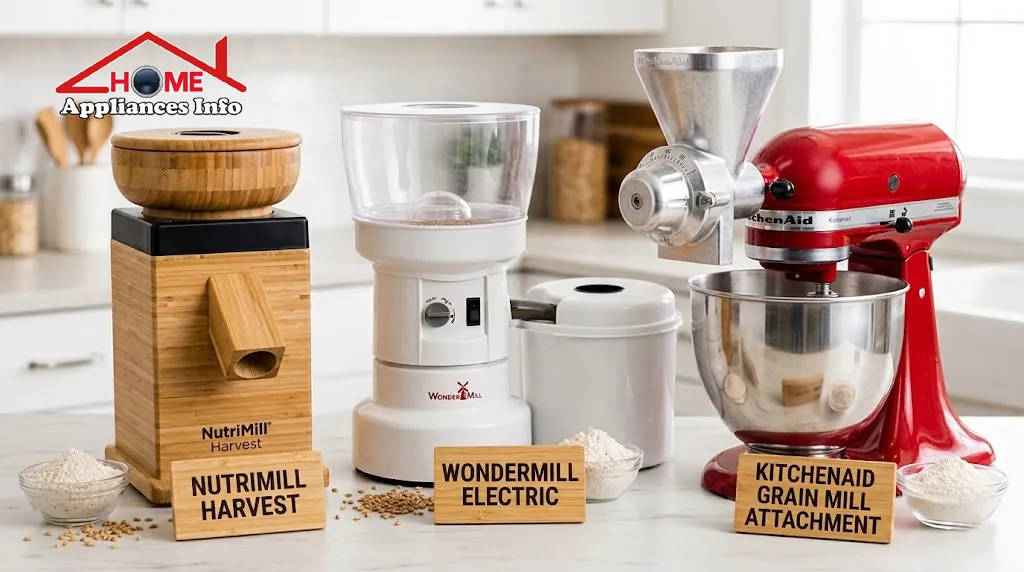
If you decide an electric model fits your lifestyle, two brands regularly rise to the top: NutriMill and WonderMill. Each brings distinct strengths.
NutriMill Harvest Grain Mill: Style Meets Gentle Grinding
The nutrimill harvest grain mill stands out for its appearance and its materials. It is a popular choice when you care about both design and nutrition.
Key features:
- Ceramic grinding stones
These mill at lower temperatures than steel impact chambers.
That helps preserve more nutrients and delicate flavors. - Texture control knob
Easy‑adjust knob lets you choose grind consistency.
You can switch from fine flour to a more rustic texture. - Stylish bamboo housing
Unlike many plastic‑bodied mills, this one looks at home on the counter.
You are more likely to use it when it is already out. - Moderate hopper capacity
The standard hopper holds about 3.5 cups of grain.
Good for small to medium batches.
If you need much more capacity, NutriMill offers larger units like the NutriMill Plus. That model includes:
- Up to 24 cups of flour capacity.
- A 1200W motor for faster milling.
- A 4‑stage filtration system to reduce mess and dust.
Together, these models make NutriMill a strong family of tools for frequent bakers.
WonderMill Grain Mill: Simple, Clean, and Dust‑Conscious
The wonder mill grain mill (often written as wondermill grain mill) focuses on simplicity and cleanliness.
Core advantages:
- Very simple operation
Pour grain into the hopper, turn it on, and flour comes out.
There are few small parts, so setup and cleanup are quick. - Self‑cleaning, low‑dust design
The milling and flour collection system is sealed.
This helps keep flour dust to a minimum. - Adjustable grind settings
You can choose from fine, bread, or coarser grind options.
However, it is not designed for very coarse output like corn grits. - Stainless‑steel blades
Durable and effective for fine and medium grinds.
Limitations:
- No manual backup option.
You rely on electricity. - Limited batch size at once.
It handles about 12 cups of grain at a time, which is enough for most homes but not for very large operations.
If respiratory sensitivity is a serious concern, the WonderMill’s dust control and self‑contained design are very appealing.
KitchenAid Grain Mill Attachment: Smart for Small Batches
If you already own a KitchenAid stand mixer, the kitchenaid grain mill attachment can be an affordable entry point.
Highlights:
- Cost‑effective
You only buy the attachment, not an entire new appliance. - Best for small batches
Handles up to about 10 cups at a time.
Great for testing home milling without a large commitment. - Texture options
It allows several grind settings from coarse to fine.
Output is good for home baking, though not as ultra‑fine as top electric mills.
Limitations:
- Not ideal for very frequent or large‑scale milling.
The stand mixer motor is not designed for industrial‑level use. - Milling speed is slower than dedicated electric units.
Still, for occasional milling or for people short on counter space, this attachment offers real flexibility.
7. Reliable Manual Workhorses for Everyday or Off‑Grid Use 💪
Manual mills remain popular for many reasons: durability, simplicity, quiet operation, and independence from the power grid. Two standout manual models are the Marcato Marga Mulino and the Wonder Junior Deluxe.
Marcato Marga Mulino Grain Mill: Compact and Budget‑Friendly
The Marcato Marga Mulino is made in Italy and offers a helpful introduction to manual milling.
Key points:
- Budget‑friendly price
Accessible for many home bakers who want to experiment. - Hand crank with 6 texture settings
Lets you choose from coarse flake to finer meal.
Ideal for cereals, flakes, and basic baking flour. - Optional drive motor attachment
If you decide hand cranking is too much, you can add a motor.
This turns the unit into a semi‑automatic system. - Best for small, fresh batches
Designed for modest quantities rather than bulk production.
It works well for people who want fresh oatmeal‑style flakes or occasional whole‑grain flour without a big investment.
Wonder Junior Deluxe: Versatility and Durability in One
The Wonder Junior Deluxe is a high‑end manual mill built for serious versatility.
Standout features:
- Multi‑purpose milling
Mills flour, spices, herbs, oily grains, coffee, and even nut butters.
This is far beyond what many mills can handle. - Faster and finer than many hand mills
Its design allows more flour per minute.
You can also reach finer textures suitable for regular baking. - Heavy‑duty bearings and steel shaft
Built to last under regular use.
The double‑post clamp keeps it stable during cranking. - Flour guide and easy‑swap milling heads
The flour guide directs output neatly into your bowl or jar.
Changing heads for different tasks is straightforward.
For anyone who values resilience and flexibility, the Wonder Junior Deluxe is a compelling choice. It can be your main everyday mill if you enjoy hand‑powered tools, or your backup when the power is out.
Bringing It All Together: How to Choose the Right Mill for You 🧭
All these details can feel like a lot. A simple series of questions can clarify your ideal choice.
Ask yourself:
- How often will I mill?
- A few times a month: manual or small electric.
- Several times a week: mid‑range or larger electric.
- What textures do I need most often?
- Mostly fine flour: electric models like NutriMill or WonderMill.
- A mix of cereal, cracked grain, and regular flour: either high‑quality manual or versatile electric.
- How sensitive is my household to noise?
- Very sensitive: consider manual mills or quieter stone‑based electrics like the NutriMill Harvest.
- Less sensitive: impact electric units are fine.
- Does dust pose a health issue?
- Asthma, children, or allergies: look at low‑dust models like WonderMill and well‑sealed systems.
- No major sensitivity: most mills will work with basic care.
- What is my realistic budget?
- Around 100–100–200: Marcato Marga Mulino, some KitchenAid attachments.
- Around 200–200–350: NutriMill Harvest, Wonder Junior Deluxe.
- Around 350–350–500+: NutriMill Plus and other high‑capacity electrics.
Once you answer these questions honestly, one or two models will usually stand out as the best fit.
[IMAGE PROMPT: A person sitting at a kitchen table with a notebook, comparing printed spec sheets of several grain mills, with a laptop open to product pages and whole grains on the table.]
Caption: A short checklist of needs—budget, noise, texture, and capacity—makes choosing the right mill much easier.
FAQs About Home Grain Milling ❓
1. Can I mill any grain in my home mill?
Most mills handle common grains like wheat, rye, barley, and spelt. Some struggle with very oily seeds or large corn kernels. Always check your model’s manual for approved grains and settings.
2. Is a manual mill too hard to use every day?
It depends on your strength, grain type, and batch size. For small batches and occasional use, many people enjoy the process. For large and frequent baking, an electric unit is often more practical.
3. How noisy are electric grain mills?
Impact‑chamber mills are quite loud, similar to a powerful blender. Stone‑based electric mills tend to be a bit quieter. If you have thin walls or sleeping children, consider this carefully.
4. Will milling make a mess in my kitchen?
It can, but it does not have to. Models with sealed chambers, flour canisters, and filtration (like WonderMill and some NutriMill units) keep dust and spillage low. Manual mills usually stay tidy if you align the output properly.
5. Do I need to store flour in the fridge if I mill at home?
For maximum freshness, use flour soon after milling. For longer storage, airtight containers in a cool, dark place work well. For very long storage (especially whole‑grain flours), the fridge or freezer can help preserve quality.
6. Is a KitchenAid grain mill attachment enough for serious baking?
It is excellent for small‑scale or occasional milling, especially if you already own the stand mixer. If you bake large batches several times a week, a dedicated electric unit will be more efficient and durable over time.
Conclusion: Why a Grain Mill Belongs in Your Kitchen Today 🌟
Upgrading to a grain mill is more than buying another gadget. It is a shift in how you think about flour, bread, and even basic pantry staples. With one tool, you gain:
- Fresher, more flavorful flour on demand.
- Full control over texture, from pastry‑fine to cereal‑coarse.
- The freedom to choose between manual and electric power.
- Better control over noise, dust, and capacity for your home.
- Options that fit almost every budget.
Electric options like the nutrimill grain mill family and the wondermill grain mill line are among the most popular for frequent bakers, thanks to their speed and fine output. For those who prefer human power or want off‑grid reliability, manual choices like the Marcato Marga Mulino and Wonder Junior Deluxe are strong, long‑lasting contenders. The kitchenaid grain mill attachment offers a smart, compact route for small batches.
If you are ready to bake more, waste less, and enjoy grain at its freshest, consider which style matches your life. Then choose the mill that feels easy to use today—because the best upgrade is the one you reach for again and again. 🌾