

To support our research and detailed appliance reviews, we may earn a small commission from qualifying purchases made through our links, at no extra cost to you. As an Amazon Associate, I earn from qualifying purchases.
To support our research and detailed appliance reviews, we may earn a small commission from qualifying purchases made through our links, at no extra cost to you. As an Amazon Associate, I earn from qualifying purchases.
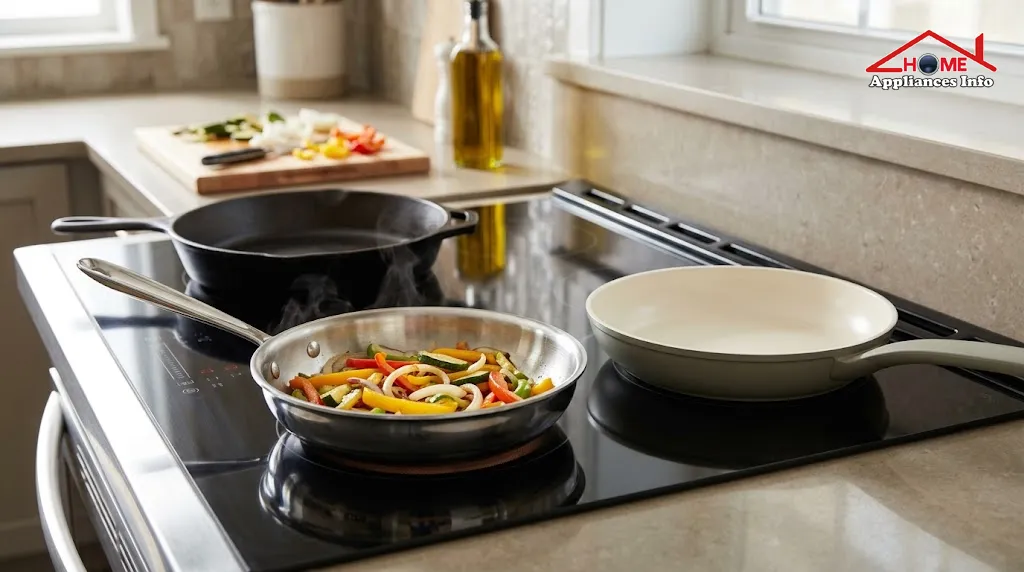
A glass cooktop looks sleek and is easy to wipe clean, but it changes the way you should think about cookware. The best pans for glass top stove cooking need more than a good cooking surface: they should sit steadily, have a reasonably smooth bottom, distribute heat well, and be easy to move without dragging across the glass.
For most households, stainless steel is the strongest all-purpose choice because it combines durability, heat performance, and a coating-free cooking surface. Ceramic and traditional nonstick pans are more convenient for eggs and other delicate foods, while cast iron can work very well if you handle its weight carefully. Current 2026 cookware testing also continues to favor high-quality stainless steel for versatility, with Hestan NanoBond and Tramontina among Good Housekeeping’s current standouts.
The seven recommendations below are ranked specifically for glass-top-stove suitability, taking construction, heat distribution, handling, durability, and everyday usefulness into account.
Quick Comparison: Best Pans for Glass Top Stoves
| Rank | Pan | Best for | Material | Main strength |
|---|---|---|---|---|
| 1 | Hestan NanoBond | Best overall | NanoBond stainless steel | Premium durability and heat performance |
| 2 | All-Clad D3 | Best premium stainless steel | Tri-ply stainless steel | Even heating and long-term durability |
| 3 | Tramontina Tri-Ply Clad | Best value | Tri-ply stainless steel | Strong performance for the price |
| 4 | Caraway Frying Pan | Best ceramic nonstick | Ceramic-coated | Easy food release and cleanup |
| 5 | GreenPan Valencia Pro | Best PFAS-free nonstick option | Ceramic nonstick | Convenient low-oil cooking |
| 6 | All-Clad HA1 | Best traditional nonstick | Hard-anodized aluminum with PTFE | Excellent everyday nonstick performance |
| 7 | Lodge Cast Iron Skillet | Best heavy-duty option | Cast iron | Exceptional heat retention and durability |
1. Hestan NanoBond Stainless Steel — Best Overall
Best for: Serious home cooks who want premium cookware that can stay in the kitchen for years.
Hestan NanoBond earns the top position because its stainless-steel construction combines durability with excellent cooking performance. Good Housekeeping’s 2026 testing names the Hestan NanoBond 10-Piece Stainless Steel Cookware Set its Best Overall cookware set after extensive laboratory testing. The publication evaluated factors such as heat distribution, searing, simmering, cleaning, and food release.
Hestan’s own specifications also list NanoBond cookware as suitable for all cooktops, including induction, and resistant to very high temperatures. Its titanium-infused stainless construction is designed for durability without relying on a conventional nonstick coating.
Why it works well on glass
- Excellent heat distribution
- Durable stainless-steel construction
- No conventional nonstick coating to wear away
- Suitable for high-temperature cooking
- Useful for searing, sautéing, frying, and simmering
- Long-term investment for frequent cooks
The main drawback is price. NanoBond sits firmly in the premium category. Stainless steel also has a learning curve: food can stick if the pan is overheated, underheated, or used without enough cooking fat.
Verdict: If budget is secondary and you want one premium option, Hestan NanoBond is the strongest overall choice.
2. All-Clad D3 Stainless Steel — Best Premium Stainless Steel
Best for: Buyers who want proven tri-ply stainless-steel construction and excellent heat control.
All-Clad D3 is one of the clearest answers to the question of what constitutes the best stainless steel cookware for glass cooktop cooking.
The D3 uses fully bonded tri-ply construction. An aluminum core sits between stainless-steel layers, allowing heat to spread efficiently while maintaining the durability and cooking characteristics of stainless steel. All-Clad states that D3 cookware is compatible with all stovetops, including induction.
All-Clad D3 official product information
That construction is particularly useful on a glass cooktop because the pan can distribute heat across its cooking surface rather than relying on a thin base that may create more concentrated hot spots.
Pros
- Excellent heat distribution
- Durable tri-ply construction
- Good for browning and searing
- Compatible with glass, electric, and induction cooktops
- Suitable for long-term everyday use
Cons
- Relatively expensive
- Heavier than inexpensive aluminum cookware
- Requires more technique than nonstick
Verdict: Choose D3 if you want premium stainless steel without moving into Hestan’s more specialized NanoBond construction.
3. Tramontina Tri-Ply Clad — Best Value
Best for: Families, beginners, and budget-conscious cooks who want stainless steel.
Tramontina gives shoppers a way to get tri-ply stainless-steel performance without spending as much as some premium competitors. Good Housekeeping currently lists the Tramontina Gourmet Tri-Ply Clad cookware set as its Best Value choice in its 2026 stainless-steel cookware testing.
Tramontina’s current product information describes its tri-ply construction as stainless steel surrounding an aluminum core and confirms compatibility with gas, electric, ceramic-glass, and induction cooktops on applicable models.
Tramontina Tri-Ply Clad cookware specifications
That makes it particularly attractive for someone looking for flat-bottom pans for glass cooktop use without paying a premium for every piece.
Best uses: Sautéing vegetables, cooking meat, making sauces, boiling, and everyday family meals.
Verdict: For shoppers who want the strongest balance of performance and price, Tramontina is arguably the easiest recommendation on this list.
4. Caraway Ceramic Nonstick Frying Pan — Best Ceramic Nonstick
Best for: Eggs, pancakes, delicate fish, and cooks who prioritize easy cleanup.
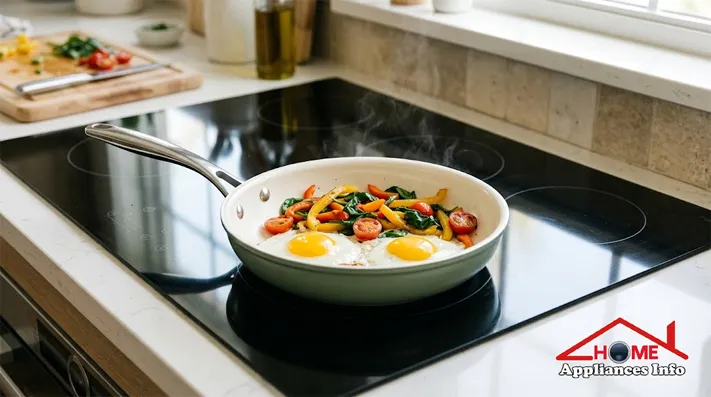
If you’re specifically searching for the best nonstick pans for glass top stove, ceramic nonstick deserves consideration. Food & Wine’s testing of cookware for glass stoves specifically highlighted the Caraway Frying Pan for its slick nonstick performance and suitability for delicate cooking.
Caraway’s ceramic surface also means you don’t need the same amount of cooking fat that you might use with stainless steel.
The trade-off is longevity. Ceramic nonstick surfaces generally require gentler treatment than bare stainless steel. High heat, abrasive cleaning, and unsuitable utensils can shorten the useful life of the coating.
This category also deserves a useful distinction: “ceramic nonstick” generally means a ceramic-based coating over another material, not a pan made entirely from ceramic.
For more information about different nonstick materials, our guide to non-Teflon nonstick pans provides a broader comparison.
Verdict: A strong choice when effortless food release matters more than maximum lifespan.
5. GreenPan Valencia Pro — Best PFAS-Free Nonstick Option
Best for: Cooks who want ceramic nonstick performance and prefer a PFAS-free cookware category.
GreenPan Valencia Pro is another strong choice for ceramic nonstick cooking. Serious Eats has highlighted the Valencia Pro line for its food release, heat distribution, and easy cleanup.
The attraction here is straightforward: you get a smooth ceramic cooking surface without relying on traditional PTFE nonstick technology.
That makes it useful for everyday foods such as:
- Eggs and omelets
- Fish
- Pancakes
- Vegetables
- Other low-to-medium-heat dishes
As with other ceramic-coated cookware, care matters. Lower or moderate heat, gentle utensils, and non-abrasive cleaning are better choices if you want the coating to retain its performance.
Our existing ceramic cookware guide also explains the differences between ceramic nonstick cookware and other common materials.
Verdict: One of the better choices for readers who specifically want ceramic nonstick rather than stainless steel or PTFE-coated cookware.
6. All-Clad HA1 Hard-Anodized Nonstick — Best Traditional Nonstick
Best for: Everyday nonstick cooking when you prefer a traditional PTFE surface.
Not everyone looking for a nonstick pan wants ceramic. The All-Clad HA1 remains a useful alternative because its hard-anodized aluminum body is reinforced with a stainless-steel base and its traditional HA1 Expert version uses a PTFE nonstick surface. All-Clad says the pan is compatible with all stovetops, including induction, and has a flat cooking surface designed for browning and pan-frying.
That flat construction is particularly relevant to glass cooktops.
The HA1 is best for foods where release matters more than extreme heat, including eggs, fish, vegetables, and reheating meals. All-Clad recommends low-to-medium heat and softer utensils for preserving the nonstick surface.
Pros
- Very good food release
- Flat, stable cooking surface
- Fast heat response
- Easy everyday cooking
- Compatible with glass and induction cooktops
Cons
- Coating requires careful treatment
- Not the best choice for extremely high-heat cooking
- Shorter coating lifespan than an uncoated stainless-steel pan
Verdict: A good traditional nonstick choice for cooks who want convenience without moving to ceramic.
7. Lodge Cast Iron Skillet — Best Heavy-Duty Option
Best for: Searing, steaks, high-heat cooking, and cooks who value extreme durability.
Can you use cast iron on glass top stove?
Yes, but you need to handle it carefully.
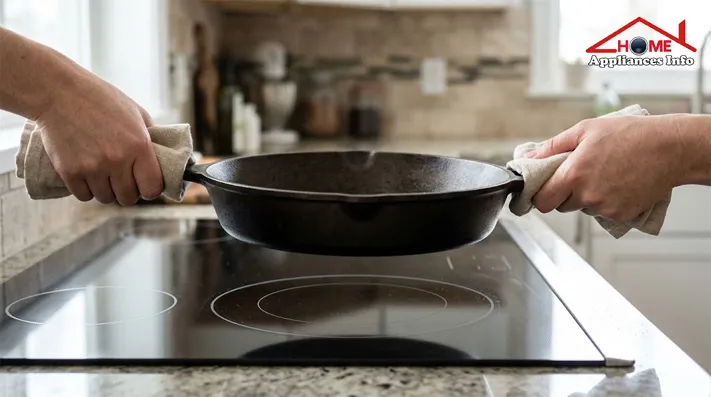
This is one of the most misunderstood questions about ceramic-glass cooktops. Lodge states that cast iron can be used on glass-top surfaces and recommends gently lifting it rather than sliding it across the cooktop. Whirlpool and Maytag give similar guidance.
Lodge’s official cast-iron guidance for glass-top stoves
The issue isn’t simply that cast iron is “too dangerous” for glass. Its weight and, depending on the cookware, the condition of its bottom make careless movement more likely to cause scratches or other damage.
Cast iron also heats more slowly than thinner cookware but retains heat exceptionally well. That makes it excellent for steaks, burgers, searing, frying, and dishes that benefit from stable temperatures.
Verdict: Cast iron is absolutely usable on a glass cooktop, but stainless steel is more forgiving for everyday movement and handling.
How to Prevent Pans From Scratching Glass Stove
Knowing how to prevent pans from scratching glass stove is just as important as choosing the right material.
1. Lift instead of slide
This is the most important habit.
When moving a pan from one heating element to another, lift it and gently place it down. Do not drag it across the glass. Whirlpool specifically recommends lifting cookware rather than sliding it, particularly with heavy cast iron.
2. Keep the bottom clean
Food particles, hardened residue, salt, and other debris trapped beneath a pan can become abrasive when the cookware moves.
Before cooking, check that the bottom is clean and reasonably dry.
3. Look for a flat, smooth base
A pan does not need to be made from one particular material to work on glass. What matters is a stable cooking surface without a severely rough or damaged underside.
4. Place heavy cookware gently
Don’t drop cast iron or another heavy pan onto the cooktop. Lower it carefully instead.
5. Avoid dragging or twisting
Even a smooth pan can cause problems if it is repeatedly dragged or rotated aggressively against the glass.
6. Replace severely warped or damaged cookware
If a pan rocks, has a badly warped base, or develops rough damage underneath, continuing to use it on a glass cooktop may not be worth the risk.
7. Follow your cooktop manufacturer’s instructions
Cooktop manufacturers can have model-specific recommendations. Those instructions should take priority over generic cookware advice.
What Makes a Pan Good for a Glass Cooktop?
Material is only part of the equation. When choosing cookware for a ceramic glass stove, pay attention to the actual construction.
Flat bottom
A stable, flat base should sit securely over the heating element.
Smooth underside
The bottom should not have rough edges, damaged surfaces, or accumulated debris.
Good heat distribution
Tri-ply stainless steel pans are particularly attractive because an aluminum core can distribute heat through the pan rather than concentrating it in one small area.
Appropriate weight
Heavy cookware is not automatically unsuitable, but heavier pans require more care when being placed or moved.
Correct size
A pan that reasonably matches the heating element usually gives more efficient and predictable cooking than one that is dramatically oversized or undersized.
Stainless Steel vs Nonstick vs Cast Iron
| Feature | Stainless Steel | Ceramic Nonstick | Traditional Nonstick | Cast Iron |
|---|---|---|---|---|
| Glass-top suitability | Excellent | Excellent | Excellent | Very good with care |
| Durability | Excellent | Good | Moderate | Excellent |
| Food release | Moderate | Excellent | Excellent | Moderate |
| Heat retention | Excellent | Good | Moderate | Excellent |
| Weight | Moderate | Light–moderate | Light–moderate | Heavy |
| High-heat cooking | Excellent | Limited | Limited | Excellent |
| Maintenance | Moderate | Easy but gentle | Easy but gentle | Seasoning/care |
| Scratch concern | Moderate | Moderate | Moderate | Higher if dragged |
| Best use | All-purpose cooking | Delicate foods | Everyday nonstick | Searing and high heat |
For most people, stainless steel is the safest all-around investment. Nonstick is more convenient for delicate foods, while cast iron is better suited to cooks who appreciate its heat retention and don’t mind handling a heavier pan.
Which Pan Should You Choose?
Choose Hestan NanoBond if you want premium stainless steel and long-term durability and the higher price is acceptable.
Choose All-Clad D3 if you want excellent tri-ply stainless steel with proven heat distribution.
Choose Tramontina Tri-Ply Clad if value matters and you want stainless steel without paying premium-brand prices.
Choose Caraway if easy food release and ceramic nonstick cooking are your priorities.
Choose GreenPan Valencia Pro if you specifically want a ceramic nonstick option in the PFAS-free category.
Choose All-Clad HA1 if you prefer traditional PTFE nonstick and want a stable, flat-bottom design.
Choose Lodge Cast Iron if maximum heat retention and durability matter more than weight and ease of movement.
Frequently Asked Questions
What is the best material for a glass-top stove?
For most households, quality stainless steel is the best all-purpose material. It is durable, handles high heat well, and is available in flat-bottom and fully clad constructions. Nonstick is more convenient for delicate foods, while cast iron can work safely with careful handling.
Can cast iron crack a glass cooktop?
Cast iron can be used on glass cooktops, but careless handling can damage the surface. The safest practice is to keep the cookware clean underneath, place it gently, and lift it rather than dragging it.
Are nonstick pans safe for glass cooktops?
Yes, provided the specific pan is rated for the cooktop and its base is suitable. All-Clad, for example, lists its HA1 cookware as compatible with all stovetops, including induction.
What type of pan is least likely to scratch a glass stove?
There is no material that can honestly be described as completely scratch-proof. A clean, smooth, stable base and careful handling matter more than simply choosing one material. Even stainless steel can scratch glass if debris becomes trapped underneath or the pan is dragged.
Should pans have completely flat bottoms for glass cooktops?
A stable, reasonably flat bottom is strongly preferred because it provides consistent contact with the heating area and reduces rocking or movement. Avoid severely warped cookware.
Is stainless steel better than nonstick on a glass cooktop?
It depends on the cooking task. Stainless steel is usually the better long-term, high-heat and all-purpose option. Nonstick is easier for eggs, pancakes, delicate fish, and low-oil cooking. Many households benefit from having both.
Final Verdict
If you want the best pans for glass top stove cooking in 2026, focus less on the material’s name and more on the pan’s actual construction. A flat, stable, reasonably smooth base is essential, and careful handling matters just as much as the cookware itself.
For most people, Hestan NanoBond, All-Clad D3, and Tramontina Tri-Ply Clad are the strongest stainless-steel choices. They offer the durability and heat performance that make stainless steel particularly well suited to everyday glass-top cooking. Caraway and GreenPan are more appealing when easy food release is the priority, while All-Clad HA1 is a strong traditional nonstick alternative.
And if you already own a Lodge cast iron skillet, you do not necessarily need to replace it simply because you have a glass cooktop. Cast iron can be used safely with the right precautions: keep the base clean, place it gently, and lift rather than slide.
The most important lesson is simple: good cookware and good handling work together. Choose a pan with a suitable base, keep that base clean, and treat the glass surface carefully. That approach will give you far more flexibility than choosing cookware based on material alone.
References
- Good Housekeeping — “We Tested 200+ Cookware Sets—These 7 Are the Best of 2026.” Current 2026 testing covering heat distribution, searing, simmering, cleaning, and food release.
Good Housekeeping cookware testing - Whirlpool — “Can You Use Cast Iron on a Glass Cooktop?” Manufacturer guidance on using cast iron safely on glass cooking surfaces, including lifting rather than sliding.
Whirlpool cast-iron glass-cooktop guidance - Lodge Cast Iron — “Cast Iron Product Guide.” Manufacturer guidance confirming that cast iron can be used on glass-top stoves and recommending that it be lifted rather than slid.
Lodge Cast Iron Product Guide

🍳 HOME & KITCHEN APPLIANCE EXPERT
Sidra Altaf
Home & Kitchen Specialist | Product Evaluator & Appliance Reviewer

🏠 Home Essentials
⚖️ Product Comparisons
⚡ Energy & Efficiency
Sidra Altaf is a seasoned expert in home and kitchen appliances with over 5 years of hands-on experience in the field. Passionate about helping families make smarter choices, she specializes in reviewing, comparing, and recommending appliances that bring convenience, efficiency, and innovation into everyday living. Her deep knowledge of product functionality, durability, and design makes her a trusted voice for anyone looking to upgrade their home.