

To support our research and detailed appliance reviews, we may earn a small commission from qualifying purchases made through our links, at no extra cost to you. As an Amazon Associate, I earn from qualifying purchases.
To support our research and detailed appliance reviews, we may earn a small commission from qualifying purchases made through our links, at no extra cost to you. As an Amazon Associate, I earn from qualifying purchases.
A tankless RO water filter system can free up a surprising amount of cabinet space and deliver filtered water without waiting for a storage tank to refill. It also tends to cost more, usually needs a power outlet, and depends on proprietary cartridges. For many households it is a good fit. For others, a traditional tank-based unit is simpler and cheaper. The right answer depends on your water quality, your cabinet space, how much filtered water you use, and what your plumbing allows.
This guide covers the seven points that matter most before buying, then compares tankless and traditional designs, explains how to read product claims, and ends with a checklist.
What Is a Tankless RO Water Filter System and How Does It Work?
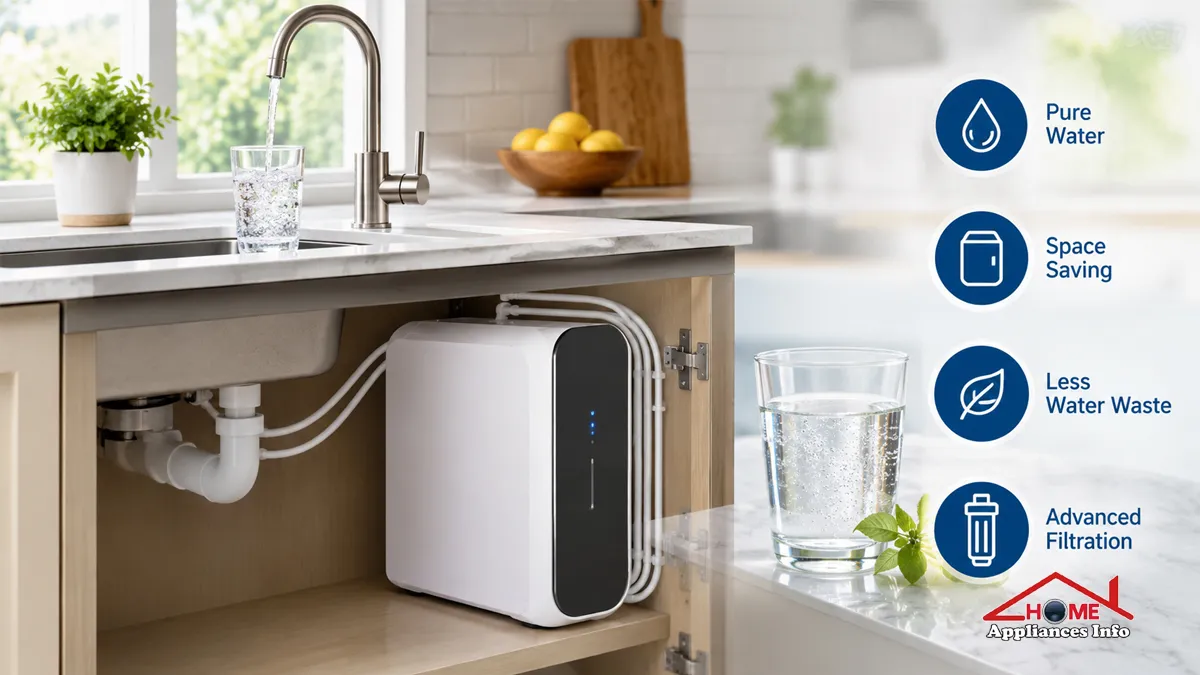
A tankless reverse osmosis system is an under-sink filter that treats water as you draw it instead of storing it in a pressurized tank. Reverse osmosis (RO) itself works the same way in both designs. According to the EPA’s WaterSense program, pressure forces water through a semi-permeable membrane. This creates one stream of treated water and a second stream of reject water, called concentrate or brine, that goes down the drain.
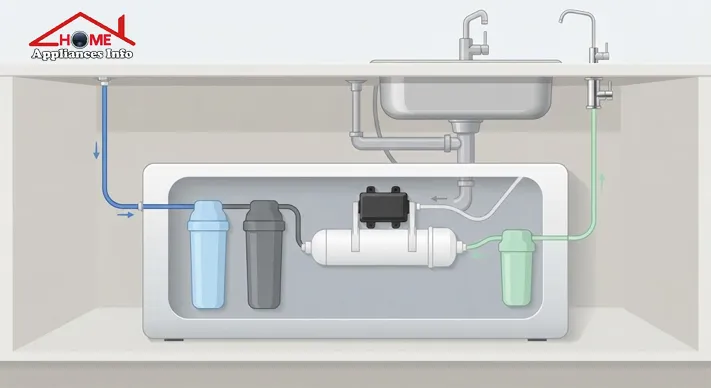
Most systems add stages around the membrane. A sediment filter and a carbon filter usually sit ahead of it to protect it, and a post-filter often polishes taste afterward. Tankless models commonly add a booster pump so the membrane gets enough pressure to produce water on demand. That pump is the main reason they differ from conventional units in size, noise, power needs, and price.
On paper, the CDC says RO can remove lead, copper, chromium, chloride, and sodium, and may reduce arsenic, fluoride, nitrate, and several other substances. The agency’s advice is to check the system’s label for the specific chemicals it addresses, because performance varies by product.
7 Things to Know Before Buying
1. Match the system to what is actually in your water
Start with the water, not the product. The CDC recommends testing your tap water and choosing a system that removes the specific chemicals or germs you are concerned about. If your water does not contain anything harmful, you may not need a treatment system at all. Municipal customers can usually request a water quality report from their supplier. Private well owners should arrange laboratory testing.
A low TDS (total dissolved solids) reading on a handheld meter is encouraging, but it does not prove the water is free of harmful substances. TDS is a general measure of dissolved minerals and salts. It says little about certain contaminants that matter for health, so match your test results to the system’s verified reduction claims.
2. Understand flow rate, GPD, and real dispensing speed
Gallons per day (GPD) describes how much treated water a membrane can produce over 24 hours under specific test conditions. It is not the same as how quickly water comes out of the faucet. A system with a high GPD rating can still dispense more slowly than expected when incoming pressure is low, water is cold, or the filters are aging.
Tankless units generally advertise higher GPD figures than tank-based ones, and the on-demand design is what lets them fill a pot without a storage reservoir. Still, a rating on a box reflects lab conditions. Check how the manufacturer defines the number, and look at flow in gallons per minute at the faucet if that is listed.
3. Look closely at wastewater
Every RO system sends some water to the drain. The EPA notes that a typical point-of-use RO system generates five gallons or more of reject water for every gallon of treated water, and some inefficient units reach ten. Systems that earn the WaterSense label must send 2.3 gallons or less to the drain per gallon produced.
Manufacturers sometimes advertise much better ratios, such as “3:1” or “1:1.” These figures can be real, but they can also reflect favorable test conditions or a different definition of efficiency. Compare ratios only when the definition and conditions are stated, and check for a WaterSense or similar independent efficiency listing. The EPA also points out that RO is not the right answer for every application, since simpler filters that waste little or no water may be enough for some water problems.
4. Add up the full cost, not just the sticker price
Purchase prices for tankless units vary widely by brand and feature set, and they change often, so check current listings for the models you are considering. The initial price is only part of the picture. Replacement filters, the membrane, installation, and electricity all add up.
Most tankless systems use proprietary cartridges, so you are tied to one brand’s replacement schedule and pricing. Cartridge shapes and connections are brand-specific, much like the model-by-model compatibility rules that apply to a refrigerator water filter. Before buying, look up the price and availability of every replacement cartridge, then estimate the annual cost using the maker’s stated replacement intervals. Intervals depend on your water, so treat them as estimates rather than promises.
5. Confirm installation and power requirements
Most under-sink RO installations involve tapping into the cold-water line, running a drain line, and mounting a dedicated faucet. Many tankless systems include their own faucet, and some add a display or smart features. Because they usually include a pump, they need an electrical outlet in or near the sink cabinet, and that outlet should be kept away from splash zones. If there is no outlet, factor in the cost of having one installed.
Check the minimum and maximum operating water pressure in the specifications. Low pressure can reduce output and efficiency, and some units include or recommend a pressure-boosting setup. The drain line normally connects to the sink’s drain pipe, so a slow drain can cause trouble. It is worth clearing a slow kitchen sink drain before the system goes in. Renters should also check whether drilling a countertop for a faucet is permitted.
6. Plan for maintenance and filter availability
Cartridges need to be replaced on a schedule that varies by design. Some systems use quick-change cartridges that twist off without tools, and others require separate membrane and filter changes at different intervals. The more integrated the design, the easier the swaps tend to be, but the less flexibility you have for third-party filters.
Electronic reminders deserve some skepticism. Most estimate usage rather than measure water quality, which is explained well in this look at why a filter indicator blinks red on a pitcher. If the water tastes off or the flow slows, check the filters even when a reminder light has not come on.
Ask how long the manufacturer commits to supplying cartridges for a model. Discontinued designs can leave owners scrambling.
7. Check certification, warranty, and support
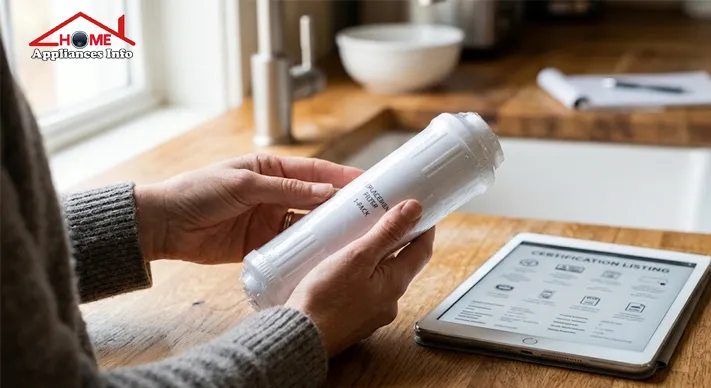
Marketing phrases such as “10-stage filtration,” “99% pure,” or “removes thousands of contaminants” are not verifiable claims. Independent certification is. NSF/ANSI 58 is the standard for residential reverse osmosis systems, and NSF notes that certification does not mean a system reduces every possible contaminant. Look up the exact model in the certifier’s official listing and confirm that the claims you care about, whether lead, PFAS, or nitrate, are listed there.
Also read the warranty. Check how long it lasts, whether it covers the pump and membrane, and whether it requires genuine replacement cartridges. Reliable customer support matters for a product with moving parts and consumables.
Tankless RO System Pros and Cons
The main advantages are straightforward. A tankless design usually takes up less cabinet space, which is a real benefit in small kitchens or when the cabinet already holds a trash bin and cleaning supplies. It produces water on demand, so there is no wait for a tank to refill after heavy use. Many models advertise higher output and are built around newer, more compact cartridges.
The drawbacks are just as concrete. Tankless systems generally cost more up front, rely on electricity, and tie owners to specific replacement cartridges. A booster pump adds a sound that some households notice in a quiet kitchen, and a pump is one more part that can eventually fail. High advertised GPD does not guarantee that water will fill a pitcher quickly in every home. Tankless systems also still waste water, so wastewater should be treated as a cost of RO in general, not a flaw that only affects one design.
No single list of tankless RO system benefits and drawbacks settles the decision. The question is which trade-offs matter in your kitchen.
Tankless RO System vs. Traditional RO System
The differences come down to storage, power, space, and cost. This table summarizes the typical differences; individual products vary.
| Feature | Tankless RO | Traditional tank RO |
|---|---|---|
| Storage | None; treats water on demand | Stores treated water in a tank |
| Cabinet space | Usually smaller footprint | Needs room for the tank |
| Power | Typically required (pump) | Often none (line pressure) |
| Dispensing | On-demand; speed varies by model | Quick at first, then refills |
| Upfront cost | Often higher | Often lower |
| Replacement parts | Frequently proprietary | More third-party options |
A conventional tank system keeps a few gallons of treated water ready, which makes it quick for filling a glass. When the tank runs low, you wait for it to refill. A tank also gives you a buffer if a power outage hits, since most conventional units run on water pressure alone. A tankless system trades that buffer for compactness and continuous output.
How to Read Tankless RO Water Filter System Reviews
Reviews are useful, but they answer different questions depending on who wrote them. It helps to separate four types of information: independent certification, laboratory testing, manufacturer claims, and customer opinions.
Certification and verified test results tell you what the system can do. Customer reviews tell you what it is like to live with, including noise, leaks, cartridge availability, and support responsiveness. Look for patterns rather than single reviews. A cluster of complaints about the same part failing after a year is more informative than one dramatic comment.
Be cautious about reviews that repeat marketing language without describing real use, and check whether the reviewer identified how long they had owned the product. Reviews of tankless RO water filter systems also age quickly, since models are revised often. Note the date and confirm that the review covers the version you are buying.
Choosing a System for Your Household
A small household that uses filtered water mostly for drinking and cooking may find that a compact tankless model is more than enough. A larger family that fills pitchers, makes ice, and cooks with filtered water should pay closer attention to dispensing speed and capacity, whichever design they choose.
Renters often benefit from a compact system that can be removed cleanly, but they should confirm what the lease allows before drilling. Homeowners renovating a kitchen have the most flexibility, since the outlet, faucet hole, and drain connection can all be planned in advance. Anyone on well water should test first and may need additional pre-treatment before RO. For more on comparing appliances, you can browse additional buying guides.
FAQs
Does a tankless RO system need electricity?
Most do, because they use a booster pump. Some conventional tank systems need no power at all. Check the specification sheet for voltage, outlet requirements, and what happens during a power outage.
How often do the filters need replacing?
It depends on the model and on your water. Manufacturers publish intervals for prefilters, post-filters, and the membrane, but sediment-heavy or hard water can shorten them. Slow flow or a change in taste is a sign to check sooner.
Is a tankless RO system wasteful?
All RO systems discharge some water as concentrate. The EPA reports a typical figure of five gallons or more of reject water per gallon produced, while WaterSense-labeled systems must stay at 2.3 gallons or less. Efficiency varies by design.
Does RO remove everything harmful from water?
No system removes everything. The CDC notes that different systems address different contaminants, so match the system’s verified claims to your test results.
Can I install one myself?
Many people do, particularly with models designed for simple connections. The work involves tapping the cold-water line, mounting the faucet, and connecting the drain, so confirm you are comfortable with basic plumbing or hire a professional.
Final Buying Checklist
Before purchasing a tankless RO water filter system, confirm the following:
- Your water has been tested, and the system’s verified claims cover your concerns
- The exact model appears in an independent certification listing, such as NSF/ANSI 58
- Output is described in real dispensing terms, not just GPD
- Wastewater ratio is defined clearly, ideally backed by an independent efficiency listing
- Replacement cartridge prices and availability are known, with a yearly cost estimate
- An outlet, adequate water pressure, and space for the faucet are available
- Warranty terms and support options are clear
A tankless design can be a very good choice when cabinet space is limited and you are comfortable with the power and cartridge requirements. When those trade-offs do not suit your kitchen, a traditional system may serve you better. Whichever you choose, ongoing maintenance tips will help keep it running well, and the quality of your results will depend on regular filter changes and a system matched to your water.
References
- Centers for Disease Control and Prevention. About Home Water Treatment Systems. https://www.cdc.gov/drinking-water/about/about-home-water-treatment-systems.html
- U.S. Environmental Protection Agency, WaterSense. Point-of-Use Reverse Osmosis Systems. https://www.epa.gov/watersense/point-use-reverse-osmosis-systems
- NSF. NSF Standards for Water Treatment Systems. https://www.nsf.org/consumer-resources/articles/standards-water-treatment-systems

📱 SMART HOME TECHNOLOGY CONSULTANT & IOT SPECIALIST
Alfredo Torres
Technology Consultant | Smart Home Automation & IoT Specialist (Lima, Peru)

🌐 Matter Protocol & IoT
⚡ Energy Efficiency
🛠️ Future-Proofing Infrastructure
Alfredo Torres is a seasoned technology consultant based in Lima, Peru, specializing in the integration of next-generation IoT ecosystems and smart home automation. With over a decade of experience navigating the rapidly evolving tech landscape of the Global South, Alfredo brings a unique, practical perspective to homeappliancesinfo.com.
As a specialist in the 2026 Matter protocol rollout, Alfredo focuses on bridging the gap between legacy household infrastructure and modern connectivity standards. His consulting work centers on “future-proofing” homes—helping users select appliances that offer maximum durability, energy efficiency, and cross-platform compatibility without the burden of “app fatigue.”
Alfredo’s expert insights are grounded in real-world problem solving, from optimizing smart kitchen workflows to implementing cost-effective home maintenance solutions in emerging markets. When he isn’t benchmarking the latest AI-integrated appliances, he can be found exploring the intersection of sustainable architecture and digital living.