

To support our research and detailed appliance reviews, we may earn a small commission from qualifying purchases made through our links, at no extra cost to you. As an Amazon Associate, I earn from qualifying purchases.
To support our research and detailed appliance reviews, we may earn a small commission from qualifying purchases made through our links, at no extra cost to you. As an Amazon Associate, I earn from qualifying purchases.
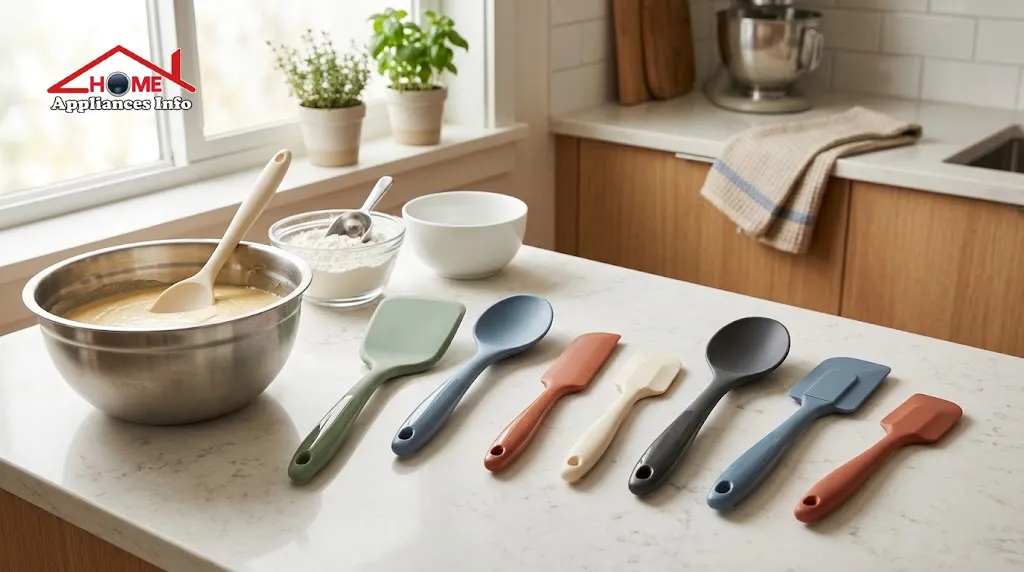
A silicone spatulas set handles the small jobs that fill a cooking day: scraping the last of the batter from a bowl, folding egg whites, stirring a pan sauce, spreading frosting, and moving scrambled eggs around a nonstick skillet without leaving scratches. The best silicone spatula set for you is not necessarily the one with the most pieces or the highest advertised temperature. It is the one with a few well-shaped tools, a heat rating that covers the whole utensil, clear food-contact information, and a design that cleans easily.
This guide groups seven kinds of sets by what they do best. For each one, you’ll see who it suits, what to compare, and what to verify before buying.
How These Seven Sets Are Organized
I haven’t named specific brands or models here, and I haven’t tested any products. Piece counts, prices, and temperature ratings change between listings and production runs, so any ranking of named products could be wrong by the time you read it. Each category below tells you what to look for, and you can check any candidate against the manufacturer’s own product page.
The table gives a quick overview. The sections that follow explain the reasoning.
| Set type | Best suited for | Check first | Common compromise |
|---|---|---|---|
| Best overall | Mixed everyday cooking | Shape variety, handle comfort | Mid-range price |
| Best budget | New kitchens, tight budgets | Useful pieces, not total count | Fewer sizes, thinner documentation |
| Best for baking | Batters, doughs, frosting | Edge flexibility, spoonula shape | Less suited to heavy stirring |
| Best heat resistant | Stovetop cooking | Rating for the whole utensil | Premium pricing |
| Best food grade, easy cleaning | Households that value hygiene | Material documentation, joints | Fewer decorative options |
| Best mini set | Jars, small containers | Head size, handle control | Not a full replacement |
| Best complete set | Large households, new homes | Duplicates vs. useful variety | Storage space |
1. Best Overall: A Balanced Set of Core Shapes
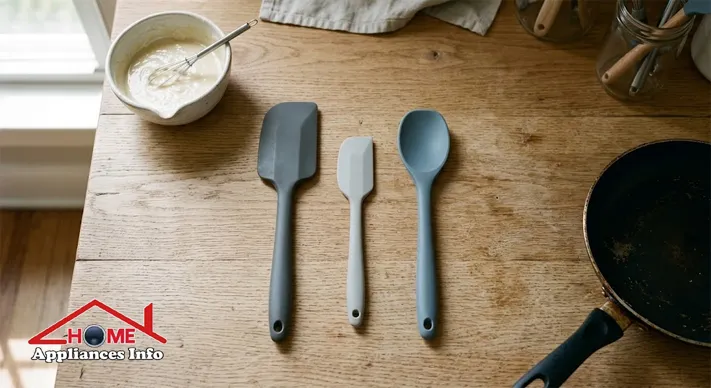
A good all-rounder doesn’t need many pieces. It needs the right ones: a large scraper-style spatula for bowls and skillets, a smaller spatula for narrow spaces, and a spoon-shaped tool for stirring and serving. If a set covers those three shapes in a comfortable, well-balanced build, it can handle most of what a home kitchen demands.
This kind of set suits people who cook a bit of everything and don’t want to think about which tool to grab. Before buying, confirm four things on the product page: the exact piece count, the material description, the cleaning instructions, and the manufacturer’s stated temperature limit. Whether the price is justified depends on how many of those answers are clear and specific. A slightly higher price is easier to defend when the documentation is thorough than when it’s just a longer list of adjectives.
2. Best Budget: Essentials Without the Padding
A budget set should deliver the basics reliably. Count the pieces you’d use in a typical week, not the total listed on the box. Three well-made tools beat ten that mostly overlap.
Expect some compromises. Budget sets often include fewer sizes, handles that feel less shaped to the hand, and thinner manufacturer documentation. None of these is a deal-breaker, but the last one deserves attention, because a low price paired with no material information gives you less to verify. Price alone shouldn’t earn a set the “best value” label. A cheaper set that cracks or turns sticky within a season costs more than a mid-priced one that lasts.
3. Best for Baking and Mixing
Baking asks for something different from silicone than stovetop cooking does. The edge needs to flex enough to follow the curve of a mixing bowl and collect thick batter, melted chocolate, or frosting. That makes this the one category where flexibility matters more than rigidity.
Silicone scraper spatulas for baking usually have a wide, thin head with a slightly curved edge. A spoonula, which blends a spoon-like bowl with a spatula edge, can scoop and scrape in one motion, making it handy for folding whipped egg whites or transferring batter to a pan. A silicone spoonula set that includes one large and one small version tends to be more flexible than one with identical shapes.
Look for a small spatula as well, since it reaches into jars and narrow containers where a large one can’t. If you often scrape batter onto a baking sheet tray or spread mixtures into corners, a slim, firm-edged tool gives better control than a floppy one.
Mixing bowls matter here too. Silicone is gentle on most surfaces, so it pairs comfortably with a glass bowl set when you’re folding delicate mixtures and want to get every last bit out.
4. Best Heat Resistant Silicone Spatulas for Everyday Cooking
For stovetop work, such as stirring sauces, scrambling eggs, or turning vegetables, heat resistant silicone spatulas should have a clearly stated limit that matches what you plan to cook.
A few details are easy to miss. The temperature rating usually refers to the silicone head. The handle, any internal core, and any bonded joints may have different limits. A spatula with a nylon or wooden handle and a silicone head is only as heat-tolerant as its weakest part. Ratings commonly advertised for silicone utensils run from a little over 400°F to about 600°F, but there’s no single standard that applies to every product.
Not all silicone utensils are designed for heat at all. A cookware brand’s guide to utensils for nonstick pans points out that while most silicone is heat-safe to well over 500°F, some utensils aren’t designated as heat-safe and can melt onto a pan if exposed long enough. Treat the manufacturer’s stated limit as the authority and don’t rely on the product photo or title.
A practical habit that protects any silicone tool: don’t leave it resting against the side of a hot pan. A silicone spatula spends most of its working life in food, where temperatures stay lower than the pan itself, but a few minutes against a hot rim can distort the head.
5. Best Food Grade Silicone Spatula Set for Easy Cleaning
“Food grade” is a phrase that appears on almost every listing, so it helps to know what it should actually mean. In the United States, the FDA regulation 21 CFR 177.2600 covers rubber articles intended for repeated use with food, and it includes certain silicone elastomers among the permitted materials, subject to limitations. The FDA’s consumer information on food contact substances explains that cookware and other items that touch food are part of this category.
In practice, a food grade silicone spatula set should come with clear material information and, ideally, documentation that the manufacturer can provide on request. Words like “premium,” “non-toxic,” or “professional grade” aren’t evidence by themselves. If you’re comparing two sets and only one explains its material and compliance, that difference is worth more than a longer feature list.
Cleaning is the second half of this category. Check three things:
- Construction. One-piece silicone spatulas have fewer joints where residue can collect. Multi-part designs can still work if the head fits tightly and comes apart for washing.
- Dishwasher compatibility. Dishwasher-safe silicone spatulas are convenient, but confirm that the entire utensil qualifies, including the handle and any removable head. If you rely heavily on dishwashing, even a compact dishwasher in a small kitchen can handle a full utensil set, provided the manufacturer says the set is dishwasher-safe.
- Residue. Oils and strong-smelling foods can cling to silicone. A tool that scrubs clean easily after tomato sauce or curry will stay more pleasant to use.
6. Best Mini Silicone Spatula Set for Small Tasks
Small spatulas earn their place in specific moments: scraping a nearly empty peanut butter jar, transferring sauce from a narrow container, mixing a spoonful of dressing, or reaching the corner of a small ramekin. A full-sized spatula can’t do any of that gracefully.
When comparing mini sets, check the number and sizes of the tools, how flexible the heads are, and whether the handles are long enough to offer control. Tiny handles can feel awkward in a larger hand. A mini set works best as a complement to a standard one, since it won’t replace a full-sized spatula for stirring a pot of soup or flipping a pancake.
7. Best Complete Set for Cooking and Baking
A complete silicone spatula set for cooking and baking suits households that make a wide range of meals and baked goods, or people furnishing a kitchen from scratch. The risk is duplication: a ten-piece set that includes four near-identical spatulas isn’t ten pieces of value.
Check whether each tool has a distinct role. A useful collection might include a large scraper, a spoonula, a narrow spatula for jars, a slotted or flat turner for eggs, and a basting-style tool. Also consider where the set will live. A bulky collection can crowd a drawer, and you’ll end up using the same three pieces while the rest sit untouched. A quick way to judge value is to count how many tools you’d reach for in an average week and compare that with the price per useful piece.
What to Check Before Buying Any Set
The sections above cover heat resistance and food-contact documentation. A few other points can separate a good set from a disappointing one.
Flexibility and firmness. Soft, flexible edges are excellent for scraping bowls and folding mixtures. Firmer heads give better control with heavy ingredients like cookie dough or sautéed onions. Many cooks end up wanting a mix of both.
Handle comfort. Consider length, weight, grip texture, and balance. A handle should feel manageable during repetitive stirring and scraping, because a tool that tires your hand tends to end up at the back of the drawer.
Set size and value. Compare the useful tools you get, the quality of construction, and the price. A smaller set of well-designed spatulas is often more practical than a large pile of redundant ones.
Longevity. Durable kitchen utensil sets should hold their shape. Replace any tool that develops tears, cracks, stickiness, a loose head, or a handle that wobbles.
Are Silicone Spatulas Suitable for Nonstick Cookware?
Yes, they’re widely recommended for it. Silicone’s soft working edge is less likely to scratch a coated surface than metal tools, which is why nonstick cookware safe spatulas are so often silicone. Always follow the cookware manufacturer’s instructions as well, and retire any spatula that has become damaged or rough, since a nicked edge can scrape a coating.
This matters most for pans used for delicate foods. If you cook a lot of eggs, for instance, a careful choice of both pan and spatula protects your investment. Our guide to the best omelette pans, which covers non-stick, stainless steel, and cast iron options, is a useful companion when you’re deciding which surface your spatulas will work on most.
How to Clean and Maintain Silicone Spatulas
Wash each tool according to the manufacturer’s directions. Pay particular attention to joints, removable heads, and the area where the head meets the handle, since grease and food can build up there. Let everything dry fully before storing it.
Inspect your spatulas now and then. Tears, cracks, a tacky surface, or a loose handle all signal that it’s time to replace the tool rather than keep using it. If a spatula holds onto odors, a wash in hot, soapy water often helps, though some stains and smells may never fully lift. Check the manufacturer’s care instructions before using any other cleaning method.
Frequently Asked Questions
Are silicone spatula sets good for everyday cooking?
They suit most daily tasks: stirring, scraping, folding, and working with nonstick pans. Where they fall short is heavy-duty scraping on bare steel or tasks that call for a firm, sharp edge, like lifting a stuck pancake. A turner is better for that.
What temperature should heat resistant silicone spatulas withstand?
There is no universal rating. Check the manufacturer’s stated limit for the full utensil, not only the head, and compare it with your actual cooking. Medium-heat stovetop stirring generally sits well below most stated limits, but don’t assume that for every product.
How can I identify a food grade silicone spatula set?
Look for specific material information and ask the manufacturer for documentation relevant to food contact. A product title that says “food grade” isn’t proof on its own.
Are one-piece silicone spatulas better?
They can be easier to clean because there are fewer joints, but flexibility, construction quality, and intended use matter just as much. A well-made multi-part spatula can outperform a poorly made one-piece design.
Can silicone spatulas go in the dishwasher?
Many can, though not all. Check the instructions for the full utensil, including any removable heads or non-silicone handles.
Should I buy a small set or a large set?
Base the decision on how you cook. A modest set with distinct shapes usually beats a large one full of duplicates, and a mini set can be added later if you find you need it.
Choosing Your Set
The best silicone spatulas set is the one that fits how you cook, offers useful shapes, states a clear heat rating, and comes apart or wipes clean without a fight. Start by deciding whether baking, stovetop cooking, or small-container work is your main use. Then compare the manufacturer’s heat rating and material documentation, and treat piece count as the last factor rather than the first. If you’re building out the rest of your kitchen too, our kitchen guides cover cookware and tools that pair well with a good spatula set.
References
- U.S. Food and Drug Administration. “Food Packaging & Other Substances that Come in Contact with Food – Information for Consumers.” https://fda.gov/food/food-ingredients-packaging/food-packaging-other-substances-come-contact-food-information-consumers
- Electronic Code of Federal Regulations. “21 CFR § 177.2600 – Rubber articles intended for repeated use.” https://www.ecfr.gov/current/title-21/chapter-I/subchapter-B/part-177/subpart-C/section-177.2600
- Made In Cookware. “Top 3 Utensils to Use with Nonstick Cookware and Why.” https://madeincookware.com/blogs/beyond-the-burner/top-3-utensils-to-use-with-nonstick-cookware-and-why

🍳 HOME & KITCHEN APPLIANCE EXPERT
Sidra Altaf
Home & Kitchen Specialist | Product Evaluator & Appliance Reviewer

🏠 Home Essentials
⚖️ Product Comparisons
⚡ Energy & Efficiency
Sidra Altaf is a seasoned expert in home and kitchen appliances with over 5 years of hands-on experience in the field. Passionate about helping families make smarter choices, she specializes in reviewing, comparing, and recommending appliances that bring convenience, efficiency, and innovation into everyday living. Her deep knowledge of product functionality, durability, and design makes her a trusted voice for anyone looking to upgrade their home.