

To support our research and detailed appliance reviews, we may earn a small commission from qualifying purchases made through our links, at no extra cost to you. As an Amazon Associate, I earn from qualifying purchases.
To support our research and detailed appliance reviews, we may earn a small commission from qualifying purchases made through our links, at no extra cost to you. As an Amazon Associate, I earn from qualifying purchases.
If you are shopping for a split air conditioner, you have probably noticed that two units with the same tonnage can differ by tens of thousands of rupees. Much of that gap comes from one component. In the inverter vs non-inverter AC debate, the deciding factor is how the compressor behaves.
A non-inverter (fixed-speed) AC runs its compressor at full output until the room reaches the set temperature. It then shuts the compressor off and restarts it when the room warms up again. An inverter AC uses a variable-speed compressor that can slow down or speed up to match the heat in the room, so it rarely needs to stop completely.
That is the core difference between inverter and non-inverter AC, and it touches electricity use, noise, comfort, price and repairs. For households that run an AC for several hours a day, an inverter model is usually the better long-term purchase. It is not the right answer for everyone, though. Running hours, room size, climate, tariff, budget and local service all change the result, and the sections below explain how.
Inverter AC vs Non-Inverter AC at a Glance
This table summarizes the general pattern. Treat “generally” literally: individual models, sizing and operating conditions can shift any row.
| Feature | Inverter AC | Non-Inverter AC |
|---|---|---|
| Compressor | Variable speed | Fixed speed |
| Operation | Adjusts to cooling demand | Cycles ON and OFF |
| Electricity use | Generally lower in long use | Generally higher in long use |
| Temperature | Steadier | More swings |
| Noise | Usually quieter | Noticeable at each restart |
| Purchase price | Usually higher | Usually lower |
| Electronics | More complex | Simpler |
| Repair cost | Can be higher | Often lower |
| Best for | Daily, long-hour use | Occasional use |
The 7 Key Differences
1. How the compressor works
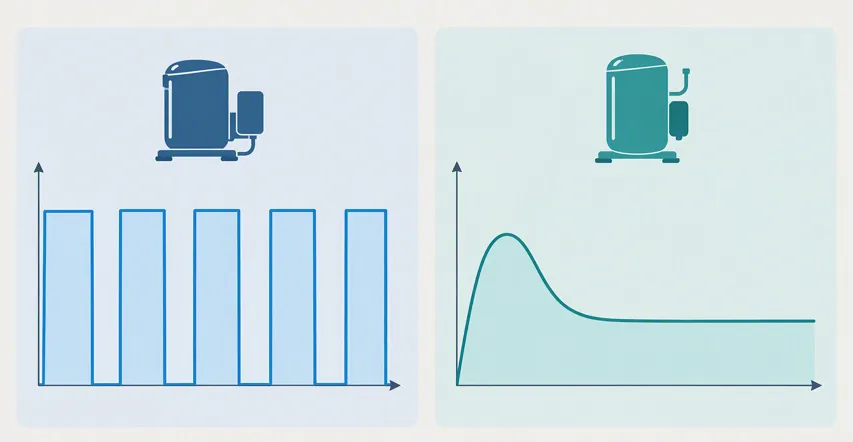
The compressor circulates refrigerant, and it is the largest electricity user in the unit. A fixed-speed compressor has two states, full power or off. When the room warms past the thermostat setting, it starts again, and this repeated start-stop pattern is called compressor cycling.
A variable-speed compressor changes its motor speed instead. When the room is hot, it works harder. As the room approaches the target, it slows down and holds the temperature at lower output. ENERGY STAR’s buying guidance for room air conditioners describes this contrast directly: conventional units behave like an on/off switch, while variable-speed units adjust continuously and can cool quietly while saving a significant amount of energy.
Most buyers meet this choice in wall-mounted split systems. Our guide to ductless air conditioners covers that category if you are still deciding on the type of unit.
2. Electricity consumption
This is the difference most buyers care about. An inverter AC generally uses less electricity during long periods of operation, because once the room is near the target temperature it can run at reduced output instead of repeatedly restarting at full power. Variable output also lets the unit match the load as the afternoon heats up or the evening cools down.
The size of the saving is where many articles overreach. Published claims range widely, and a single percentage cannot describe every home. Actual inverter AC electricity consumption depends on:
- the AC’s capacity and efficiency rating
- room size, insulation and sun exposure
- outdoor temperature and humidity
- the temperature you set
- how many hours it runs each day
- how often doors and windows open
- how clean the filters and coils are
An inverter AC that runs only an hour or two a day has little opportunity to save. A bedroom unit that runs through the night in peak summer has plenty. Inverters also work hardest in the first minutes, when they pull the room down to temperature, so the savings accumulate during the steady-running period afterwards.
3. Temperature control and comfort
Because an inverter can trim its output, the room tends to hold closer to the temperature you set. A fixed-speed unit overshoots, switches off while the room warms, then restarts, so you may feel slight swings between cool and slightly warm. The effect is modest in a well-insulated, correctly sized room and more noticeable in rooms with large windows or heavy occupancy.
Steadier output also helps comfort in a less obvious way. When a unit runs longer at lower speed, it has more time to remove moisture from the air, which is why a steadily running AC often feels less clammy than one that blasts cold air and stops.
4. Noise
Inverter ACs are generally quieter once the room has cooled, because the compressor and outdoor fan slow down. A fixed-speed unit produces a noticeable change in sound each time the compressor restarts at full capacity, which can wake a light sleeper.
Noise depends on design as well as compressor type, since fan quality, mounting and installation all play a part. Still, the difference tends to matter most in bedrooms, study rooms, home offices and nurseries.

5. Purchase price
Here the non-inverter AC has a clear advantage. Its simpler compressor control costs less to build, and that usually shows up as a lower sticker price. An inverter model carries the cost of variable-speed compressor technology and the electronics that drive it.
Premium smart models push prices higher still, and our look at premium smart models shows what that segment offers. Comparing sticker prices alone, however, misses the full picture, which is why the last difference below matters.
6. Repairs and maintenance
An inverter AC contains more sophisticated electronics, including the board that drives the compressor. When one of these parts fails, the repair can be more expensive and may need a technician familiar with inverter systems. A fixed-speed unit is simpler to diagnose and, in many cases, simpler to repair.
That does not make inverters less reliable or shorter-lived by definition. Installation quality, power conditions, cleaning habits and servicing matter at least as much as compressor type. Diagnostic codes are one example: our guide to the E4 error code explains how a single code can point to airflow, sensor or pressure problems on either type of AC.
Some jobs are within reach of a careful owner. Our walkthrough of air conditioner motor replacement is one, but anything involving refrigerant or the electronic control board should go to a qualified technician.
7. Cost over the life of the AC
The fairest comparison is purchase price plus electricity plus servicing over the years you plan to keep the unit. A simple way to think about it is a break-even point: divide the extra upfront cost of the inverter model by the amount it saves you each month.
Purely for illustration, imagine an inverter model costs Rs. 40,000 more and trims your bill by Rs. 4,000 a month in the months you run it heavily. It would take ten months of heavy use to recover the difference, or roughly two summers if the AC works hard for five months a year. Your own numbers will differ, but the exercise tells you quickly whether a higher price makes sense for your usage.
Inverter vs Non-Inverter AC: Which Is Better?
For most households that use an AC regularly for several hours a day, an inverter AC is the better long-term choice. It tends to use less electricity under sustained use, holds temperature more steadily and runs more quietly. A non-inverter AC remains a sensible choice when the unit will be used only occasionally, or when a low purchase price matters more than long-term savings.
| Your situation | Better choice |
|---|---|
| AC runs 6 to 10 hours a day | Inverter |
| Bedroom used every night | Inverter |
| Electricity bills are a major worry | Inverter |
| You plan to keep the AC for many years | Inverter |
| Guest room or occasional use | Non-inverter can make sense |
| Lowest upfront price is the priority | Non-inverter |
| Inverter service is hard to find locally | Consider non-inverter |
Reading Your AC Electricity Bill
Electricity is billed in units, and one unit is one kilowatt-hour (kWh). A device drawing 1,000 watts for one hour uses one unit. If an AC averaged 900 watts over an eight-hour night, that would be 900 × 8 = 7,200 watt-hours, or 7.2 units.
There is a catch. The wattage printed on the nameplate is a rating, not a constant draw. A fixed-speed compressor draws close to its rated power whenever it runs, while an inverter’s draw moves up and down with the load. That is why no one can honestly say “a 1.5-ton inverter AC uses X units per hour.” Compare the rated power input, the efficiency rating and the annual energy figure on each model’s label or datasheet, then estimate your own running hours.
Size and Efficiency Rating Matter as Much as the Type
An inverter will not rescue a badly sized AC. ENERGY STAR warns that bigger is not better: an oversized unit costs more, wastes energy and can cool the room before it has removed enough humidity, leaving the air damp and clammy. Before choosing between technologies, work out the cooling capacity your room actually needs, taking into account sun exposure, ceiling height and how many people use the room.
“Inverter” is also not a guarantee of efficiency. A well-rated fixed-speed model can beat a poorly rated inverter in some conditions, so compare efficiency ratings, power input and warranty terms model by model. Habits count too. According to the U.S. Department of Energy, replacing a clogged filter can lower an AC’s energy use by 5 to 15 percent, and filters should be cleaned or replaced every month or two during the cooling season, more often in dusty conditions.
What to Check Before Buying an AC in Pakistan
Local conditions can matter as much as the technology.
Climate rating (T1 vs T3). These are standardized climate classes used when rating air conditioners: T1 for moderate climates and T3 for hot climates, as reflected in the Pakistan Standard adoption of ISO 16358-1. A T3 unit is designed for hotter outdoor conditions, which is relevant in places with extreme summers. Check the manufacturer’s stated operating temperature range instead of assuming one class suits everyone.
Voltage conditions. Where supply is unstable, confirm the model’s rated voltage range and ask the seller or manufacturer how it handles fluctuations.
Warranty details. Ask separately about compressor cover and about the inverter or control board, since these are the costliest parts. Check how long each is covered.
Spare parts and service. A very efficient AC is a poor purchase if genuine parts or trained technicians are hard to find in your city.
Installation quality. Poor installation can undermine cooling and efficiency, and badly managed drainage is a common cause of water leaking from an aircon. Make sure the installer follows the manufacturer’s guidance on pipe runs, drainage and outdoor unit clearance.
Solar use. If you plan to run the AC on a solar system, do not assume every inverter AC is solar compatible. Ask for the unit’s electrical characteristics, including starting current and operating range, and have your solar installer confirm compatibility.
FAQs
Is an inverter AC worth the higher price?
It usually is when the AC runs for many hours every day, because the electricity savings can offset the extra cost over a few seasons. For a guest room used a few weeks a year, the extra money may never be recovered.
Does an inverter AC cool faster?
Not necessarily. Cooling speed depends mainly on capacity, room size and conditions. An inverter’s advantage is how steadily it holds the temperature afterwards, not how fast it first cools the room.
Is an inverter AC better for hot weather?
Compressor type does not determine heat tolerance. What matters for very hot weather is the unit’s rated operating range and climate class, so check the T1 or T3 rating and the maximum outdoor temperature the manufacturer specifies.
Are inverter ACs more expensive to repair?
They can be, particularly when electronic parts fail, since those parts cost more and need technicians who know inverter systems. Regular cleaning and servicing lower the chance of expensive faults on either type.
Can I run an inverter AC on solar power?
Possibly, but it depends on the specific model and your system. Ask the manufacturer for the electrical details and have a solar installer confirm the system can handle the starting and running load.
Will an inverter AC save money if I only run it a couple of hours a day?
The saving will be small, because the benefits come from long periods of steady running. Light use makes a lower-priced model easier to justify.
Conclusion
Weighing inverter vs non-inverter AC comes down to how you will use the unit. An inverter AC offers lower electricity use under sustained operation, steadier cooling and quieter running, at a higher purchase price and with potentially costlier electronic repairs. A non-inverter AC remains practical for occasional use or tight budgets.
Before deciding, estimate how many hours a day the AC will run, check the correct capacity for your room, compare efficiency ratings and confirm that warranty and service are available near you. With those four checks, the right choice usually becomes clear.
References
- ENERGY STAR (U.S. EPA and DOE), “Room Air Conditioners”: https://www.energystar.gov/products/room_air_conditioners
- U.S. Department of Energy, “Maintaining Your Air Conditioner”: https://www.energy.gov/energysaver/maintaining-your-air-conditioner
- Pakistan Standards and Quality Control Authority, “PS ISO 16358-1 Amd-1: Air-cooled air conditioners and air-to-air heat pumps”: https://psqca.com.pk/Electrotechinal/PS%20ISO%2016358-1%20Amd-1.pdf

🌐 FOUNDER & DIGITAL PUBLISHER
Muhammad Ali
Founder | SEO Strategist & E-E-A-T Digital Publishing Specialist

📈 SEO Strategy
🛠️ Appliance Optimization
🛡️ E-E-A-T Standards
Muhammad Ali is a digital publisher, SEO strategist, and founder of Home Appliances Info. He specializes in home appliance optimization, structured schema networks, and advanced E-E-A-T digital publishing standards to ensure accurate, trustworthy content across the platform.