

To support our research and detailed appliance reviews, we may earn a small commission from qualifying purchases made through our links, at no extra cost to you. As an Amazon Associate, I earn from qualifying purchases.
To support our research and detailed appliance reviews, we may earn a small commission from qualifying purchases made through our links, at no extra cost to you. As an Amazon Associate, I earn from qualifying purchases.
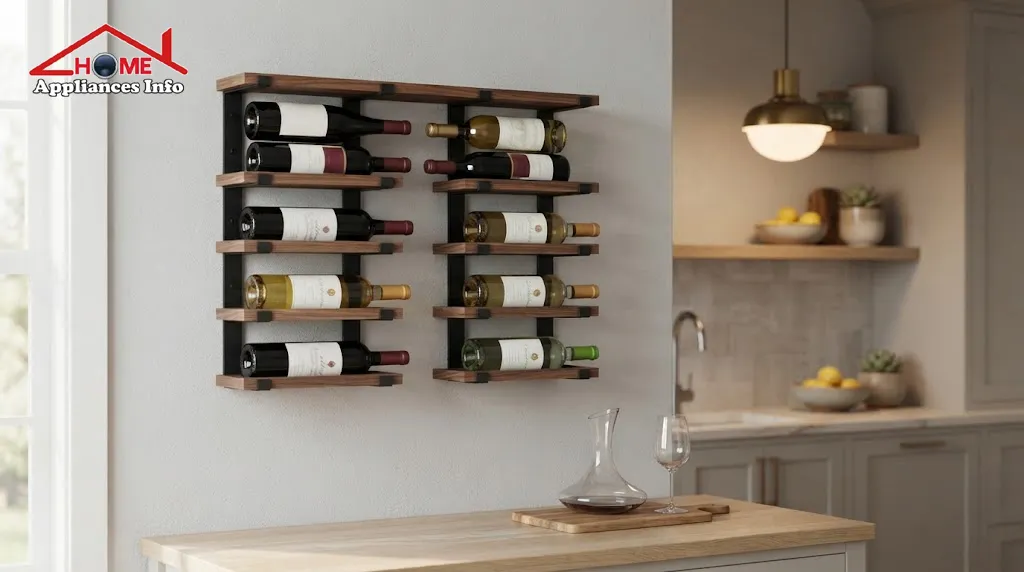
A wall mounted wine rack is one of the few storage upgrades that gives space back instead of taking it. Bottles lined up on the counter or crowded into a cabinet use room you probably need for cooking or entertaining. A rack fixed to an empty stretch of wall puts them within reach and off the work surface. The right choice depends on how many bottles you own, what your wall is made of, and where in the room the rack will hang. For most small kitchens, a compact rack holding six to nine bottles is enough. Home bars often benefit from a design that also stores glasses.
What Is a Wall Mounted Wine Rack?
A wall mounted wine rack attaches directly to a wall and holds bottles either horizontally or at a slight angle. You may also see it sold as a wine rack wall mounted design, a wall wine rack, or a wall mounted wine bottle holder. The terms are largely interchangeable, though “bottle holder” often means a simpler, smaller frame.
Most are made of metal, wood, or a mix of both, and many include a shelf or hooks for stemware. Capacity ranges from a few bottles to a dozen or more.
Why Choose a Wall Mounted Wine Rack?
The main appeal is practical. A bottle takes up surprisingly little wall area, yet a countertop holder claims a permanent patch of worktop. Moving storage upward frees that surface, which matters most in apartments and galley kitchens where every few inches count. If you are tidying the rest of the counter too, a compact organizer such as a sponge holder for the sink works on the same principle: give small items a fixed home so the surface stays clear.
There are secondary benefits as well. Bottles stay visible and easy to grab, and the rack doubles as décor, particularly in a room that otherwise lacks wall interest. Some designs add a glass rail, so one fixture handles both bottles and stemware.
One caution belongs here. A rack is a convenient place to keep wine, not a replacement for proper storage if you plan to hold bottles for years. I return to this point in the placement section.
7 Best Wall Mounted Wine Rack Ideas
These are seven configurations rather than seven products, so you can match the type to your space.
1. Compact 6-Bottle Wall Wine Rack
This is the entry point. A six-bottle rack suits apartments, studio kitchens, and anyone who buys a few bottles at a time. Many are slim enough to fit beside a doorway or above a narrow console. Because the load is modest, usually under 20 pounds with bottles, installation is simpler, though you should still locate a stud or use anchors rated for the load. Its limit is obvious: once you start buying by the case, you will outgrow it.
2. 8-Bottle Wall Mounted Wine Rack
An 8 bottle wall mounted wine rack is a useful middle ground. It holds enough for a week of dinners and a few bottles in reserve, yet it does not dominate a wall. Eight bottles typically come in two rows of four or a single long row. Two rows suit a tall, narrow space, while one long row is better under a window or over a counter. Check the stated weight limit before buying. A full 750 ml bottle weighs roughly 2.5 to 3 pounds (about 1.2 to 1.4 kg), so eight bottles add around 20 to 24 pounds before you count the rack itself.
3. 9-Bottle Metal Wall Mounted Wine Rack
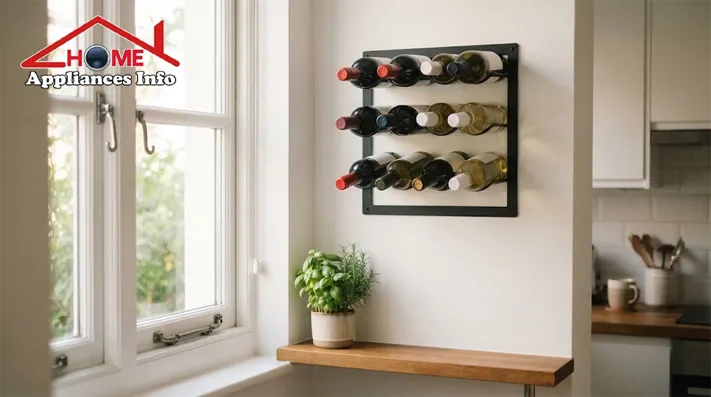
Metal racks, usually steel with a powder-coated or plated finish, suit minimalist kitchens and home bars. They are generally slim and sturdy, and they tolerate kitchen humidity better than untreated wood. Nine-bottle designs often use a staggered or honeycomb layout that reads as decorative when partly filled. The finish matters for longevity, so look for even coating at the weld points, since that is where rust begins first.
4. Wall Mounted Wine Rack With Glass Holder
For anyone who entertains, this combination is hard to beat. Bottles sit below and stemware hangs above on a rail or in slotted tracks, so a pour takes seconds. It works well on a short bar wall, beside a pantry, or in a dining nook. Make sure the glass slots match your stems, because wide-bowled glasses can be a tight fit in standard tracks. Hanging glasses also add weight and sway, so a stud-mounted fixing is wise.
5. Rustic Wood-and-Metal Wall Wine Rack
Wood paired with a metal frame suits farmhouse kitchens, dining rooms, and traditional bars. The warmth of the timber softens a room that has a lot of steel and tile. Solid wood gives a more substantial feel than veneered board, and it usually holds screws better. Wood does respond to moisture and temperature, so a spot away from the stove and sink will keep it looking good longer.
6. Floating Shelf-Style Wall Wine Rack
This design combines a shelf with a bottle cradle, so you can store bottles alongside glasses, a small plant, or a few decorative objects. It suits modern kitchens where a wall of bare bracket-style hardware would look busy. Because the load sits out from the wall, the fixing needs to be good. A shelf with a hidden bracket relies on secure attachment, so choose one that supplies proper hardware and follow its instructions exactly.
7. Large-Capacity Wall Mounted Wine Rack for Home Bars
If you have a dedicated bar or entertaining area, a rack for twelve or more bottles makes sense. These are often modular, with sections you can add or rearrange. At this size, weight becomes the central issue: twelve bottles weigh roughly 30 to 36 pounds, and larger systems far more, so mounting into studs or using a purpose-built heavy-duty system is not optional.
Bars also benefit from lighting that flatters the display without heating it. A smart dimmer switch lets you keep the area softly lit for evenings and bright enough to read labels when needed, and low-heat LEDs are kinder to bottles than hot bulbs.
Where Should You Put a Wall Mounted Wine Rack?
Location affects both safety and how well your wine keeps. Wine tolerates most things except heat, light, and sudden change. Berry Bros. & Rudd, the long-established London wine merchant, advises keeping wine dark, still, and cool, and avoiding the kitchen, where it can get too warm. It also warns against hot pipes and vibration.
That is a useful corrective, because the kitchen is exactly where many people hang a rack. If you do, choose the coolest, shadiest wall you have. Avoid:
- Walls beside or above the oven, stovetop, or dishwasher
- Spots in direct sun, including late-afternoon light through a window
- Positions where a cabinet door, pantry door, or passing elbow could strike the bottles
- Walls that vibrate, such as those shared with a washing machine
A sensible rule: a wall mounted wine rack suits bottles you plan to drink within weeks or a few months. Wine you intend to age for years deserves steadier conditions, such as a cool cupboard or a dedicated wine fridge. Forbes notes that around 55°F (13°C) is the commonly recommended temperature and that corked bottles should lie on their side, which most racks allow. Screw-cap bottles do not need to lie flat.
How to Install a Wall Mounted Wine Rack Safely
Wine is heavy, and a fully loaded rack puts steady, downward force on a few fixing points. Drywall by itself is not strong, so how you attach the rack matters as much as which rack you buy.
- Check the weight limit. Add the rack’s stated capacity to the weight of the bottles you will actually store, and stay comfortably below the maximum.
- Identify your wall. Drywall, plaster, brick, and concrete each need different fixings. If you are unsure, test with a small pilot hole in a hidden spot.
- Find the studs. A stud finder will locate the timber or metal framing behind drywall. Screwing into a stud gives the strongest hold, and it is the better choice for anything heavy.
- Use proper anchors where no stud exists. Select anchors rated for more than your expected load, and match the type to the wall. Plastic expansion anchors are generally for light loads only.
- Use the supplied hardware and instructions. The manufacturer’s screws and template are designed for that rack. If they seem inadequate for your wall, ask the maker rather than improvising.
- Level it before you tighten. A rack that tilts will let bottles creep sideways and put uneven strain on one fixing.
- Check it periodically. Every few months, give it a gentle tug and look for loosening or wall cracks.
Renters should check their lease before drilling, and homes with older plaster walls may need an experienced installer.
Wall Mounted Wine Rack vs Countertop Wine Rack
Both have a place. The wall option wins on space, while the countertop option wins on flexibility.
| Feature | Wall mounted | Countertop |
|---|---|---|
| Counter space used | None | Some |
| Installation | Drilling required | Usually none |
| Portability | Low | High |
| Small kitchens | Very good | Can crowd the worktop |
| Home bars | Very good | Good |
Renters or anyone who rearranges often may prefer a countertop rack for that reason alone. If you are planning other changes to the room, our kitchen appliance guides cover what else might compete for counter space.
How to Choose the Best Wall Mounted Wine Rack
- Capacity: Six to nine bottles suits most small kitchens. Twelve or more suits a bar or someone who buys in cases.
- Material: Metal is durable and low-maintenance, wood adds warmth, and combinations balance both. Look for solid construction rather than thin, hollow tubing.
- Wall compatibility: Confirm the rack’s hardware suits your wall type, and be realistic about whether you can hit studs.
- Weight capacity: Look for a clearly stated limit, and treat the absence of one as a warning sign.
- Bottle orientation: Horizontal storage protects corks. Some racks angle bottles slightly, which is fine for short-term storage.
- Size: Measure the wall, then add clearance for hands and doors. Wide-shouldered bottles such as some champagne and sparkling wines can be tight in narrow slots.
- Cleaning: Open frames collect dust. A design you can wipe quickly will stay tidy.
- Glass storage: Decide whether you want stemware in the same fixture. A wall mounted wine bottle holder with a glass rail is convenient, but it adds weight and width.
Another route, if you are also upgrading your cold storage, is a dedicated wine cooler. MasterClass notes that a wine fridge holds wine at a steadier temperature and humidity than a regular refrigerator, which suits long-term bottles better than an open wall display.
Frequently Asked Questions
What is the best wall mounted wine rack for a small kitchen?
A compact rack holding six to nine bottles usually fits best. Choose a slim profile, a finish that tolerates kitchen humidity, and a position away from heat sources.
Are wall mounted wine racks safe?
They are safe when installed properly and used within their stated capacity. Most problems come from weak fixings in drywall or from overloading, so use studs or appropriately rated anchors.
How many bottles can a wall wine rack hold?
Designs range from a handful to a dozen or more, and modular systems can hold more. Always compare the bottle count with the weight limit, not just the slots.
Can an 8-bottle wine rack fit in a small kitchen?
Often yes. Many eight-bottle racks are shallow because the bottles sit horizontally, and some use two rows to stay narrow. Measure the available wall and leave clearance around it.
Can you mount a wine rack on drywall?
Yes, but not carelessly. Screw into a stud whenever you can, and use anchors rated well above your load when you cannot. Masonry and tile walls need different fixings.
Is a wall mounted wine rack better than a countertop rack?
It saves counter space and suits small rooms, but it needs drilling and cannot be moved easily. A countertop rack is simpler and more portable, though it occupies work surface.
Final Thoughts
The best wall mounted wine rack is the one that matches your wall, your collection, and the room’s conditions. Start with realistic capacity, check the weight limit, and fix it into studs where possible. Then place it away from heat, strong light, and door swings. For bottles you will drink soon, a wall rack is a tidy and attractive option. For wine you plan to keep for years, add a cooler, darker spot to your plan. If you are still sorting through storage and décor ideas, you can browse more home and lifestyle ideas for the rest of the house.
References
- Berry Bros. & Rudd, “How to store wine at home” (bbr.com): https://www.bbr.com/articles/guides/store-wine-home
- Forbes, “How To Properly Store Wine At Home: Tips For Keeping Your Bottles Fresh” (Emily Price, October 2024): https://www.forbes.com/sites/emilyprice/2024/10/07/how-to-properly-store-wine-at-home-tips-for-keeping-your-bottles-fresh/
- MasterClass, “How to Store Wine at Home: 7 Tips”: https://www.masterclass.com/articles/how-to-properly-store-wine-at-home

📱 SMART HOME TECHNOLOGY CONSULTANT & IOT SPECIALIST
Alfredo Torres
Technology Consultant | Smart Home Automation & IoT Specialist (Lima, Peru)

🌐 Matter Protocol & IoT
⚡ Energy Efficiency
🛠️ Future-Proofing Infrastructure
Alfredo Torres is a seasoned technology consultant based in Lima, Peru, specializing in the integration of next-generation IoT ecosystems and smart home automation. With over a decade of experience navigating the rapidly evolving tech landscape of the Global South, Alfredo brings a unique, practical perspective to homeappliancesinfo.com.
As a specialist in the 2026 Matter protocol rollout, Alfredo focuses on bridging the gap between legacy household infrastructure and modern connectivity standards. His consulting work centers on “future-proofing” homes—helping users select appliances that offer maximum durability, energy efficiency, and cross-platform compatibility without the burden of “app fatigue.”
Alfredo’s expert insights are grounded in real-world problem solving, from optimizing smart kitchen workflows to implementing cost-effective home maintenance solutions in emerging markets. When he isn’t benchmarking the latest AI-integrated appliances, he can be found exploring the intersection of sustainable architecture and digital living.