

To support our research and detailed appliance reviews, we may earn a small commission from qualifying purchases made through our links, at no extra cost to you. As an Amazon Associate, I earn from qualifying purchases.
To support our research and detailed appliance reviews, we may earn a small commission from qualifying purchases made through our links, at no extra cost to you. As an Amazon Associate, I earn from qualifying purchases.
A sponge holder for sink is a simple kitchen accessory, but the right design can make a noticeable difference to how clean and organized your sink area feels. Instead of leaving a wet sponge on the counter or in a pool of water, a well-designed holder gives it a dedicated place with drainage and airflow.
The best option depends on your kitchen rather than just the appearance of the caddy. A countertop organizer may work beautifully beside a spacious sink, while a suction, adhesive, faucet-mounted, or over-the-sink design can be much more practical when counter space is limited.
For this 2026 guide, I compared different mounting styles, drainage systems, materials, storage capacity, and cleaning requirements. The seven choices below are deliberately different so you can choose according to your sink setup rather than buying seven versions of essentially the same product.
Quick Comparison: 7 Best Sponge Holders for Sink
| Product | Best For | Material | Mounting | Drainage | Storage |
|---|---|---|---|---|---|
| Cisily Sponge Holder | Best Overall | 304 stainless steel | Countertop | Rotatable drainage spout | Sponge, soap, brushes |
| OXO Stainless Steel Sink Organizer | Stainless Steel | Stainless steel | Countertop | Perforated base + removable tray | Sponge, brushes, dispenser |
| 3M Command Sponge Caddy | Adhesive Mounting | Plastic | Adhesive | Drain holes + removable tray | Sponge |
| Simplehuman Sink Caddy | Suction Mounting | Mixed construction | Suction cups + ledge hanger | Ventilation holes | Sponges + cleaning tools |
| Casabella Sink Sider Faucet Caddy | Faucet Mounting | Plastic | Adjustable faucet strap | Drainage holes | Sponge + dish brush |
| Dcolora Expandable Over-Sink Caddy | Over-Sink Storage | 304 stainless steel + silicone caps | Sits over sink | Open design | Sponge, soap, brushes, cloth |
| Joseph Joseph Caddy Sink Tidy | Budget-Friendly | Plastic | Countertop | Concealed reservoir | Sponge, brush, soap |
Specifications can vary by model or regional version, so check the manufacturer’s current listing before purchasing.
7 Best Sponge Holders for Sink in 2026
1. Cisily Sponge Holder for Kitchen Sink — Best Overall
Cisily Sponge Holder for Kitchen Sink
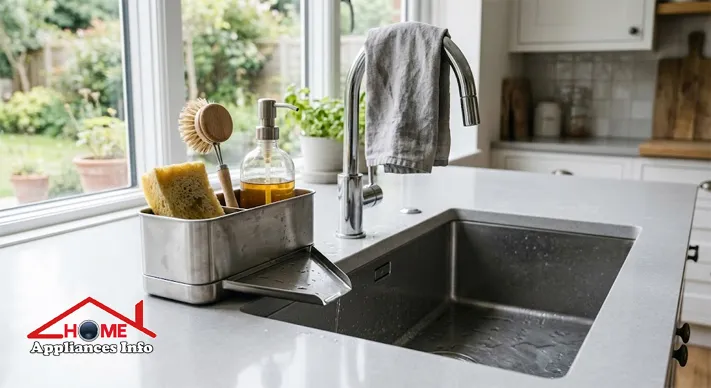
The Cisily sponge holder is a strong all-purpose choice for someone who wants more than a small dish sponge holder. Its countertop design combines several storage areas with a drainage system that directs water toward the sink.
The manufacturer describes the holder as being made from 304 stainless steel and equipped with a rotatable drainage spout. Its design includes separate compartments and a brush holder, making it suitable for households that keep a sponge, dish soap, scrubber, and several brushes around the sink.
The rotatable spout is particularly useful because the direction of drainage can be adjusted toward the basin. That is more convenient than a drip tray that simply collects water and needs to be emptied repeatedly.
Why it stands out: versatile storage, 304 stainless steel, compact footprint, and directed drainage.
Best for: households that want one countertop caddy for several sink-cleaning tools.
Potential drawback: it takes up countertop space, so measure the area beside your sink before buying.
2. OXO Good Grips Stainless Steel Sink Organizer — Best Stainless Steel Option
OXO Stainless Steel Sink Organizer
If material durability and a clean, compact appearance are high on your list, the OXO Good Grips Stainless Steel Sink Organizer is worth considering.
OXO specifies a stainless-steel construction with separate areas for long-handled brushes, palm brushes, pump dispensers, and a sponge. Its perforated base allows water to drain away, while the removable drip tray makes routine cleaning easier. The listed dimensions are 9 × 3.75 × 4.75 inches.
This is a good example of why drainage design matters more than simply choosing a container with holes. A holder that separates wet items from standing water and can be taken apart for cleaning is easier to maintain over time.
Why it stands out: thoughtful compartment layout and a removable drip tray.
Best for: kitchens where you want stainless steel and several storage zones without a very large caddy.
Potential drawback: stainless-steel construction usually costs more than a basic plastic holder.
3. 3M Command Sponge Caddy — Best Adhesive Sponge Holder
An adhesive holder makes sense when you want to free the countertop without drilling into the wall or sink.
The 3M Command Sponge Caddy is designed for tool-free installation using Command adhesive. 3M says it can be used on several indoor surfaces, including finished wood, tile, metal, glass, and painted surfaces, subject to the product’s installation requirements. The caddy has drainage holes and a removable tray for catching drips.
This design is especially useful on a backsplash or under a sink cabinet where a countertop organizer would occupy valuable working space.
The important qualification is surface compatibility. Adhesive mounting is not universally suitable for every wall finish, porous surface, or constantly wet location. Follow the manufacturer’s preparation and weight instructions rather than assuming every adhesive holder will stick equally well.
Why it stands out: no drilling and very little countertop footprint.
Best for: renters or homeowners who want wall-mounted storage without permanent holes.
Potential drawback: adhesive performance depends heavily on the mounting surface and installation conditions.
4. Simplehuman Sink Caddy — Best Suction-Cup Design
Suction cups are convenient because the holder can be repositioned without adhesive residue or drilling. The Simplehuman Sink Caddy uses four suction cups plus a wire ledge hanger to secure the organizer to the sink. It also has ventilation holes and elevated sponge compartments to increase airflow around wet items.
The design is particularly useful for people who want the sponge stored inside or immediately beside the sink instead of occupying the countertop.
However, suction cups work best when the surface is smooth and clean. Simplehuman itself provides separate guidance for situations where the mounting surface is not smooth, including suction-cup stickers as an alternative.
Why it stands out: a secure multi-point suction system combined with elevated sponge storage.
Best for: smooth-sided sinks where countertop space is limited.
Potential drawback: textured or unsuitable surfaces can reduce suction performance.
5. Casabella Sink Sider Faucet Sponge Holder — Best Faucet-Mounted Option
Casabella Sink Sider Faucet Sponge Holder
A faucet-mounted holder takes the idea of a sink caddy one step further by using space around the faucet instead of the countertop.
The Casabella Sink Sider faucet model uses an adjustable strap that attaches to the faucet and provides two storage compartments for a sponge and dish brush. The open design and drainage holes allow excess water to leave the holder, while the manufacturer lists dimensions of 2.3 × 5.75 × 8.8 inches.
This type of kitchen sink sponge holder can be especially useful in a small kitchen where every inch of counter space is already occupied.
Before purchasing, check the shape and diameter of your faucet. “Fits most standard-sized faucets” does not mean that every faucet configuration will be compatible.
Why it stands out: it uses otherwise unused faucet space.
Best for: compact kitchens and sinks with little counter space.
Potential drawback: compatibility depends on the faucet and strap arrangement.
6. Dcolora Expandable Over-the-Sink Caddy — Best Over-the-Sink Design
Dcolora Expandable Over-the-Sink Caddy
An over-the-sink organizer is useful when you want wet items to remain above or inside the sink rather than sitting on the counter.
The current Dcolora listing describes a 304 stainless-steel construction with silicone caps and an expandable width from 12.25 to 17.25 inches. It is designed to sit across the sink without installation and includes separate areas for soap and brushes, with space for sponges and a rail for dishcloths.
This is the category where measuring matters most. The listed compatibility is based on specific sink dimensions, so don’t rely on the phrase “expandable” alone.
Why it stands out: it uses the sink opening rather than counter space.
Best for: larger sinks and kitchens where countertop storage is at a premium.
Potential drawback: an over-sink design can interfere with faucet access or become inconvenient if the dimensions don’t match your sink.
7. Joseph Joseph Caddy Sink Tidy — Best Budget-Friendly Option
Not everyone needs a large stainless-steel organizer. If your main goal is simply to give a sponge, brush, soap bottle, and cloth a defined home, the Joseph Joseph Caddy Sink Tidy is a more compact approach.
The current model has a main compartment for a larger washing-up liquid bottle and brush, a rail for hanging a damp cloth, and a dedicated sponge plate. Its concealed reservoir collects drained water, and the unit can be dismantled for cleaning. Joseph Joseph also lists it as dishwasher safe.
Why it stands out: practical organization without the complexity of a larger stainless-steel caddy.
Best for: buyers who want a straightforward, space-conscious organizer.
Potential drawback: plastic construction won’t have the same look or feel as a stainless-steel sink organizer.
How to Choose the Best Sponge Holder for Kitchen Sink
The most attractive holder is not necessarily the most useful one. Think about where water goes, where the holder sits, and what you actually keep beside your sink.
Drainage and Ventilation
Drainage should be your first consideration.
A wet sponge needs somewhere for excess water to go. Look for:
- Open or perforated bases
- Drainage holes
- Slotted surfaces
- Removable drip trays
- Sloped drainage channels
- Spouts that direct water into the sink
Good drainage does not make a sponge hygienic by itself. It simply helps prevent the holder from becoming a place where water continuously pools.
The USDA notes that kitchen sponges can be difficult to clean and recommends replacing them frequently rather than assuming that cleaning alone makes an old sponge safe.
Material and Durability
| Material | Main Advantage | Consideration |
|---|---|---|
| Stainless steel | Durable and suitable for wet environments | Usually costs more |
| Silicone | Flexible and easy to wash | Less rigid than metal |
| Plastic | Lightweight and affordable | Quality varies by product |
| ABS/plastic blends | Rigid and often inexpensive | Construction quality varies |
For a frequently wet environment, material quality and construction matter more than simply seeing the word “stainless” on a product listing.
If a manufacturer specifies a particular grade, such as 304 stainless steel, that is more useful information than an unsupported “rustproof” claim.
Mounting Method
Choose the installation style according to your kitchen:
Countertop: easiest to install and reposition.
Adhesive: excellent for saving counter space, provided the surface is compatible.
Suction: convenient for smooth sink surfaces.
Faucet-mounted: useful when countertop space is extremely limited.
Over-sink: keeps wet tools close to the basin but requires careful measurement.
There isn’t a universally superior mounting method. The right choice is the one that works with your sink’s shape and your normal cleaning routine.
Size and Capacity
A person who uses one sponge has different needs from a household that keeps a sponge, dish brush, bottle brush, scrubber, soap bottle, and cloth beside the sink.
Before buying, consider what you actually want to store.
A compact sink sponge organizer is often easier to keep clean, while a larger sink caddy makes sense when several cleaning tools need their own compartments.
Ease of Cleaning
A holder that cannot be cleaned easily can become frustrating even if its initial drainage is good.
Look for:
- Removable drip trays
- Accessible drainage channels
- Few narrow crevices
- Dishwasher-safe construction when appropriate
- Components that can be separated for washing
The same principle applies to the sponge itself. The CDC recommends regular cleaning of household surfaces and emphasizes that cleaning removes dirt and many germs, while sanitizing or disinfecting has a different purpose.
If your kitchen sink is already draining slowly, you can also see our guide on how to unclog a kitchen sink for practical drain-maintenance steps.
Are Sponge Holders for Sinks Worth It?
For many kitchens, yes—provided you choose a holder that solves an actual problem.
A good holder can:
- Keep cleaning tools in one predictable location
- Reduce countertop clutter
- Give wet sponges better drainage
- Free up valuable counter space
- Separate sponges from brushes and soap
- Make the sink area easier to wipe and clean
But a holder is not a substitute for maintaining the sponge. A beautifully designed caddy cannot compensate for a sponge that is old, visibly dirty, or repeatedly left saturated.
The practical goal is simple: store the sponge in a way that lets it drain, allows air around it, and makes the holder itself easy to clean.
How to Keep a Kitchen Sink Sponge Holder Clean
Even the best sponge holder kitchen sink setup needs occasional attention.
Start by removing the sponge, brush, soap bottle, and any other items. Empty standing water from a drip tray and wash removable components according to the manufacturer’s instructions.
For the sponge, rinse away food debris after use and squeeze out excess water rather than placing it into the holder completely saturated. USDA guidance specifically warns that kitchen sponges can harbor bacteria and recommends buying new ones frequently.
If you are cleaning the sink or surrounding surfaces after handling raw meat or poultry, USDA recommends washing those surfaces with hot, soapy water and following appropriate sanitizing guidance where necessary.
🔴 IMAGE PROMPT: “Editorial kitchen-cleaning scene showing a person removing a wet sponge and removable drip tray from a stainless-steel sink caddy, washing the organizer with warm soapy water at a bright kitchen sink, clean brushes and soap bottle nearby, realistic natural lighting, close three-quarter perspective, no labels or text in the image”
🟢 Alt Text: “Person cleaning a removable sink caddy and sponge holder with soapy water”
🟢 CAPTION: “Removable trays and accessible drainage areas make a sink organizer easier to clean regularly.”
Avoid storing a damp sponge inside a completely enclosed container. The aim is to give it airflow and drainage between uses.
Frequently Asked Questions
What is the best sponge holder for a kitchen sink?
There is no single design that suits every sink. A countertop stainless-steel caddy works well when you have counter space, while a faucet-mounted, suction, or adhesive model can be more practical in a smaller kitchen. Prioritize drainage, airflow, stability, and easy cleaning.
Where should I put a sponge holder in my sink?
Place it somewhere that allows the sponge to drain without blocking the sink drain, faucet controls, or normal washing area. If the holder uses suction cups, choose a smooth surface and follow the manufacturer’s installation instructions.
Are suction-cup sponge holders good?
They can be very convenient on smooth, non-porous surfaces. Their main limitation is surface compatibility. Textured, dirty, wet, or unsuitable surfaces can reduce the effectiveness of suction mounting.
What material is best for a sink sponge holder?
Stainless steel is a strong choice for durability and wet environments, while plastic and silicone can be lighter and less expensive. The construction and drainage design are at least as important as the material itself.
How do you keep a sponge holder from getting moldy?
Don’t allow dirty water to remain in the holder. Empty removable trays, wash the organizer regularly, rinse away residue, and allow the sponge to drain and air-dry between uses. Replace the sponge when it becomes worn, persistently odorous, or otherwise unsuitable for continued use.
Do sponge holders help sponges dry faster?
A ventilated holder can help by exposing more of the sponge to air and allowing excess water to drain away. It does not guarantee that the sponge will dry quickly, because drying also depends on the sponge material, humidity, airflow, and how much water remains after use.
Final Thoughts
A sponge holder for sink doesn’t need to be complicated to be useful. The most important features are straightforward: effective drainage, enough airflow, stable mounting, suitable capacity, and easy cleaning.
For a countertop setup, the Cisily and OXO designs offer different approaches to multi-tool organization. The 3M Command holder is better suited to adhesive mounting, while Simplehuman and Casabella provide alternatives for suction and faucet mounting. If counter space is your biggest concern, an over-sink design such as the Dcolora can move storage away from the worktop.
Whichever style you choose, measure your available space and check the mounting surface before ordering. A smaller, well-drained holder that fits your sink properly is generally more useful than a larger organizer that gets in the way.
References
- USDA FSIS — How do I clean my kitchen sponge? — Guidance on kitchen sponge cleaning and replacement.
- CDC — When and How to Clean and Disinfect Your Home — General household cleaning and disinfection guidance.
- USDA FSIS — Washing Food: Does It Promote Food Safety? — Kitchen sink and surface-cleaning guidance.

🍳 HOME & KITCHEN APPLIANCE EXPERT
Sidra Altaf
Home & Kitchen Specialist | Product Evaluator & Appliance Reviewer

🏠 Home Essentials
⚖️ Product Comparisons
⚡ Energy & Efficiency
Sidra Altaf is a seasoned expert in home and kitchen appliances with over 5 years of hands-on experience in the field. Passionate about helping families make smarter choices, she specializes in reviewing, comparing, and recommending appliances that bring convenience, efficiency, and innovation into everyday living. Her deep knowledge of product functionality, durability, and design makes her a trusted voice for anyone looking to upgrade their home.