

To support our research and detailed appliance reviews, we may earn a small commission from qualifying purchases made through our links, at no extra cost to you. As an Amazon Associate, I earn from qualifying purchases.
To support our research and detailed appliance reviews, we may earn a small commission from qualifying purchases made through our links, at no extra cost to you. As an Amazon Associate, I earn from qualifying purchases.
A tea strainer makes loose-leaf tea much easier to brew without ending up with leaves and fine particles floating in your cup. But not every strainer works equally well for every tea. The size of the brewing chamber, mesh or opening pattern, material, cup compatibility, and cleaning requirements can all affect how practical it is.
For most people brewing loose-leaf tea at home, a roomy fine-mesh basket is a versatile starting point because it gives the leaves space to open while keeping small particles contained. Smaller tea balls can still be useful for travel, while handheld strainers and built-in teapot filters make more sense for different brewing methods.
Here are seven common types, followed by a practical guide to choosing the right one for your tea, mug, or teapot.
1. What Is a Tea Strainer?
A tea strainer is a filtering or brewing accessory used to separate tea leaves from the finished drink.
There are two closely related ways to use one. A traditional strainer sits over a cup or teapot and catches leaves as tea is poured. A basket-style design can hold loose leaves while they steep directly in the water.
That is why the terms tea strainer and tea infuser are often used interchangeably in online stores, even though their functions can be slightly different.
An infuser primarily holds the tea leaves during steeping, whereas a strainer primarily filters leaves from the liquid. Modern basket designs can effectively do both.
The distinction matters when shopping because someone searching for a tea strainer for loose tea may actually need a basket-style infuser rather than a small pouring strainer.
2. Tea Strainer vs. Tea Infuser: What’s the Difference?
The simplest way to understand the difference is to look at where the leaves are during brewing.
| Feature | Tea Strainer | Tea Infuser |
|---|---|---|
| Main function | Filters leaves from brewed tea | Holds leaves during steeping |
| Typical position | Over a cup or teapot | Inside a cup, mug, or teapot |
| Loose-leaf use | Yes | Yes |
| Fine filtration | Available | Available |
| Reusable designs | Common | Common |
| Best suited to | Pouring and filtering | Direct steeping |
A separate strainer allows tea leaves to move freely around a teapot before being caught during pouring. An infuser confines the leaves to a basket or chamber while water passes through.
For everyday single-cup brewing, a loose leaf tea infuser or basket is often the more convenient option because you can put the leaves directly into the mug, add water, and remove the basket when brewing is finished.
3. The 7 Best Types of Tea Strainers for Loose Leaf Tea
Rather than treating one design as universally best, consider these seven types according to the way you actually brew tea.
1. Fine-Mesh Basket Tea Strainer
Best for: Everyday loose-leaf brewing
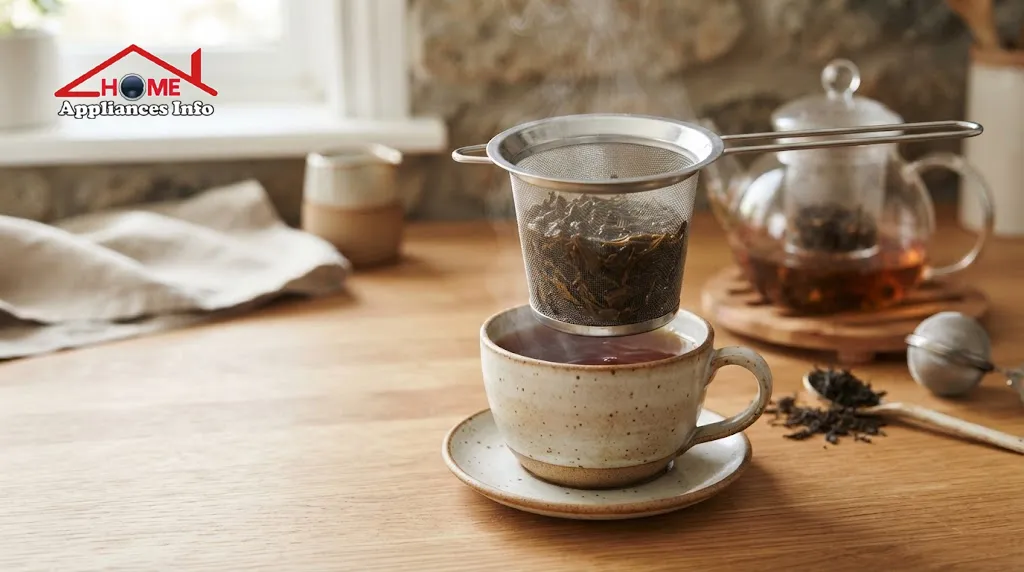
A wide basket is one of the most practical designs for regular tea drinking. Its main advantage is space. Loose leaves can spread out and come into contact with water instead of being compressed into a tiny chamber.
A large basket can also make loading and removing leaves easier. The OXO Tea Infuser Basket, for example, uses a large-capacity stainless-steel basket with an etched hole pattern designed to contain small tea particles. Its lid also doubles as a drip tray.
A basket-style design is particularly useful for whole-leaf green, white, and oolong teas that expand noticeably during steeping.
Advantages:
- Good water circulation
- Generous brewing space
- Easy to load and remove
- Reusable
- Available in stainless steel
- Suitable for many different tea styles
The main limitation is compatibility: the basket needs to fit securely inside or over the opening of your mug or teapot.
2. Extra-Fine Mesh Tea Strainer
Best for: Fine-cut tea, rooibos, and teas that produce small particles
An extra-fine mesh tea strainer is useful when ordinary perforations allow tiny pieces of leaf to escape into the cup.
This design is especially helpful for finely cut teas and rooibos, where a conventional tea ball with relatively large openings may not contain everything.
There is a trade-off, however. The finer the filtration surface, the more easily very small particles can accumulate on it. That means rinsing after use becomes particularly important.
When shopping, look for a fine mesh tea infuser with adequate brewing space rather than choosing solely on the fineness of the mesh.
3. Tea Ball or Tea Egg
Best for: Compact storage, travel, and occasional brewing
The familiar tea ball or tea egg is one of the smallest and simplest loose-leaf brewing tools. Tea is placed inside a perforated or mesh container, which is then suspended in the mug or teapot.
Its compact size is convenient, but that same feature can be a disadvantage with larger leaves. Tea leaves need room to hydrate and expand, and a cramped container can restrict their movement.
TeaSource recommends allowing enough space for leaf expansion and suggests using a roomy infusing basket where possible.
A tea ball can therefore be perfectly serviceable for smaller quantities or travel, but it is not automatically the best format for every loose-leaf tea.
4. Handheld Tea Strainer
Best for: Traditional brewing and filtering while pouring
A handheld strainer takes a different approach. Instead of enclosing the leaves throughout the brewing process, you brew the tea in a teapot or other vessel and hold the strainer over the receiving cup as you pour.
This gives the leaves plenty of room during steeping.
It is a particularly useful option if you already own a teapot without a suitable built-in filter. You can also change teas without having to fit an infuser inside the brewing vessel.
The drawback is that it requires a little more coordination than an all-in-one basket.
5. Tea Strainer Mug With Built-In Infuser
Best for: Single-cup brewing
An infuser mug combines several pieces of tea equipment into one setup. Typically, a removable basket sits inside the mug and a lid helps retain heat while the tea steeps.
This arrangement works well at a desk, in a kitchen, or anywhere you normally prepare only one cup at a time.
If you already enjoy dedicated glass tea equipment, you may also find useful ideas in this HomeAppliancesInfo guide to a [glass tea set for loose-leaf brewing]glass tea set for loose-leaf brewing.
Before buying an infuser mug, check the basket depth and diameter. A decorative mug with a very shallow infuser may look attractive but provide less useful brewing space.
6. Teapot With Built-In Tea Filter
Best for: Brewing several cups
A teapot with a removable or integrated filter basket is convenient when you’re making multiple servings.
The larger vessel generally provides more room for the leaves than a small individual tea ball. A removable filter also makes it easier to empty the leaves after brewing.
Pay attention to:
- Filter capacity
- Mesh or opening size
- Ease of removal
- Lid design
- Pouring performance
- Ease of cleaning
This type is especially practical when tea is normally prepared for two or more people rather than one mug at a time.
7. Disposable Tea Filter Bags
Best for: Travel and occasional loose-leaf brewing
Disposable filter bags allow you to use your own loose tea without carrying a reusable strainer.
They are convenient when travelling, staying in hotels, or preparing tea somewhere that washing equipment is inconvenient. You simply fill the bag, steep it, and dispose of it afterward.
The trade-off is obvious: reusable equipment creates less ongoing waste and is generally more practical for frequent tea drinkers.
4. What Makes a Good Tea Strainer?
The best design depends on the tea and brewing method, but several characteristics consistently matter.
Brewing space
This is one of the easiest specifications to overlook.
Large leaves can expand considerably after absorbing water. A basket that gives them room to move generally makes more sense for whole-leaf teas than a tightly packed ball.
TeaSource specifically recommends enough space for full leaf expansion when brewing loose tea.
Mesh or opening size
The filter should contain the leaves without unnecessarily restricting water movement.
A coarse opening may let small particles through, while extremely fine mesh can require more frequent cleaning.
Material
A stainless steel tea strainer is a practical reusable option because stainless steel is commonly used in tea-brewing equipment and does not require the fragile handling associated with some glass components.
The important point is to check the manufacturer’s material and care specifications rather than assuming every product with a similar appearance is made to the same standard.
Size and compatibility
Measure your mug or teapot opening if necessary. A basket that is too small can sit awkwardly, while one that is too large may not fit securely.
Cleaning
Fine mesh catches small particles, which can become difficult to remove once they dry.
A design that can be thoroughly rinsed is much easier to live with than one containing inaccessible corners or narrow chambers.
5. How to Choose a Tea Strainer for Loose Tea
Choosing a tea strainer for loose tea becomes much easier when you start with the tea rather than the appearance of the accessory.
Consider the leaf size
Whole-leaf oolong and white tea generally benefit from more room than finely cut tea.
Match the filtration to the tea
If your tea produces small particles, consider a finer filter. For larger leaves, excessive filtration may not provide much additional benefit.
Check the capacity
Do not pack loose leaves tightly into a small chamber. The basket should provide enough room for the amount you intend to brew.
Check your mug or teapot
A good strainer is only useful if it sits securely and allows the leaves to remain properly immersed.
Think about cleaning
If you drink tea several times a day, easy cleaning may matter more than a decorative shape.
For readers who are also choosing the appliance used to heat their brewing water, HomeAppliancesInfo’s guide to [electric kettles with temperature-control features]electric kettles with temperature-control features provides related buying considerations.
6. Stainless Steel vs. Silicone Tea Strainers
Material alone should not determine your purchase. The actual design matters more.
| Feature | Stainless Steel | Silicone |
|---|---|---|
| Durability | Generally high | Generally good, depending on design |
| Fine filtration | Common | Depends on the design |
| Heat resistance | Generally excellent for tea brewing | Product-specific |
| Cleaning | Usually straightforward | Can vary by shape |
| Odor retention | Generally low | Product-dependent |
| Typical use | Everyday brewing | Convenience and novelty designs |
Stainless steel is particularly common in basket-style strainers because it can be formed into mesh or perforated structures.
Silicone designs can be flexible and visually distinctive, but filtration varies considerably from one product to another. Instead of assuming one material is always superior, inspect the filter openings, brewing capacity, heat specifications, and cleaning instructions.
7. Which Strainer Works Best With Different Teas?
There is no need to buy a different strainer for every tea. One well-designed basket can handle a surprisingly broad range.
| Tea type | Useful strainer characteristic |
|---|---|
| Black tea | Fine or medium-fine basket |
| Green tea | Roomy basket |
| Oolong | Large basket with plenty of leaf space |
| White tea | Large, open brewing basket |
| Herbal tea | Fine-mesh basket |
| Rooibos | Extra-fine mesh |
| Chai | Fine-mesh basket |
| Broken-leaf tea | Fine or extra-fine filtration |
The general principle is leaf size + brewing space + suitable filtration.
For example, an oolong containing large rolled leaves benefits from room to unfold, while rooibos consists of much smaller particles and is better matched with finer filtration.
8. How to Use a Tea Strainer
Once you have the appropriate equipment, brewing is straightforward.
- Choose a suitable strainer or infuser.
- Add the recommended amount of loose tea without compressing it.
- Place the basket in the mug or teapot.
- Add water at the temperature appropriate for that tea.
- Allow it to steep according to the tea’s instructions.
- Remove the infuser or pour the tea through the strainer.
- Empty and rinse the reusable filter.
Avoid treating one temperature or steeping time as correct for every tea. The Tea and Herbal Association of Canada, for example, provides different brewing guidance for white, green, oolong, black, and herbal teas.
If you use an electric kettle, a temperature-control model can make these adjustments easier, particularly for teas that are normally brewed below boiling temperature.
9. How to Clean a Reusable Tea Strainer
Cleaning is simple if you do it soon after brewing.
After each use:
- Empty the leaves.
- Rinse the filter under warm water.
- Check the mesh for trapped particles.
- Wash according to the manufacturer’s instructions.
- Allow the strainer to dry completely before storage.
Do not leave wet tea leaves sitting in a fine mesh basket for long periods. Dried particles can be considerably harder to remove.
If the manufacturer says the product is dishwasher safe, follow those instructions rather than assuming all metal or silicone strainers can go into a dishwasher. For example, OXO identifies its current Tea Infuser Basket as dishwasher safe.
10. Tea Filter vs. Tea Strainer
The term tea filter can describe several different products.
It may refer to:
- A stainless-steel mesh basket
- A disposable paper filter
- A reusable loose tea filter
- A built-in teapot filter
- A fine-mesh infuser
In practical terms, the important question is what the filter is designed to do.
If you want to steep loose tea directly inside a mug, look for a basket-style infuser. If you already brew tea in a pot and simply need to prevent leaves from reaching the cup, a handheld strainer may be more appropriate.
Quick Comparison: 7 Tea Strainer Types
| Type | Best use | Main advantage | Main limitation |
|---|---|---|---|
| Fine-mesh basket | Everyday brewing | Good leaf space and filtration | Needs suitable mug |
| Extra-fine mesh | Fine particles | Excellent containment | Can require more cleaning |
| Tea ball/egg | Travel or occasional use | Compact | Limited leaf space |
| Handheld strainer | Pouring | Leaves brew freely | Requires separate vessel |
| Infuser mug | Single servings | Convenient all-in-one setup | Less flexible |
| Built-in teapot filter | Multiple cups | Large brewing capacity | Less portable |
| Disposable filter bags | Travel | Easy cleanup | Creates waste |
Frequently Asked Questions
What is the best tea strainer for loose-leaf tea?
For general-purpose brewing, a roomy fine-mesh basket is a versatile choice because it combines adequate filtration with space for the leaves to expand. The ideal design still depends on the tea and your mug or teapot.
Is a tea strainer the same as a tea infuser?
Not exactly. A strainer traditionally filters leaves from brewed tea, while an infuser holds the leaves during steeping. Many modern basket products effectively perform both functions.
What is the best tea strainer for fine tea leaves?
An extra-fine mesh design is usually the most practical option when the tea contains very small particles. Make sure the basket still provides enough space for the quantity you intend to brew.
Can I use a regular kitchen strainer for tea?
You can, but ordinary kitchen strainers may have openings that are too large to retain small tea particles. A dedicated fine-mesh tea filter is generally more suitable for loose-leaf brewing.
Are stainless-steel tea strainers suitable for regular use?
Stainless-steel strainers are widely used for reusable tea brewing. Check the specific product’s material, heat, and cleaning instructions rather than relying only on the generic material description.
Is a tea ball good for loose-leaf tea?
It can be, particularly when portability and compact storage matter. For large whole leaves, however, a roomy basket generally provides more space for expansion.
Conclusion
The right tea strainer is less about finding one universally perfect design and more about matching the filter to your tea and brewing routine.
For everyday loose-leaf tea, a roomy fine-mesh basket is a practical starting point. Extra-fine mesh makes sense for small particles, while tea balls remain useful when compactness matters. Handheld strainers suit traditional pouring, and infuser mugs or teapots can simplify brewing when convenience is the priority.
Before buying, check leaf space, filtration, material, capacity, vessel compatibility, and cleaning requirements. Those details will tell you far more about whether a strainer is suitable than its appearance or marketing description.
If you already have a kettle and a favorite mug, you may not need a complicated tea setup. A well-sized reusable basket and the right loose-leaf tea can be enough to make the brewing process simple, consistent, and enjoyable.
References
- Tea and Herbal Association of Canada — “How to Brew”: brewing temperature, quantity, and steeping guidance for different tea categories.
Tea and Herbal Association of Canada — How to Brew - OXO — “Tea Infuser Basket”: current manufacturer information on basket construction, etched filtration, capacity, materials, and dishwasher safety.
OXO Tea Infuser Basket - TeaSource — “Seven Steps to Great Tea: Step 6 – Allow for Full Leaf Expansion”: practical explanation of why loose-leaf tea needs adequate room during steeping.
TeaSource — Full Leaf Expansion

🍳 HOME & KITCHEN APPLIANCE EXPERT
Sidra Altaf
Home & Kitchen Specialist | Product Evaluator & Appliance Reviewer

🏠 Home Essentials
⚖️ Product Comparisons
⚡ Energy & Efficiency
Sidra Altaf is a seasoned expert in home and kitchen appliances with over 5 years of hands-on experience in the field. Passionate about helping families make smarter choices, she specializes in reviewing, comparing, and recommending appliances that bring convenience, efficiency, and innovation into everyday living. Her deep knowledge of product functionality, durability, and design makes her a trusted voice for anyone looking to upgrade their home.