

To support our research and detailed appliance reviews, we may earn a small commission from qualifying purchases made through our links, at no extra cost to you. As an Amazon Associate, I earn from qualifying purchases.
To support our research and detailed appliance reviews, we may earn a small commission from qualifying purchases made through our links, at no extra cost to you. As an Amazon Associate, I earn from qualifying purchases.
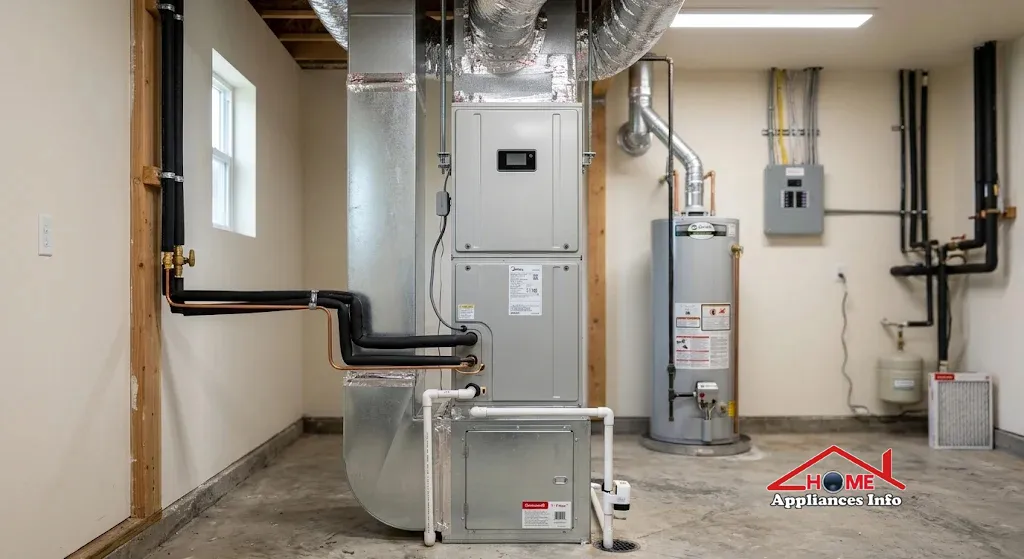
If you’re replacing an aging furnace or adding a heat pump to a home with existing ducts, a Midea air handler is one of the indoor units you’re likely to come across. It’s the indoor half of a split heat pump system: a cabinet holding a blower fan and a refrigerant coil that pushes heated or cooled air through your ductwork. Midea makes several different families of these units, and the details (capacity, sound level, warranty, which outdoor unit it pairs with) change from one family to the next.
This guide covers what these units do, which models exist, what the published specifications mean in practice, and what to ask before signing a quote. It relies on manufacturer documentation for technical facts and avoids repeating marketing claims as independent verdicts.
What Is a Midea Air Handler?
An air handler does no heating or cooling on its own. In summer, refrigerant flowing through its indoor coil absorbs heat from your home’s air. In winter, a heat pump reverses that flow, and the same coil releases heat into the air. The blower then moves that air through the ducts.
That makes it different from a gas furnace, which burns fuel to create heat. An air handler paired with a heat pump moves existing heat, which is why this setup is common in mild to moderate climates and in all-electric homes.
Midea’s North American residential products are largely developed through Carrier Midea North America, so a given model may be sold under more than one brand name. The D5FSAA, for example, appears in Tempstar’s catalog, and Heil lists it too. This affects how you shop. The hardware may be the same, but the warranty paperwork, dealer network, and parts channel can differ by brand. Midea’s reach also extends well beyond heating and cooling, into kitchen products such as the Midea smart refrigerator, so the brand name alone tells you little about any one product line. tempstarheil-hvac
How It Works With a Heat Pump
In a split system, the outdoor heat pump and the indoor air handler are linked by refrigerant lines and control wiring. On a cooling call, the outdoor unit sends cold refrigerant to the indoor coil, and the blower pulls warm room air across it. On a heating call, a reversing valve flips the direction, so the indoor coil becomes the warm side.
Most air handlers can also hold an electric heat kit, a set of resistance heating strips that supplements the heat pump during very cold weather or defrost cycles. If you’re in a cold climate, the question to ask isn’t just which air handler you’re buying but how the whole system will heat on your coldest nights.
Equipment matching matters here. An air handler is built for a particular refrigerant and a particular family of outdoor units, so it can’t be mixed with just any condenser. Midea’s current literature for its newer ducted line says the system supports only R-454B refrigerant, for example, which is one more reason to confirm compatibility in writing before purchase.
Seven Features Worth Understanding
The features below apply differently to different models, so treat each as something to confirm against the specific unit quoted to you.
1. Heating and cooling from one system. Paired with a compatible heat pump, a Midea air handler handles both seasons. The D5FUAA, for instance, is listed as connecting to the D5CUHA or D5CURA heat pump for single-zone applications. tempstar
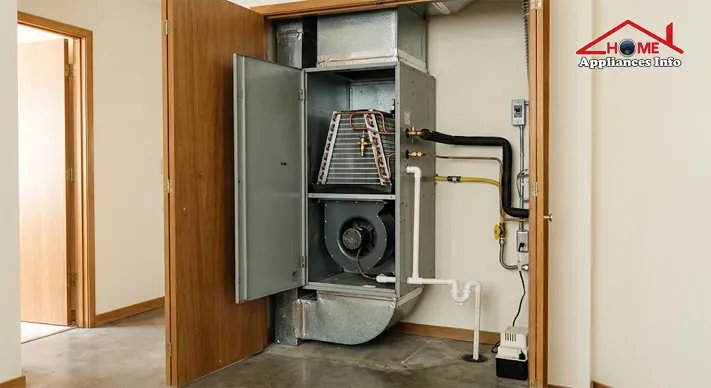
2. Flexible installation positions. Several models are multi-position units. The DLFSAB retailer listings describe upflow, downflow, horizontal-right and horizontal-left installation, which helps in closets, attics, basements and crawl spaces where a fixed orientation would not fit. Midea’s D5FUAA installation manual adds that its units are designed for up-flow, down-flow and horizontal orientations, including manufactured and mobile home applications. minisplitwarehouseshareddocs
3. Quiet indoor operation. Published sound figures are encouraging but need context. The D5FSAA lists sound as low as 25.5 decibels, and the D5FUAA carries the same figure. The footnote matters, though: the Payne listing for a related model says the number refers to the quietest size within each model group at low fan speed. Larger sizes at higher fan speeds will be louder. Duct design affects what you actually hear, too. heil-hvacpayne
4. Efficiency that depends on the pairing. An air handler doesn’t have its own standalone efficiency rating in the way a heat pump does. SEER2 and HSPF2 ratings belong to the combination. Midea’s Excel series literature, for example, cites up to 19 SEER2 and up to 10.8 HSPF2 when the 37MUHA heat pump is paired with the 45MUHA air handler. A different outdoor unit gives a different number. Ask your installer for the AHRI-certified rating of the exact combination. shareddocs
5. Airflow handling. Midea’s D5FUAA documentation states that all fan coils have a DC fan motor with variable speeds, and listings for related units mention total system static pressure up to 0.8 inches of water column. Static pressure is the resistance your ductwork puts on the blower. A unit that tolerates reasonable resistance is more forgiving in older or imperfect duct systems, but it won’t rescue badly undersized ducts.
6. Thermostat compatibility. Some units include a factory 24V interface for third-party thermostats. One retailer listing notes the requirement of a five-wire thermostat with at least R, C, G, Y and B connections. If you have a smart thermostat you like, check this before purchase rather than after.
7. Maintenance and corrosion features. Listings for the Advantage-series units mention an aluminum coil and an anti-corrosive fin coating. The D5FUAA also has a factory-installed refrigerant leak detection system, which is relevant given the newer, mildly flammable refrigerants now entering the market. cloudfrontheil-hvac
Midea Air Handler Models at a Glance
Because Midea sells several families, it helps to see them side by side. Specifications below come from the manufacturer and brand pages cited in this article; always confirm against the current spec sheet for the exact model number.
| Model family | Capacity | Notable points |
|---|---|---|
| D5FSAA | 1.5–3 tons | Horizontal or vertical installation; single or multi-zone; as low as 25.5 dB |
| D5FUAA | 1.5–5 tons | Single-zone; optional 5–25 kW heater; leak detection; as low as 25.5 dB |
| 45MUHA / Excel series | Varies by size | Compact (2-ton unit 14.5″ wide); R-454B only; indoor unit as low as 33 dB(A) |
| EVOX Gen2 | 1.5–5 tons (A-coil), 1.5–3 tons (ceiling-mounted) | As low as 30 dBA; Midea lists a 10-year compressor and parts warranty |
Please don’t carry a number from one row to another. The 25.5 dB figure belongs to the D5FSAA and D5FUAA, not to EVOX, and the warranty terms differ by line. Midea also lists an MVME variable-speed air handler, which I haven’t verified in detail, so check its current spec sheet directly if it’s on your shortlist.
Midea Air Handler Specifications Explained
Spec sheets are dense, so here’s how to read the lines that matter most.
Capacity (tons and BTU/h). One ton of cooling equals 12,000 BTU/h. A 1.5-ton unit delivers 18,000 BTU/h, a 2-ton unit 24,000, a 3-ton unit 36,000, and a 5-ton unit 60,000. Bigger isn’t better: an oversized system cycles on and off too quickly, handles humidity poorly, and costs more to run. The right size comes from a proper load calculation of your home, not from square footage rules of thumb.
Voltage and electrical requirements. Units vary: the D5FSAA lists 208/230V, while the D5FUAA is listed as 115/208/230V. This determines your circuit and wiring, so your electrician needs the exact data plate values.
Airflow and static pressure. Airflow is measured in cubic feet per minute (CFM), while external static pressure describes how hard the blower has to push against your ducts. Both should be matched to your duct system, not just the tonnage.
Refrigerant. Newer Midea lines are built around R-454B. Older listings, such as some DLFSAB-era packages, show R-410A. The air handler and outdoor unit must use the same refrigerant.
Auxiliary heat. Electric heat kits are optional. The D5FUAA lists an EHKMC auxiliary heater of 5 to 25 kW. heil-hvac
Midea Air Handler Reviews: Pros and Cons Based on Available Information
I haven’t tested these units, and I’m not going to invent homeowner feedback. What follows is an assessment based on published specifications and how the market tends to work.
Potential advantages. Multi-position installation makes these units adaptable to tight spaces. The range of capacities, from 1.5 to 5 tons, covers most residential needs. Quiet low-speed operation is a documented design target. And some models offer a path to replace a gas furnace in a ducted home while keeping existing ductwork. A Carrier-family listing for a related unit describes it as a way to replace outdated gas furnaces or complement traditional systems. carrier
Potential limitations. Compatibility is narrower than it looks: indoor and outdoor units must be matched. Ductwork modifications can add cost. Newer lines have shorter track records, and long-term reliability data for them is limited. That’s a normal feature of newer product lines, not evidence of a problem, but it’s a reason to ask your installer about local parts supply and service support before committing. And because the same hardware appears under several brand names, it’s worth asking which brand’s warranty and dealer network apply to your purchase.
One buyer-side caution: retailer pages sometimes display customer testimonials on product listings. Treat those as marketing material, not independent testing.
Midea Air Handler Installation Requirements
Choosing a Midea air handler involves more than matching a tonnage label to your house. A reasonable installation plan covers equipment pairing, duct sizing, airflow, electrical supply, condensate drainage, refrigerant piping, and manufacturer clearances.
Midea’s installation instructions, hosted by Carrier, open with safety considerations for installing, starting up and servicing air-conditioning equipment, and the wiring and refrigerant work involved can cause real hazards if done wrong. This is professional HVAC work. A licensed contractor should handle it, and doing so is also usually a condition of warranty coverage. You can read the full instructions in the D5FUAA installation manual. shareddocs
Some practical points to raise with an installer:
- Ask whether your existing ducts can handle the airflow the new unit needs, including a static pressure check.
- Ask how condensate will drain, and whether a secondary drain pan or float switch will be installed.
- Confirm the outdoor unit’s refrigerant and line-set requirements.
- Ask who commissions the system, and whether they check drainage and refrigerant connections at start-up.
Midea Air Handler Troubleshooting: What You Can Check and What You Can’t
Some problems have simple causes. Others need a technician. The table separates the two. Midea’s owner’s manuals for these models include their own troubleshooting sections, so consult the manual for your model’s fault indicators and error codes.
| Symptom | Safe homeowner checks | Call a professional if |
|---|---|---|
| Unit won’t start | Thermostat mode and setpoint, batteries, tripped breaker | It keeps tripping or has no power at the unit |
| Weak airflow or poor cooling | Dirty filter, blocked vents, closed registers | Airflow stays weak, or a coil is frozen |
| Unusual noise or vibration | Loose panels, debris near the unit | Grinding, squealing or rattling continues |
| Water around the unit | Clogged or disconnected drain, full drain pan | Leak persists, or refrigerant leakage is suspected |
| Fault indicators or shutdowns | Reset thermostat, check filter | Error codes repeat, or the control board is involved |
| Poor heating performance | Thermostat set to heat, filter clean | Heat pump or auxiliary heat is not engaging |
Refrigerant leaks, wiring faults, control-board issues and internal component failures should never be a DIY repair. Midea’s newer units include leak detection that raises an alert code, but once an alert appears, the correct response is to call a qualified technician.
Maintenance and Warranty Considerations
The routine maintenance is modest. Replace or clean the filter on the schedule your manual specifies, keep the area around the cabinet clear, and have a technician inspect the coil, drain line and electrical connections periodically. A neglected filter is the most common way a perfectly good system ends up underperforming.
For warranty, read the certificate for your exact model and brand. The published terms I found vary. Midea’s own Excel-series literature says ductless units are covered by a 10-year parts limited warranty upon timely registration, and the period is five years if not registered within 90 days. The Heil D5FSAA page lists a 10-year parts limited warranty and a five-year No Hassle Replacement warranty, while another brand page notes that other applications get 7-year parts and 7-year compressor coverage. Because terms depend on registration, application and brand, never assume. Register the equipment promptly, keep the installer’s paperwork, and get the exact terms in writing. 01 DLS 045 MD 01 +2
Also ask about labor. Most parts warranties do not cover the cost of the technician’s time, which is often the larger part of a repair bill.
Is a Midea Air Handler Worth Buying?
It can be, for the right home and the right installer. If you have workable ductwork, want a heat pump system, and value quiet operation and installation flexibility, the published specifications make these units worth a serious look. If your priority is the longest possible track record, or you live somewhere with few installers familiar with the brand, weigh that against the specs. For perspective on how the brand performs in other categories, a separate Midea induction cooker review is a useful side read, though kitchen appliances tell you nothing direct about HVAC reliability.
A simple checklist before you buy:
- The exact model numbers of the indoor and outdoor units, and their AHRI rating together.
- The refrigerant type, and confirmation both units match.
- A written load calculation and duct assessment.
- The warranty certificate for that model, including registration steps.
- Who will service it locally, and where replacement parts come from.
Compare at least two or three quotes. The same equipment can be priced very differently depending on the installer’s duct work, electrical upgrades and labor.
Frequently Asked Questions
Can a Midea air handler replace a gas furnace?
In many ducted homes, yes, when paired with a compatible heat pump. Cold-climate homes may need electric auxiliary heat or a dual-fuel arrangement. Your installer should size the system for your coldest design temperature, not an average day.
Is a Midea air handler compatible with any heat pump?
No. Air handlers are matched to specific outdoor units and refrigerants. Using a mismatched pair can reduce efficiency and may void warranty terms.
Are Midea air handlers loud?
Published figures describe quiet operation, with the 25.5 dB number applying to the quietest size at low fan speed. Real-world noise also depends on ductwork, installation and fan speed.
Can I install one myself?
It isn’t recommended. Electrical and refrigerant work requires qualified technicians, and improper installation can create safety hazards and affect warranty coverage.
How do I find error codes for my unit?
Check the owner’s manual for your exact model, which lists its fault indicators. Many Midea manuals are available through the manufacturer’s document libraries.
Does the same air handler appear under different brand names?
Some do. The D5FSAA, for example, appears in both Heil and Tempstar catalogs. Confirm which brand’s warranty applies to the unit you’re buying.
Final Thoughts
A Midea air handler is best judged as part of a complete system, not as a standalone appliance. Match it correctly with its outdoor unit, have the ductwork assessed, read the warranty for your specific model, and choose an installer who will still be around to service it. Start by requesting the exact model numbers from your contractor, then compare them with the manufacturer’s current spec sheets.
References
- Heil, “D5FSAA QuietComfort Air Handler” product page: https://www.heil-hvac.com/en/us/products/ductless-systems/d5fsaa
- Carrier/Midea, “D5FUAA Crossover Air Handler Installation Instructions”: https://www.shareddocs.com/hvac/docs/1009/Public/03/D5FUAA-03SI.pdf
- Carrier Midea North America, “01-DLS-045-MD-01” system features and warranty sheet: https://www.shareddocs.com/hvac/docs/1010/Public/00/01-DLS-045-MD-01.pdf

📱 SMART HOME TECHNOLOGY CONSULTANT & IOT SPECIALIST
Alfredo Torres
Technology Consultant | Smart Home Automation & IoT Specialist (Lima, Peru)

🌐 Matter Protocol & IoT
⚡ Energy Efficiency
🛠️ Future-Proofing Infrastructure
Alfredo Torres is a seasoned technology consultant based in Lima, Peru, specializing in the integration of next-generation IoT ecosystems and smart home automation. With over a decade of experience navigating the rapidly evolving tech landscape of the Global South, Alfredo brings a unique, practical perspective to homeappliancesinfo.com.
As a specialist in the 2026 Matter protocol rollout, Alfredo focuses on bridging the gap between legacy household infrastructure and modern connectivity standards. His consulting work centers on “future-proofing” homes—helping users select appliances that offer maximum durability, energy efficiency, and cross-platform compatibility without the burden of “app fatigue.”
Alfredo’s expert insights are grounded in real-world problem solving, from optimizing smart kitchen workflows to implementing cost-effective home maintenance solutions in emerging markets. When he isn’t benchmarking the latest AI-integrated appliances, he can be found exploring the intersection of sustainable architecture and digital living.