

To support our research and detailed appliance reviews, we may earn a small commission from qualifying purchases made through our links, at no extra cost to you. As an Amazon Associate, I earn from qualifying purchases.
To support our research and detailed appliance reviews, we may earn a small commission from qualifying purchases made through our links, at no extra cost to you. As an Amazon Associate, I earn from qualifying purchases.
You open the washer after a long cycle, find a drum of soaking clothes, and see UE blinking on the display. The Samsung washer UE error code rarely means the machine has failed. It means the washer sensed that the laundry had piled up unevenly inside the drum and stopped the spin rather than let an unstable load shake the cabinet. In most homes the repair takes a few minutes: open the door, spread the clothes out, and start the spin again. This guide covers what UE means, why it appears, seven fixes in a sensible order, and the signs that a technician should take a look.
What Does UE Mean on a Samsung Washer?
According to <a href=”https://www.samsung.com/in/support/home-appliances/how-to-fix-ue-ub-error-in-samsung-washing-machine”>Samsung India’s UE/UB troubleshooting guide</a>, the washer shows UE or UB when it detects an unbalanced load and stops the spin for safety reasons. During a spin, the drum accelerates to a high speed. If wet laundry has gathered on one side, the drum turns off-center, the whole machine begins to shake, and the washer halts the spin rather than carry on.
Think of a bicycle wheel with a lump of mud stuck to one side of the rim. At low speed you barely notice it, but at high speed the wheel wobbles. A washer drum behaves the same way, only with several kilograms of wet fabric in place of mud.
UE is a load-balance message first and a fault message second. That distinction matters because many people assume the motor or control board has died. In the majority of cases, nothing is broken at all. Samsung’s terminology does vary between models and regions, so if the code on your display differs slightly, the user manual for your exact model is the final word.
Why Is My Samsung Washer Showing a UE Error?
The common triggers fall into a handful of patterns:
- Bunched laundry. Wet towels, jeans, and sheets twist into a single mass that settles on one side of the drum.
- One heavy item. A lone bath mat, bathrobe, or pair of jeans has nothing to counterbalance it. Samsung’s support page for UE during the spin cycle notes that single large or heavy items such as bath mats or large towels are unlikely to spin properly on their own.
- Too small a load. A few light items can slide into one position and stay there.
- Overloading. A drum packed too tightly can’t redistribute clothes as it turns.
- A washer that isn’t level. Even a slight rock amplifies vibration, so a load that is only mildly uneven can trip the sensor.
- Bulky bedding. Comforters and blankets absorb a lot of water and tangle easily.
- A recurring mechanical issue. Worn suspension components or a sensor fault can cause UE even when the load looks perfect, though this is the less common explanation.
Drum design plays a part too. Front-loaders generally spin faster than top-loaders, which makes them more sensitive to an unlevel floor. If you’re curious how the two designs differ in vibration and noise, our comparison of <a href=”https://homeappliancesinfo.com/front-load-vs-top-load-washer-pros-cons/”>front load vs top load washer</a> designs covers it in plain terms.
How to Fix UE Error on Samsung Washer
The seven fixes below run from the quickest to the most diagnostic, so you can stop as soon as the error clears. The same steps apply to the broader family of Samsung washer unbalanced load error codes (Ub, UE, and similar), though button names and cycle names vary by model.
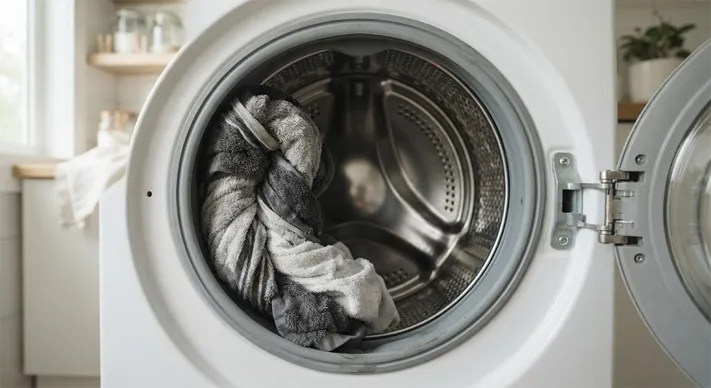
1. Redistribute the Laundry
This resolves most UE errors by itself.
- Pause the washer.
- Wait for the door or lid to unlock. This can take a minute or two.
- Open it and pull apart any clothes that have knotted together.
- Spread the items evenly around the drum, placing the heaviest ones opposite each other where you can.
- Close the door and restart the spin.
If the door stays locked and UE remains on the display, <a href=”https://www.samsung.com/ae/support/home-appliances/washing-machine-displays-a-ue-or-dc-error-code”>Samsung’s guidance for UE codes</a> suggests running a drain program. You do this by selecting the spin cycle and stepping the spin setting down to “no spin,” then letting the water drain before you open the door.
2. Add or Remove Items to Balance the Load
Rearranging the same clothes doesn’t always help, because the real problem is sometimes the mix of items. If you’re washing a single bulky piece, add a few towels so the weight has something to balance against. Samsung’s UE page suggests two or three extra towels for a lone heavy item. If the drum is overstuffed, take some items out and wash them separately. A very small load can also be unstable, so a couple of towels or similar items can steady it.
3. Check That the Washer Isn’t Overloaded
Samsung’s support material says the maximum capacity is usually listed on the control panel or in the user manual, and that you should avoid overloading. Clothes need room to tumble and shift position. A drum that looks full to the brim is usually too full for a stable spin, especially with towels or denim. As a rough habit, leave enough space that you could still move your hand freely through the laundry.
4. Make Sure the Washer Is Level
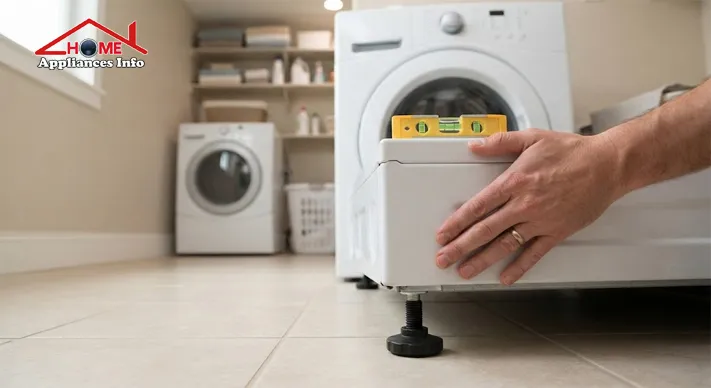
A washer that rocks, even slightly, can produce a UE code with a perfectly sensible load inside. Samsung’s <a href=”https://www.samsung.com/us/support/troubleshoot/TSG10007111″>troubleshooting page for a washer that shakes too much</a> walks through the main checks:
- Gently rock the machine from the corners and see whether it moves or wobbles.
- Confirm that every foot touches the floor.
- On front-loaders, release the locking nuts before adjusting the feet and tighten them again once the machine is level.
- On a front-loader, confirm the shipping bolts were removed, because leaving them in will cause heavy shaking.
For safety, switch the washer off and unplug it before you adjust anything, and avoid forcing the machine across the floor, since Samsung warns that excessive force can damage the leveling feet. Samsung India also notes that using a stand or trolley under the washer isn’t recommended, so don’t treat a makeshift platform as a solution.
5. Check the Selected Wash Cycle and Type of Laundry
Cycles are designed for different fabrics, and not every program treats the spin the same way. Bedding is the usual culprit. Samsung India’s UE guidance notes that washing bedding or bedding covers can lengthen the wash and reduce spin efficiency, and it lists lower recommended load limits for bedding covers on certain models. Those limits differ from model to model, so use the cycle and spin speed recommended in your manual for your washer, rather than a universal setting. Washing a comforter on its own, with nothing to balance it, is a classic recipe for UE.
6. Run a Spin or Rinse/Spin Cycle Again
Once you’ve balanced the load, give the washer a fresh attempt. Most models let you run a Spin or Rinse+Spin cycle on its own, which is faster than repeating the whole wash. The key is to run it after you’ve corrected the load. Restarting the same lopsided load repeatedly rarely fixes anything.
Some Samsung washers also use weight sensors that can be recalibrated. Samsung’s UE support page describes a manual calibration procedure for certain models, which requires an empty drum with nothing sitting on top of the machine. The button combination differs between models, so check your manual before trying it.
7. Check Whether the UE Error Keeps Returning
The last fix is really a diagnostic question: does UE appear with one particular load, or with nearly every load?
If it’s occasional, the cause is almost certainly load-related: bulky items, a lone heavy piece, or a very small or very large load. If it returns constantly, even with a small, balanced load and a washer you’ve confirmed is level, the cause may lie deeper in the machine. That’s the point at which repeated redistribution stops being useful and a professional inspection makes sense, which is covered further below.
Samsung Washer UE Error Fix: Quick Troubleshooting Table
| Likely cause | What to try |
|---|---|
| Clothes bunched together | Pause, open the door, spread the laundry out |
| One heavy item | Add a few towels or other items |
| Very small load | Add a couple of towels to the drum |
| Overloaded drum | Remove some laundry and wash it separately |
| Large bedding | Redistribute and use the cycle your manual recommends |
| Washer not level | Rock-test it and adjust the leveling feet |
| UE returns every time | Check the manual and contact Samsung support |
Why Does My Samsung Washer Show UE During the Spin?
The spin cycle is where UE appears because that’s when the drum reaches its highest speed and any imbalance becomes noticeable. The washer may pause, try again, or stop altogether, leaving the clothes dripping. That’s why a UE error and a washer that won’t spin often go hand in hand.
Before assuming the motor is at fault, work through the UE fixes first. It’s also worth ruling out other causes of a weak or missing spin. Samsung’s support pages note that a washer may not spin properly if the drum can’t drain completely, and that too much detergent can trigger a suds error. A drain-related code such as 5C usually points toward the drain hose or pump filter rather than a load problem.
Samsung UE vs Ub vs Ur: Are They the Same?
They overlap, but they aren’t identical in every case. UE and Ub are both widely used by Samsung for unbalanced-load conditions, and some regional pages group them together. Ur appears in the same part of some Samsung error-code lists, though at least one Samsung page describes it as an informational message rather than a fault, which hints at differences between models. Samsung’s codes aren’t perfectly uniform across every market, so if your display shows something that doesn’t match, consult your washer’s manual rather than assuming it means exactly the same as UE.
When Does a UE Error Require Professional Service?
A persistent UE can have several different causes, such as worn suspension parts or a faulty sensor, and the code alone can’t tell you which. Consider booking service if:
- UE returns repeatedly with properly balanced loads and a level machine
- The washer shakes severely even after leveling
- You hear grinding or banging from the drum
- The washer stops mid-spin no matter what you wash
- The problem began suddenly and continues after you’ve worked through the basic checks
If the machine is older and the quote for repair is high, that’s the time to weigh repair against replacement. Our <a href=”https://homeappliancesinfo.com/washing-machine-buying-guide-top-3-advised/”>washing machine buying guide</a> can help you compare options.
A few safety points apply throughout:
- Unplug the washer before you adjust or inspect anything physical.
- Never bypass a door or lid lock.
- Don’t open electrical panels unless you’re qualified.
- If you notice a burning smell, smoke, damaged wiring, or severe mechanical noise, stop using the machine and call a professional.
How to Prevent the Samsung Washer UE Error
A few habits keep the error from coming back:
- Mix large and small items in the same load so the weight spreads out.
- Avoid washing a single bulky item alone, and pair it with a few towels.
- Stay within the capacity listed in your manual.
- Shake out and separate towels and sheets before loading them.
- Recheck the leveling every so often, especially after moving the machine or cleaning behind it.
Frequently Asked Questions
Can I just keep restarting the cycle until it works?
It’s tempting, but a lopsided load usually stays lopsided. Open the washer, fix the distribution, and then restart. Repeated restarts only add wear and delay.
Is it safe to keep using my Samsung washer after a UE error?
The error is a protective response, because the washer stops the spin instead of running an unstable drum. Using the machine again after correcting the load is normal. If UE keeps recurring or the machine shakes violently, stop and have it checked.
Does UE mean I need a new washer?
Not usually. Most UE errors come from the load or the installation, and neither requires replacement. Replacement only enters the conversation if a technician finds a fault that costs more to repair than it’s worth.
What if the door won’t open when UE appears?
The door often stays locked until the drum has stopped and drained. If it doesn’t unlock, running a drain program, as described in Samsung’s UE guidance, is the standard route. Don’t force the door.
Why does UE only happen with towels or bedding?
Both soak up large amounts of water and clump into heavy masses. They’re the loads most likely to unbalance the drum, which is why the same machine can run jeans and shirts without trouble.
Conclusion
The Samsung washer UE error code is the machine’s way of saying the load isn’t balanced, and in most households a few quick checks put it right. Start by redistributing the laundry, then adjust the load size, confirm the washer is level, and run the spin again. If UE keeps returning with balanced loads on a machine you’ve confirmed is level, it’s time to consult the manual and contact Samsung support rather than keep rearranging towels.
References
- Samsung India, “How to fix UE / UB error in Samsung washing machine” (updated Feb 2026): https://www.samsung.com/in/support/home-appliances/how-to-fix-ue-ub-error-in-samsung-washing-machine
- Samsung, “My Samsung washing machine is showing a UE code during a spin cycle. What can I do?”: https://www.samsung.com/ae/support/home-appliances/washing-machine-displays-a-ue-or-dc-error-code
- Samsung US, “Samsung washing machine is shaking too much”: https://www.samsung.com/us/support/troubleshoot/TSG10007111

📱 SMART HOME TECHNOLOGY CONSULTANT & IOT SPECIALIST
Alfredo Torres
Technology Consultant | Smart Home Automation & IoT Specialist (Lima, Peru)

🌐 Matter Protocol & IoT
⚡ Energy Efficiency
🛠️ Future-Proofing Infrastructure
Alfredo Torres is a seasoned technology consultant based in Lima, Peru, specializing in the integration of next-generation IoT ecosystems and smart home automation. With over a decade of experience navigating the rapidly evolving tech landscape of the Global South, Alfredo brings a unique, practical perspective to homeappliancesinfo.com.
As a specialist in the 2026 Matter protocol rollout, Alfredo focuses on bridging the gap between legacy household infrastructure and modern connectivity standards. His consulting work centers on “future-proofing” homes—helping users select appliances that offer maximum durability, energy efficiency, and cross-platform compatibility without the burden of “app fatigue.”
Alfredo’s expert insights are grounded in real-world problem solving, from optimizing smart kitchen workflows to implementing cost-effective home maintenance solutions in emerging markets. When he isn’t benchmarking the latest AI-integrated appliances, he can be found exploring the intersection of sustainable architecture and digital living.