

To support our research and detailed appliance reviews, we may earn a small commission from qualifying purchases made through our links, at no extra cost to you. As an Amazon Associate, I earn from qualifying purchases.
To support our research and detailed appliance reviews, we may earn a small commission from qualifying purchases made through our links, at no extra cost to you. As an Amazon Associate, I earn from qualifying purchases.
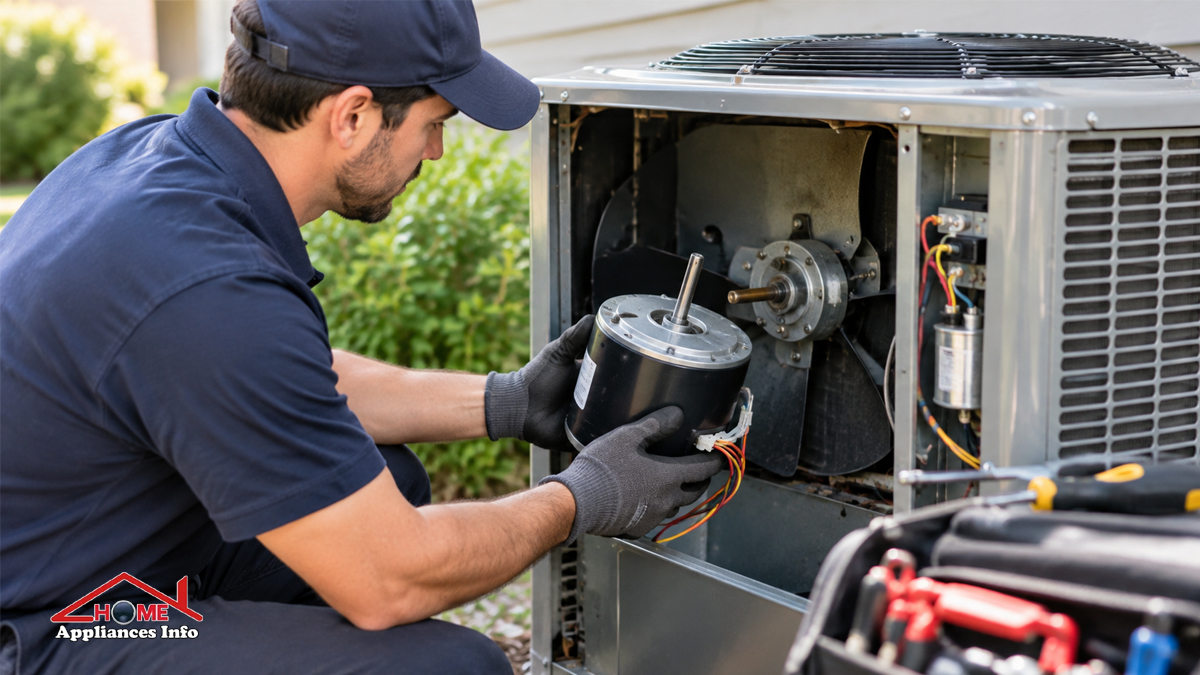
An air conditioner can run for years without much attention, but when a fan stops spinning, airflow becomes weak, or the unit starts making a strange humming or grinding sound, the motor may be part of the problem. Air conditioning motor replacement can sometimes restore normal operation without replacing the entire AC system—but the first challenge is identifying which motor has failed and whether the motor is actually the cause.
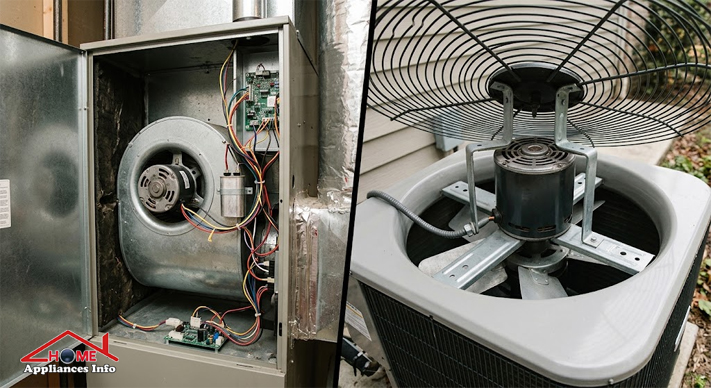
Most central air conditioners have two motors homeowners are likely to encounter. The indoor blower motor moves conditioned air through the home’s ductwork, while the outdoor condenser fan motor moves air across the condenser coil so heat can be released outside. Their symptoms and replacement procedures are different.
Just as importantly, a fan that refuses to run does not automatically mean the motor is bad. A failed capacitor, wiring fault, contactor, control problem, or mechanical obstruction can produce similar symptoms. Carrier specifically lists capacitors, motors and compressors among possible causes of outdoor-unit problems and warns that electrical troubleshooting involves high-voltage components.
This guide explains how to identify the likely fault, what replacement can cost, how to test a motor safely with a multimeter, and the six main steps involved in replacing a compatible motor.
What Is Air Conditioning Motor Replacement?
The motors in a central AC system perform different jobs.
Indoor blower motor
The AC blower motor powers the indoor blower assembly. It pushes cooled air through the evaporator section and into the home’s ductwork and rooms.
A failing blower motor may cause:
- Weak airflow from the vents
- Little or no air movement
- Humming or unusual mechanical noise
- Intermittent operation
- Overheating or repeated shutdowns
- An AC that appears to run but does not distribute air properly
The indoor blower is sometimes called a fan motor, but it should not be confused with the outdoor condenser fan motor.
Outdoor condenser fan motor
The condenser fan motor drives the fan in the outdoor unit. Its job is to move air through the outdoor condenser coil so heat can leave the refrigeration system.
A typical outdoor condensing unit contains the condenser coil, compressor, condenser fan and associated controls. If the outdoor fan stops, the system can lose its ability to reject heat properly. Carrier notes that a non-spinning outdoor fan can be associated with a faulty capacitor, motor or compressor, which is why diagnosis matters before ordering parts.
Signs You May Need an AC Motor Replacement
The symptoms of a failing motor depend on whether you are dealing with the indoor or outdoor assembly.
Common air conditioner motor symptoms include:
- A fan that does not spin
- Slow or intermittent startup
- Weak airflow from indoor vents
- Humming, buzzing, grinding or squealing
- A motor that becomes unusually hot
- An outdoor unit that runs while its fan remains still
- Warm air from the vents
- Repeated shutdowns
- Burning odors or visibly overheated wiring
- A fan that struggles to start
- Increasingly poor cooling performance
If the outdoor fan is not spinning, however, resist the temptation to immediately buy a new motor. Carrier identifies a faulty capacitor, motor or compressor as possible causes of a malfunctioning condensing unit.
For example, a weak or failed AC fan motor capacitor can prevent a motor from starting even though the motor itself may still be serviceable. A humming fan is therefore a symptom, not a diagnosis.
Should You Replace the Motor or the Whole AC?
Motor replacement usually makes more sense when the rest of the system remains in reasonable condition.
Consider repairing the motor when:
- The compressor is functioning normally.
- The coils and refrigerant circuit do not have major problems.
- The motor has been confirmed as defective.
- A compatible replacement is readily available.
- The system is not already experiencing repeated major failures.
A much older system may require a broader cost-benefit decision. If the motor, compressor, controls and other major components are approaching the end of their service life, repeatedly repairing individual parts may not be the most economical long-term choice.
The age of the system should not be the only deciding factor, though. A relatively young AC with a failed motor can still be a sensible repair, particularly if the motor is covered by a warranty.
AC Blower Motor Replacement Cost in 2026
If you are researching ac blower motor replacement cost, current U.S. consumer cost data provides a useful reference point.
Angi’s July 2026 data puts the average HVAC blower motor replacement cost at about $560, although actual projects vary significantly. Its published ranges show that motor type, horsepower, speed control, accessibility and labor can move the price substantially higher or lower.
HomeAdvisor’s June 2026 data similarly reports an average of about $560, with many blower motor replacements falling around $300–$900 before unusual circumstances push the total higher.
These are U.S. reference prices, not universal prices. Local labor rates and parts availability can make a major difference in other countries.
| Cost factor | Why it matters |
|---|---|
| Motor type | PSC, ECM and variable-speed designs have different prices |
| Horsepower | Larger motors generally cost more |
| Voltage | The replacement must match the system’s electrical requirements |
| Speed | Multi-speed and variable-speed motors can cost more |
| OEM vs. aftermarket | OEM components may carry a higher price |
| Accessibility | Difficult-to-reach air handlers can increase labor |
| Diagnostic fee | Some companies charge separately for diagnosis |
| Emergency service | After-hours work can increase the final bill |
Condenser fan motor replacement is a separate cost category. HomeAdvisor’s current data puts AC fan motor replacement at roughly $100–$700, with an average around $500, while Angi’s 2026 data reports a broader potential range of approximately $60–$1,200 depending on the situation.
That wide range is a useful reminder: do not compare a quote solely against an online average. Ask what motor is being installed, whether the capacitor or other parts are included, and how much labor and diagnosis cost.
Before You Start: AC Motor Replacement Safety
This is where a seemingly simple repair becomes more serious.
Central AC equipment can contain hazardous electrical voltages, and electrical components may retain stored energy. OSHA’s electrical-safety requirements emphasize de-energizing equipment before work and verifying that electrical parts are actually de-energized.
Before opening an AC cabinet:
- Turn the thermostat off.
- Disconnect the appropriate electrical power source.
- Follow the manufacturer’s shutdown procedure.
- Verify that power is actually absent before touching exposed electrical components.
- Never work on energized wiring unless you are properly qualified and equipped.
- Do not bypass safety controls.
- Do not open the refrigerant circuit or handle refrigerant.
- Stop if you are unsure about electrical isolation or testing.
Carrier specifically advises against homeowner troubleshooting of high-voltage electrical components in the outdoor condenser.
This is why the six steps below should not be interpreted as a beginner’s invitation to work inside every HVAC system. Mechanical replacement on a straightforward, properly isolated assembly is different from diagnosing live high-voltage circuitry.
How to Test AC Motor With a Multimeter
If you are searching for how to test AC motor with multimeter, the most important principle is simple: resistance testing should be performed on an appropriately isolated, de-energized motor.
1. Disconnect power
Do not use a resistance setting on a powered circuit. Isolate the equipment and verify the de-energized condition before proceeding. OSHA requires appropriate verification rather than assuming that switching a control to “off” means the equipment is electrically safe.
2. Identify the motor terminals
Use the motor’s label, wiring diagram and manufacturer documentation. Do not guess which terminals are which.
3. Inspect the wiring first
Look for:
- Burnt terminals
- Loose connections
- Corroded contacts
- Melted insulation
- Damaged connectors
- Signs of overheating
A damaged wire can create symptoms that look like a failed motor.
4. Measure winding resistance
With the motor appropriately isolated from the circuit, use the multimeter’s resistance function to measure the relevant winding circuits.
There is no universal resistance number that means “good motor.” Motor construction, winding configuration and manufacturer specifications all affect expected readings.
The useful comparison is therefore the manufacturer’s specification—not an arbitrary number found online.
5. Check for an unwanted path to ground
Where the motor design and test procedure allow it, an appropriately isolated winding can be checked for an unintended electrical path to the motor frame or ground.
If the result indicates a winding-to-ground fault, the motor may be damaged.
6. Interpret the measurement with the symptoms
A multimeter reading should be treated as one piece of the diagnosis.
A capacitor, control problem, wiring fault, bearing problem or mechanical obstruction can cause similar symptoms. If the diagnosis is uncertain, professional HVAC testing is safer than replacing expensive components by trial and error.
How to Replace AC Fan Motor DIY: 6 Steps
The exact procedure differs between manufacturers and between indoor and outdoor assemblies. The following six steps provide a practical framework rather than a universal wiring diagram.
Step 1: Confirm the Motor Is Actually the Problem
Before buying a replacement, determine which motor is involved.
Ask:
- Is it the indoor blower or outdoor condenser fan?
- Does the motor receive the correct electrical supply when properly tested?
- Is the capacitor defective?
- Is the wiring intact?
- Is the motor mechanically seized?
- Is the control system operating correctly?
- Are there signs of overheating?
This diagnostic stage can save you from spending hundreds of dollars on a motor that was never the real problem.
Step 2: Record the Old Motor’s Specifications
Photograph the motor label before removing anything.
Record:
- Manufacturer
- Model or part number
- Horsepower
- Voltage
- RPM
- Frequency
- Rotation direction
- Number of speeds
- Frame size
- Capacitor requirement
- Shaft dimensions
- Mounting configuration
Do not buy a replacement simply because it physically fits.
The electrical and mechanical specifications need to be compatible with the HVAC system.
For example, two motors can have similar dimensions but different voltage, RPM, horsepower, speed-control or rotation requirements. Installing the wrong motor can produce poor airflow, overheating, incorrect fan operation or other problems.
Step 3: Shut Off Power and Access the Motor
Turn off the thermostat and disconnect the appropriate power source.
Before disconnecting wires, photograph their original positions. If appropriate, label them according to the manufacturer’s wiring diagram.
Outdoor condenser motors may be mounted to a fan assembly on the top of the cabinet. Indoor blower motors may sit inside a furnace or air handler and can have considerably different access arrangements.
Do not assume that one online wiring diagram applies to every HVAC system.
Step 4: Remove the Failed Motor
The removal method depends on the equipment.
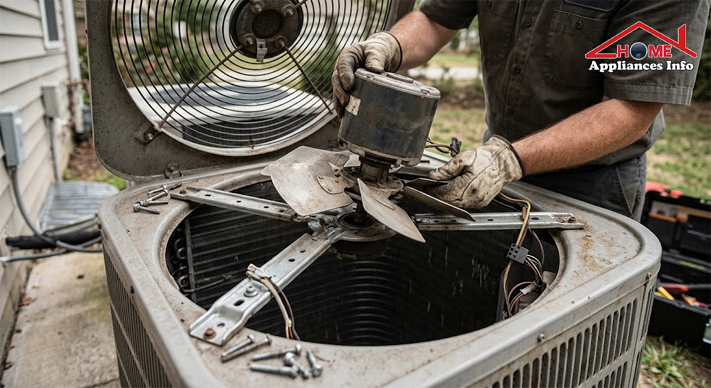
For an outdoor condenser fan motor, the general mechanical process may involve removing the fan assembly, disconnecting the motor wiring, separating the fan blade from the motor shaft and removing the motor mounting hardware.
For an indoor blower motor, the blower assembly may need to be removed before the motor can be separated from the blower wheel.
Keep track of brackets, washers, spacers and mounting hardware.
Most importantly, do not force the fan blade or blower wheel off the shaft. Excessive force can bend the blade or damage the wheel, creating vibration after installation.
Step 5: Install and Wire the Replacement Motor
Before installation, compare the new motor against the old motor’s specifications.
Check:
- Voltage
- Horsepower
- RPM
- Rotation
- Speed configuration
- Capacitor requirements
- Shaft size
- Mounting arrangement
Follow the manufacturer’s wiring diagram exactly.
This is particularly important with multi-speed motors. A generic internet wiring diagram is not an adequate substitute for the diagram supplied for your motor and HVAC system.
After securing the motor, reinstall the fan blade or blower wheel correctly. Rotate the assembly by hand, where appropriate, to check that it moves freely without rubbing.
Step 6: Test the System
Once the assembly is completely reinstalled and all required panels and guards are back in place, restore power according to the manufacturer’s procedure.
Then:
- Set the thermostat to cooling.
- Observe startup.
- Listen for abnormal sounds.
- Check that the fan rotates correctly.
- Check indoor airflow.
- Watch for excessive vibration.
- Confirm that the outdoor fan operates normally.
- Confirm that the AC actually produces cooling.
A successful repair is not simply a motor that spins.
The system should operate normally without abnormal noise, vibration, overheating or repeated shutdowns.
Signs the Condenser Fan Motor Is Bad—or Something Else
The same symptom can have several possible causes.
| Symptom | Possible causes |
|---|---|
| Outdoor fan completely dead | Motor, capacitor, wiring, contactor or control issue |
| Fan hums but does not start | Capacitor, motor or mechanical problem |
| Fan spins slowly | Motor, capacitor, voltage or mechanical issue |
| Fan starts and stops | Motor overheating, capacitor or control problem |
| Grinding noise | Bearing or mechanical damage |
| Outdoor unit becomes excessively hot | Fan/airflow problem or another system fault |
| AC blows warm air | Several possible causes, including outdoor-unit problems |
| Fan works but compressor does not | Compressor, control or electrical problem |
This is why AC motor troubleshooting should begin with diagnosis rather than parts replacement.
Carrier’s troubleshooting guidance similarly warns that a non-working outdoor fan can involve more than the motor itself.
DIY or HVAC Professional?
A capable DIYer may be comfortable with a straightforward mechanical replacement when the exact replacement motor is known, the equipment is safely isolated and no energized electrical diagnosis is required.
Professional HVAC help is the better choice when:
- High-voltage diagnosis is required.
- You are unsure how to safely isolate the equipment.
- Capacitor testing or replacement is beyond your training.
- Wiring is burnt or damaged.
- The motor is ECM or variable-speed and requires specialized diagnosis.
- The compressor may be involved.
- Refrigerant work is required.
- The system repeatedly trips a breaker.
- You cannot confidently identify the correct motor.
- There is evidence of electrical burning.
Carrier recommends professional assistance for complex electrical and refrigerant-related problems.
If you simply need an additional household-airflow option during a repair, HomeAppliancesInfo.com’s guide to AC/DC fans and their power requirements provides related information about smaller fan systems.
How to Save Money on Motor Replacement
You do not necessarily need to choose the cheapest motor or the cheapest contractor. The goal is to avoid paying for unnecessary work.
Get the specifications before shopping
The motor’s label is more useful than the AC brand alone. Record the complete part and electrical information.
Compare OEM and compatible motors
A compatible aftermarket motor may cost less, but compatibility needs to be verified rather than assumed from physical size.
Diagnose before replacing
A relatively inexpensive capacitor can mimic a motor failure. Replacing the motor first can turn a small repair into an unnecessarily expensive one.
Request an itemized quote
Ask the HVAC company to separate:
- Diagnostic charge
- Motor cost
- Capacitor cost
- Labor
- Service fees
- Other required parts
Consider the condition of the entire system
If the AC is already experiencing compressor, coil, control or repeated electrical failures, discuss the bigger picture before spending more money on another component.
Common Motor Replacement Mistakes to Avoid
Avoid these common errors:
- Assuming a dead fan automatically means the motor is bad
- Buying a motor based only on horsepower
- Ignoring RPM or rotation direction
- Installing the wrong capacitor
- Guessing at AC motor wiring
- Working on energized equipment
- Failing to photograph wiring before disconnection
- Forcing a fan blade off the motor shaft
- Ignoring abnormal vibration after installation
- Continuing to run an AC with a failed outdoor fan
- Attempting refrigerant work without appropriate training and authorization
A failed outdoor fan can affect the system’s ability to reject heat. Continuing to operate a malfunctioning AC can therefore turn a relatively contained problem into a more serious repair.
Frequently Asked Questions
1. How much does AC blower motor replacement cost?
Current U.S. consumer cost data puts the average around $560, although actual prices vary considerably. Angi reports an average of $560 for blower motor replacement, while HomeAdvisor likewise reports about $560 and a typical range around $300–$900. Motor type, horsepower, accessibility, labor and warranty coverage can all change the final price.
2. What are the signs an AC condenser fan motor is bad?
A non-spinning outdoor fan, slow operation, unusual buzzing or grinding, overheating and intermittent startup can all point toward a condenser fan motor problem. However, a failed capacitor, wiring fault or another component can create similar symptoms, so these signs do not prove the motor has failed.
3. How do you test an AC motor with a multimeter?
With the equipment safely de-energized and the motor appropriately isolated, a multimeter can be used to measure winding resistance and, where appropriate, check for an unintended path to ground. Compare the results with the manufacturer’s specifications rather than relying on a universal resistance value.
4. Can I replace an AC fan motor myself?
Sometimes. An experienced DIYer may be able to handle a straightforward motor replacement after proper power isolation, but central AC equipment can contain hazardous electrical components. If diagnosis involves energized circuits, unfamiliar wiring, capacitors or refrigerant work, professional service is the safer choice.
5. How do I know whether the capacitor or motor is bad?
The symptoms often overlap. A fan that hums without starting, for example, can have a capacitor problem or a motor problem. Proper electrical testing and comparison with the manufacturer’s specifications are more reliable than diagnosing the component solely from the fan’s behavior.
6. Is replacing an AC motor cheaper than replacing the whole unit?
Usually, replacing one failed motor is a much smaller repair than replacing an entire HVAC system. Whether it is financially sensible depends on the system’s age, condition, efficiency, warranty status and the number of other components that may soon require repair.
Conclusion
Air conditioning motor replacement can be a practical repair when the motor is genuinely the failed component and the rest of the system remains in good condition. The key is not simply learning how to remove and install a motor; it is learning how to distinguish a motor problem from a capacitor, wiring, control or mechanical problem.
For homeowners, the safest approach is to identify whether the problem involves the indoor blower or outdoor condenser fan, record the original motor’s specifications, isolate electrical power properly and avoid energized troubleshooting unless you are qualified to perform it.
If the diagnosis is uncertain—or if the repair exposes you to high-voltage electrical components—calling an HVAC professional is usually a better decision than replacing parts by trial and error.
References
- Carrier — “Troubleshoot an Air Conditioner: 6 Steps to Fix an AC Not Working” — guidance on condenser-unit symptoms, motors, capacitors, compressors and when professional service is required.
- U.S. Occupational Safety and Health Administration (OSHA) — “1910.333: Selection and Use of Work Practices” — electrical de-energization and verification requirements.
- Angi — “How Much Does a Blower Motor Replacement Cost? [2026 Data]” — current U.S. consumer cost estimates and factors affecting blower motor replacement pricing.
E4 Error Code Fix: Ultimate Guide to air conditioner Repair

📱 SMART HOME TECHNOLOGY CONSULTANT & IOT SPECIALIST
Alfredo Torres
Technology Consultant | Smart Home Automation & IoT Specialist (Lima, Peru)

🌐 Matter Protocol & IoT
⚡ Energy Efficiency
🛠️ Future-Proofing Infrastructure
Alfredo Torres is a seasoned technology consultant based in Lima, Peru, specializing in the integration of next-generation IoT ecosystems and smart home automation. With over a decade of experience navigating the rapidly evolving tech landscape of the Global South, Alfredo brings a unique, practical perspective to homeappliancesinfo.com.
As a specialist in the 2026 Matter protocol rollout, Alfredo focuses on bridging the gap between legacy household infrastructure and modern connectivity standards. His consulting work centers on “future-proofing” homes—helping users select appliances that offer maximum durability, energy efficiency, and cross-platform compatibility without the burden of “app fatigue.”
Alfredo’s expert insights are grounded in real-world problem solving, from optimizing smart kitchen workflows to implementing cost-effective home maintenance solutions in emerging markets. When he isn’t benchmarking the latest AI-integrated appliances, he can be found exploring the intersection of sustainable architecture and digital living.