

To support our research and detailed appliance reviews, we may earn a small commission from qualifying purchases made through our links, at no extra cost to you. As an Amazon Associate, I earn from qualifying purchases.
To support our research and detailed appliance reviews, we may earn a small commission from qualifying purchases made through our links, at no extra cost to you. As an Amazon Associate, I earn from qualifying purchases.
If you are weighing an induction vs electric cooktop for your kitchen, the short answer is this: induction usually heats faster, wastes less energy, and responds more precisely to adjustments, while a conventional radiant electric cooktop usually costs less and works with almost any flat-bottomed pan. Neither is the right choice for everyone. The better pick depends on the cookware you own, your budget, your wiring, and how you cook.
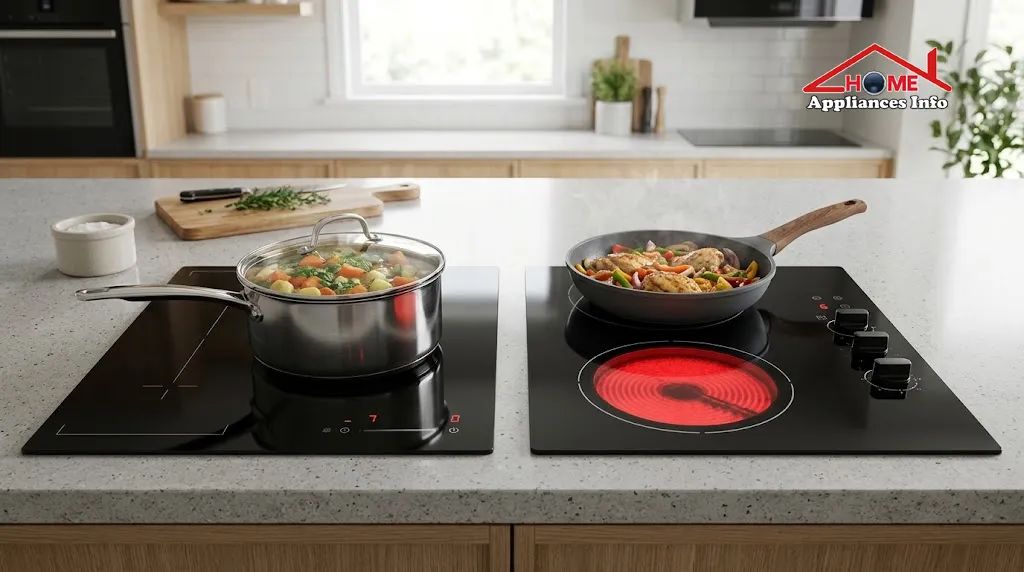
The confusion is understandable. Both are electric, both usually have a smooth glass-ceramic top, and from across the room they look nearly identical. The difference is in how the heat is made, and that one difference shapes almost everything else: speed, efficiency, safety, cleaning, and cost.
How the two technologies actually work
Understanding the mechanism makes the rest of the comparison easier to follow.
How an induction cooktop works
Beneath the glass of an induction cooktop sits a coil of copper wire. When you switch on a zone, electricity passes through the coil and creates a rapidly alternating magnetic field. Place a compatible pan on the surface and that field induces electrical currents in the metal of the pan itself. The pan’s resistance to those currents turns them into heat. In other words, the cookware becomes the heating element. The glass is not heated directly, though it warms up from contact with the hot pan.
A cooktop also needs sensors to detect whether a pan is present and whether it is suitable, plus power electronics that control how much energy goes into the coil. This is why an induction zone does nothing if you set a glass dish on it.
How a radiant electric cooktop works
A radiant electric cooktop, sometimes just called a ceramic or smooth-top electric cooktop, works the older way. A resistance element beneath the glass heats up, often glowing red, and passes that heat through the glass to the pan by conduction and radiation. The pan then warms the food.
Induction is itself an electric technology, so “induction vs electric” is shorthand. Throughout this article, “electric cooktop” means a radiant resistance model, which is what shoppers usually mean when they compare induction vs ceramic cooktops.
Seven key differences
1. Cooking speed and responsiveness
Because induction creates heat in the pan rather than beneath it, there is no element to warm up first. Water reaches a boil quickly, and when you turn the dial down, the heat drops almost immediately. This is most noticeable when you move from a hard sear to a gentle simmer, or when a sauce threatens to boil over.
A radiant element has to heat up before the pan benefits, and it keeps radiating heat for a while after you turn it off. For slow braises and steady simmering, that retained heat is not a drawback. For recipes that demand quick changes, it can be frustrating.
Real performance varies by model. A well-built radiant cooktop can feel more controllable than a poorly designed induction unit, so brand reputation and reviews matter as much as the technology.
2. Energy efficiency and electricity use
This is the comparison many shoppers care about most, so it deserves a careful answer. When it comes to induction vs electric cooktop energy efficiency, the U.S. Environmental Protection Agency’s ENERGY STAR program states that conventional gas and resistance cooking tops transfer energy at roughly 32% and 75–80% efficiency, while induction transfers energy at approximately 85%. The same program describes induction as about 5–10% more efficient than conventional electric resistance units and about three times more efficient than gas. energystarenergystar
| Cooking technology | Approximate energy-transfer efficiency |
|---|---|
| Induction | About 85% |
| Radiant electric (resistance) | About 75–80% |
| Gas | About 32% |
Source: ENERGY STAR, Emerging Technology Award for Residential Induction Cooking Tops. These are approximations, and real results depend on pan size, cookware, and cooking habits.
Two things are worth keeping in mind. First, the gap between induction and radiant electric is smaller than the gap between either one and gas. Anyone coming from gas will see a much larger change than someone replacing an electric cooktop. If you are still weighing flame cooking, our review of 36-inch gas stoves covers that side of the decision.
Second, efficiency does not translate into a fixed percentage off your bill. Your savings depend on how often you cook, local electricity prices, and how well your pans match the zones. ENERGY STAR also notes a secondary benefit: because less heat escapes into the room, there is less load on the HVAC equipment, which can matter in a small or hot kitchen.
3. Cookware compatibility
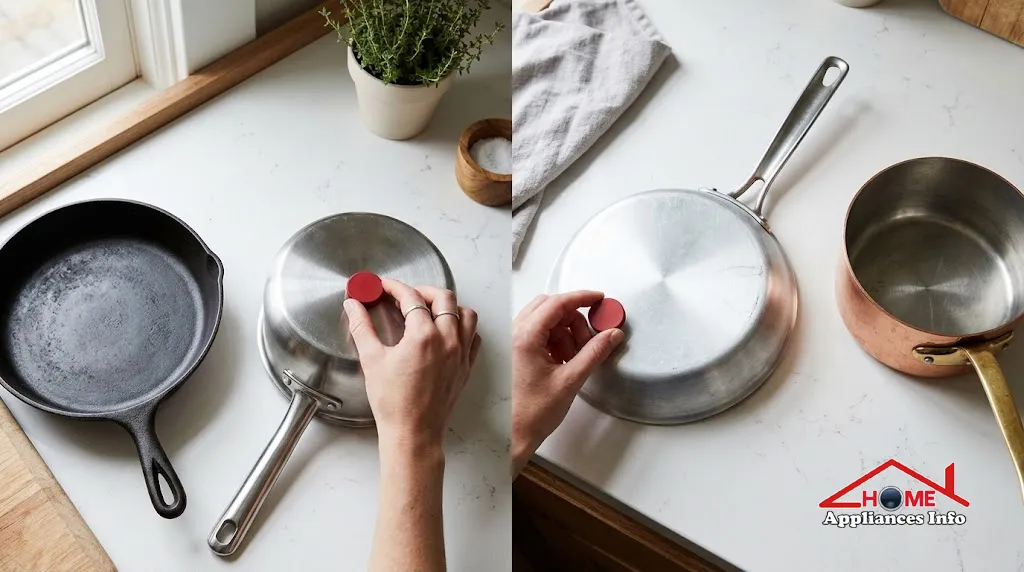
This is the difference that surprises people most, and it is where an induction vs electric cooktop pros and cons list tends to pivot. Induction requires cookware made of, or containing, a magnetic (ferromagnetic) metal. The U.S. Department of Housing and Urban Development’s induction cooking guide says that cookware is induction-compatible if a magnet will stick to it. pnnl
That gives you a free test: hold a refrigerator magnet to the bottom of a pan. If it clings firmly, the pan will generally work. If it does not, it will not heat.
Pans that usually work on induction:
- Cast iron
- Enameled cast iron
- Many stainless steel pans with a magnetic base
- Carbon steel
Pans that usually do not, unless they have a magnetic layer bonded to the base:
- Aluminum
- Copper
- Glass
- Ceramic
Stainless steel is where people get caught out, because grades differ. Some are magnetic, some are not, and the label “induction ready” on the packaging is more reliable than guessing from appearance. Many pan makers now include an induction symbol on the base.
A radiant electric cooktop is far more forgiving. Nearly any flat-bottomed pan works, including aluminum and copper. The pan should be flat and smooth for good contact, and heavy cast iron should be handled carefully on glass. Our guide to choosing pans for a glass-top stove goes through what to look for, and much of it applies to induction too.
4. Temperature control
Induction offers fine electronic control over power, which suits delicate work like melting chocolate or holding a sauce just below a simmer. Some models cycle power on and off at very low settings, and in a few designs that can make extremely gentle, continuous low heat harder to maintain. If low-and-slow cooking is central to how you cook, check reviews for that specific behaviour.
A radiant cooktop heats and cools more gradually. That lag makes it less nimble, though it can be reassuring for steady simmering, because the element’s stored heat smooths out fluctuations.
5. Safety
Neither type uses a flame, and that removes combustion and open-fire concerns. Beyond that, the two differ in how hot the surface gets. ENERGY STAR notes that because the heat originates in the cookware, the cooking top surface remains cool to the touch relative to other types, and it describes induction as safer to work with than other cooktops. That should be read as “cooler”, not “cold”: the glass still absorbs heat from a hot pan, and a burn is still possible. energystar
Many induction models add useful extras, such as automatic pan detection, which stops the zone from heating when no pan is present, along with timers, child locks, and residual heat indicators. Radiant models often include hot-surface indicators as well, and the glass stays dangerously hot for some time after cooking, which matters in households with small children or older relatives.
Features differ by brand, so compare specifications rather than assuming. No cooktop is burn-proof.
6. Cleaning and maintenance
Both are smooth glass-ceramic surfaces that wipe clean easily, and both can be scratched by abrasive pads or rough-bottomed pans. The practical difference is residual heat. On a radiant cooktop, a spill can land on a very hot surface and bake on, leaving a stubborn film. On induction, the glass is typically cooler, so spills are less likely to burn on immediately, although a splash under a hot pan can still bake onto the glass from the pan’s heat.
For either type, let the surface cool, wipe with a soft cloth and a cleaner approved for glass-ceramic, and avoid scouring pads. Follow your manufacturer’s care instructions, because warranty terms sometimes depend on it.
7. Price, installation, and long-term cost
Induction cooktops usually cost more upfront than comparable radiant models, though prices vary widely by brand, size, and features. Add the possible cost of replacing pans, and the initial outlay can climb further.
| Factor | Induction | Radiant electric |
|---|---|---|
| Purchase price | Often higher | Often lower |
| Energy efficiency | Generally higher | Generally lower |
| Cookware | May need replacing | Usually reusable |
| Installation | Check circuit and wiring | Check circuit and wiring |
| Running cost | Can be lower | Can be higher |
Whether the efficiency advantage repays the higher price depends on local tariffs and cooking habits, so it would be wrong to promise a payback period. A household that cooks every day in a region with expensive electricity has more to gain than one that cooks occasionally where power is cheap.
Installation deserves attention before you buy. Both types draw substantial power, and the circuit capacity, breaker rating, voltage, and manufacturer instructions all need to match. Wiring questions are best handled by a qualified electrician, and local codes vary. Ventilation also matters regardless of cooktop type, because steam, grease, and cooking odors still need somewhere to go. If you are updating the whole cooking area, our guide to choosing an under-cabinet range hood explains ducted and ductless options.
Warranty length, spare-part availability, and local repair service are easy to overlook, but they affect long-term value just as much as the sticker price.
Induction vs electric cooktop pros and cons
Induction
Advantages: faster heating, higher energy-transfer efficiency, quick response to adjustments, a cooler surface than radiant electric, no open flame, and relatively easy cleanup.
Drawbacks: needs magnetic cookware, often costs more upfront, may need suitable electrical supply, and some models produce fan or buzzing noise.
Radiant electric
Advantages: works with most flat-bottomed pans, often more affordable, no open flame, and a smooth surface that suits everyday cooking.
Drawbacks: slower heating and cooling, somewhat lower efficiency, a surface that stays hot after use, and spills that can bake on.
Induction cooktop vs electric stove: matching the choice to how you cook
Some cooking habits point clearly toward one type:
| If you mostly… | Likely better fit |
|---|---|
| Boil water or stir-fry quickly | Induction |
| Change heat levels often | Induction |
| Own mixed cookware, including aluminum or copper | Radiant electric |
| Want the lowest purchase price | Radiant electric |
| Cook steady, slow simmered dishes | Either |
Someone who prepares quick weeknight meals and adjusts heat constantly will probably appreciate induction. Someone with a large set of non-magnetic pans who wants a straightforward appliance at a lower price may be happier with radiant electric, at least until their pans need replacing anyway.
There is also a middle route. Some appliances combine induction zones with radiant zones on one surface, so you can use magnetic pans on one side and other cookware on the other. These are hybrid products rather than part of the standard comparison, but they suit households that are moving gradually.
Specialist induction units designed for round-bottomed woks also exist. Standard flat induction cooktops generally need flat-bottomed pans, so do not assume any induction cooktop will handle a traditional wok.
Which one should you choose?
Choose induction if you want faster cooking, you value efficiency and a cooler surface, you adjust heat often, and you are comfortable buying or already own compatible cookware.
Choose a conventional electric cooktop if upfront cost matters most, your current pans are non-magnetic, and you are content with slower heating.
One last factor is local conditions. Where voltage fluctuates or electricity is costly or unreliable, check how well each appliance copes with your supply and ask an electrician or the retailer before you commit. Both types depend on a stable, adequate connection.
Frequently asked questions
Is induction worth the extra money?
It can be, particularly if you cook often, want quick response, and either own magnetic pans or plan to replace yours. If you cook only occasionally and own non-magnetic cookware, the extra spend may take a long time to justify.
Can I use my existing pans on induction?
Only if they are magnetic. Hold a magnet to the base. Cast iron and many stainless steel pans pass; plain aluminum, copper, and glass do not.
Does induction need special wiring?
Some models do. Wattage and local electrical rules determine whether you need a dedicated circuit or a particular breaker, so check the manufacturer’s installation sheet and speak to an electrician.
Is an induction surface completely safe to touch?
No. It is generally cooler than a radiant surface, but heat from the pan warms the glass, and burns remain possible. Use the residual heat indicator and keep children supervised.
Will induction lower my electricity bill?
Probably a little, since it transfers energy more efficiently, but the amount depends on your tariff and habits. Treat any promised percentage with caution.
Which is easier to clean?
Both are easy to wipe. Induction often has an edge because spills are less likely to bake on instantly, though neither is maintenance-free.
Final thoughts
The induction vs electric cooktop decision comes down to trade-offs, not a clear winner. Induction rewards you with speed, efficiency, and responsive control, but asks for compatible pans and usually a higher price. A radiant electric cooktop gives up some performance in return for flexibility and a lower cost.
A practical next step is to do the magnet test on your current cookware and check your kitchen’s circuit capacity. Those two answers often settle the question before you ever look at a price tag.
References
- ENERGY STAR (U.S. EPA), “2021–2022 Residential Induction Cooking Tops,” Emerging Technology Award page. https://www.energystar.gov/partner_resources/products_partner_resources/brand-owner/eta-consumers/res-induction-cooking-tops
- U.S. Department of Housing and Urban Development / Pacific Northwest National Laboratory, “Induction Cooking” poster (May 2024). https://basc.pnnl.gov/sites/default/files/resource/HUD-Induction%20Cooking_HUD%20Poster%20TG%20SG_5-30-24.pdf

🍳 HOME & KITCHEN APPLIANCE EXPERT
Sidra Altaf
Home & Kitchen Specialist | Product Evaluator & Appliance Reviewer

🏠 Home Essentials
⚖️ Product Comparisons
⚡ Energy & Efficiency
Sidra Altaf is a seasoned expert in home and kitchen appliances with over 5 years of hands-on experience in the field. Passionate about helping families make smarter choices, she specializes in reviewing, comparing, and recommending appliances that bring convenience, efficiency, and innovation into everyday living. Her deep knowledge of product functionality, durability, and design makes her a trusted voice for anyone looking to upgrade their home.