


To support our research and detailed appliance reviews, we may earn a small commission from qualifying purchases made through our links, at no extra cost to you. As an Amazon Associate, I earn from qualifying purchases.
To support our research and detailed appliance reviews, we may earn a small commission from qualifying purchases made through our links, at no extra cost to you. As an Amazon Associate, I earn from qualifying purchases.
Dark kitchen counters can make simple tasks surprisingly difficult. Chopping vegetables, reading food labels, or measuring ingredients becomes harder when upper cabinets block overhead light.
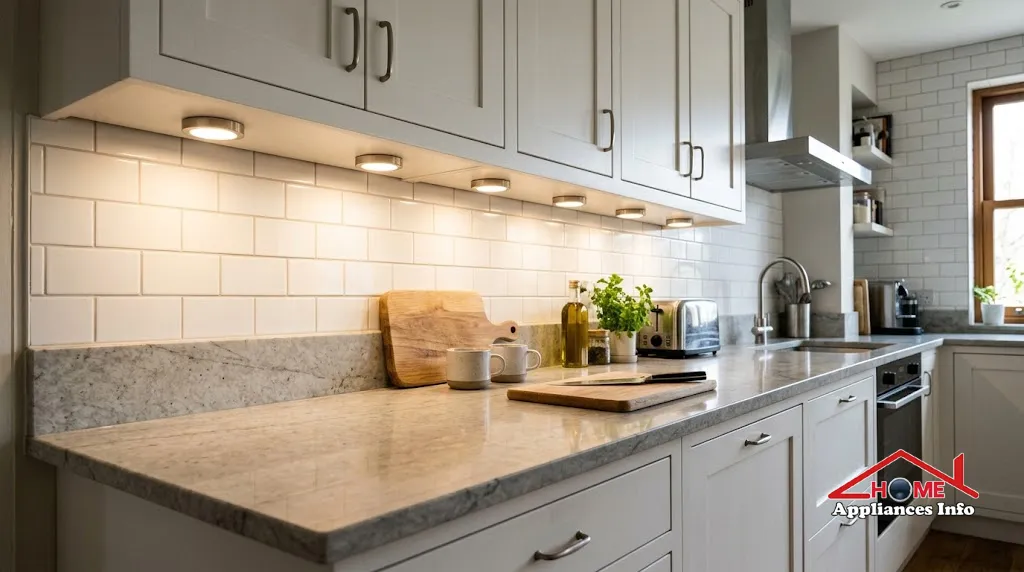
That is where LED puck lights earn their place. These compact, round fixtures direct focused light onto worktops, shelves, display cabinets, wardrobes, and other shadowy areas. Unlike LED strips, puck lights create individual pools of illumination, giving a kitchen a more intentional, layered appearance.
However, not every puck light suits every home. Renters may need adhesive-mounted wireless lights. Homeowners renovating a kitchen may prefer recessed fixtures with hidden wiring. Others simply want bright, dependable lighting without replacing batteries every week.
I compared current product specifications, installation methods, output levels, controls, warranties, and published hands-on evaluations. I did not physically test every model listed below, so I have avoided making unsupported testing claims. The recommendations are based on transparent product research and practical installation criteria.
This guide will help you choose the right lights, plan their spacing, and understand how to install LED puck lights under cabinets safely. For a complete layered kitchen design, you can also combine them with Pendant Lights for Kitchen over an island or dining area.
Quick Comparison of the Best LED Puck Lights
| Product | Best For | Power Source | Light Output | Key Controls | Installation Difficulty |
|---|---|---|---|---|---|
| Enbrighten Linkable LED Pucks | Best overall | Plug-in or convertible | 230 lumens per puck | Five colour temperatures | Easy to moderate |
| Utilitech Rechargeable Puck Kit | Best wireless option | Rechargeable | 40 lumens per puck | Remote, motion, timer | Easy |
| Brilliant Evolution BRRC134 | Best battery remote model | AA batteries | 55 lumens per puck | Remote, dimmer, timer | Easy |
| PowerBee Rechargeable Pucks | Best bright rechargeable option | USB-C rechargeable | 200 lumens per puck | Remote, dimming, timer | Easy |
| Armacost Dot LED Puck | Best recessed option | 12V low voltage | 100 lumens per puck | Compatible dimmer | Moderate |
| Good Earth USB Puck Kit | Best hybrid system | USB or power bank | 80 lumens per puck | Controller, dimming, timer | Easy |
| GE Wireless LED Puck Lights | Best basic budget option | Replaceable batteries | 20 lumens per puck | Tap control | Easy |
Product specifications and availability were checked in July 2026. Retail listings, model availability, and package contents can change, so confirm the latest details before ordering.
Best LED Puck Lights Reviewed
1. Enbrighten Linkable LED Puck Lights: Best Overall
The Enbrighten three-puck system offers one of the strongest balances of brightness, flexibility, and colour quality.
Each puck produces 230 lumens, giving the three-light kit a combined output of 690 lumens. That is enough for meaningful countertop illumination rather than a faint decorative glow. You can also select colour temperatures from 2700K to 6500K and link up to 40 compatible pucks.
The fixtures support both surface and recessed mounting. They plug into a standard outlet, while compatible accessories can convert them into a hardwired, dimmable system. A CRI of 93 makes food, countertops, timber, and cabinet finishes appear more natural.
Pros
- High output for kitchen tasks
- Five selectable white temperatures
- Surface or recessed installation
- High colour-rendering performance
Cons
- Cables must be concealed
- Full dimming requires additional compatible equipment
2. Utilitech Rechargeable Puck Kit: Best Wireless Under Cabinet Puck Lights
These wireless under cabinet puck lights are designed for people who want flexible controls without replacing disposable batteries.
The four-puck kit includes a charging station, magnetic mounts, remote control, adjustable white settings, timers, and two motion-sensing modes. The remote works from up to 20 feet away, while the magnetic mounting system lets you remove each light for charging.
The main limitation is output. At 40 lumens per puck, these lights work well for pantries, shelves, night lighting, and supplementary counter lighting. They are less suitable as the only source of serious food-preparation light.
Best for: Renters, closets, pantries and occasional kitchen use.
3. Brilliant Evolution BRRC134: Best Battery Operated LED Puck Lights With Remote
For a straightforward disposable-battery system, the Brilliant Evolution BRRC134 remains a practical choice.
Each puck produces 55 lumens of 3000K warm-white light. The remote offers dimming, four timer settings and a range of up to 15 feet. You can also press the lens manually, which matters when the remote disappears into a kitchen drawer.
The manufacturer states that each unit can operate for up to 100 hours using three AA batteries, although real runtime will depend on brightness and usage patterns.
These battery operated LED puck lights with remote are convenient for short daily sessions. For several hours of continuous task lighting, a plug-in system will usually be more economical.
4. PowerBee Rechargeable Pucks: Best Bright Rechargeable Option
Many rechargeable puck lights sacrifice brightness to extend battery life. PowerBee takes a different approach, reporting output of 200 lumens per light.
The lights include USB-C charging, magnetic mounting, remote operation, white colour-temperature settings, RGB modes, five brightness levels and timer controls. The stated runtime is up to eight hours at full brightness, with longer performance at reduced output.
I would consider these for renters who need brighter wireless lighting but do not mind charging the fixtures regularly. They are more suitable for intermittent use than all-evening kitchen lighting.
5. Armacost Dot LED Puck: Best Recessed LED Puck Lights for Kitchen Cabinets
The Armacost Dot is a compact option for permanent kitchen cabinet lighting.
It can be recessed into cabinetry or installed on the surface. The fixture produces 100 lumens at 2700K, has a CRI of 90, and operates from a compatible 12V power supply. It is also dimmable when paired with the manufacturer’s appropriate controller.
These recessed LED puck lights for kitchen cabinets suit custom cabinets, glass displays and renovation projects where cables can be hidden. Their 1.4-inch diameter is useful when a standard three-inch fixture would look bulky.
Never connect a 12V fixture directly to household line voltage. The light requires a compatible driver or power supply.
6. Good Earth USB Puck Kit: Best Hybrid-Power System
The Good Earth RE1342 kit offers three power arrangements: USB, an included 4000mAh power bank, or a suitable 5V adapter.
Each puck provides 80 lumens at 3000K. The three lights link together and can be dimmed to 10%. The included power bank provides a stated runtime of up to 6.5 hours, making this a useful middle ground between wired and completely independent battery lights.
The downside is that the pucks are connected by cables. They are wireless only in the sense that the power bank can operate without a wall outlet.
7. GE Wireless LED Puck Lights: Best Basic Budget Option
GE wireless pucks are simple tap-controlled lights with no remote, app, timer or colour settings.
Independent hands-on evaluation measured them at approximately 20 lumens per light. That makes them more appropriate for cupboard shelves, pet-feeding areas and gentle supplementary lighting than demanding kitchen tasks. Testers also reported that the included adhesive could be unreliable on some cabinet surfaces.
Their simplicity is the attraction. There is less to configure, and each light can be controlled independently.
What Are LED Puck Lights?
LED puck lights are small, round fixtures shaped roughly like an ice-hockey puck. They produce concentrated circles of light rather than the continuous line created by LED tape or bars.
They work particularly well for:
- Short cabinet sections
- Display shelves and glass-front cabinets
- Kitchen preparation zones
- Bookcases and wardrobes
- Workbenches and home offices
- Decorative accent lighting
Think of each fixture as a small spotlight. One creates a bright circle. Several correctly spaced fixtures allow those circles to overlap, producing more consistent LED task lighting.
A similar layered-lighting approach can be applied to hallways and staircases through Stunning Stair Light Solutions, where low-profile fixtures improve both appearance and visibility.
Types of LED Puck Lights
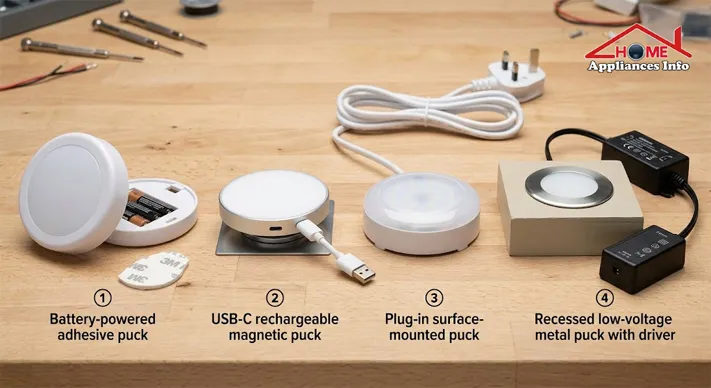
Battery-Powered Lights
Battery lights require no outlet or electrical wiring. Installation may take only a few minutes, but ongoing battery costs can become significant.
They are best for occasional use, rental properties and areas where running a cable is impractical.
Rechargeable Lights
Rechargeable models reduce disposable-battery waste. Most attach magnetically, allowing the light to be removed for charging.
Check the charging connector, full-power runtime and whether several lights can be charged simultaneously.
Plug-In Low-Voltage Lights
Plug-in models provide consistent brightness without modifying household wiring. They normally connect to an adapter or driver, so cable management becomes the main installation challenge.
Hardwired and Low-Voltage Lights
Hardwired systems provide the cleanest permanent finish. Many low voltage puck lights require a 12V or 24V driver that converts household electricity into the correct operating voltage.
Professional installation may be appropriate when household wiring, new switches or electrical permits are involved.
How to Choose LED Puck Lights
Start With Lumens, Not Marketing Words
Terms such as “ultra-bright” are subjective. Lumens provide a measurable comparison.
Lowe’s suggests approximately 80–200 total lumens for mood lighting, 200–500 lumens for accent or task lighting, and 500–1,000 lumens where under-cabinet fixtures serve as a major light source. These figures describe the combined lighting arrangement, not necessarily one puck.
A six-puck system producing 40 lumens each provides 240 total lumens. A three-puck system producing 230 lumens each provides 690.
For broader guidance, Lowe’s offers a useful under cabinet lighting overview covering fixture styles, placement, brightness and colour temperature.
Choose the Right Colour Temperature
The Kelvin rating describes whether white light looks warm or cool:
- 2700K–3000K: Warm and decorative
- 3000K–3500K: Comfortable warm-neutral light
- 3500K–4000K: Clear light for everyday kitchen tasks
- 5000K and above: Cooler daylight appearance
In most kitchens, 3000K to 4000K creates a practical balance. Match new fixtures with existing ceiling lights and pendants so the room does not contain conflicting shades of white.
Check the Colour Rendering Index
CRI indicates how naturally colours appear beneath a light source. ENERGY STAR lighting specifications use 80 CRI as a minimum benchmark.
I recommend looking for:
- CRI 80 or higher for ordinary cupboards and utility areas
- CRI 90 or higher for food preparation, premium cabinetry, artwork and displays
Consider Beam Angle and Diffusion
A narrow beam creates dramatic spotlighting but may leave dark gaps. A wider beam overlaps more easily.
Glossy countertops also reflect individual LEDs more strongly. A frosted diffuser can soften the light and reduce distracting reflections.
Evaluate the Controls
Useful control options include:
- Dimming
- Remote control
- Tap operation
- Motion or door sensors
- Timers
- Group control
- Brightness memory
- Wall switches
Remote control cabinet lights should also have a manual button. Otherwise, losing the remote can make basic operation frustrating.
How to Install LED Puck Lights Under Cabinets
Learning how to install LED puck lights under cabinets begins with planning. Avoid attaching every light permanently before seeing how the beams interact with your countertop.
Step 1: Measure Each Cabinet Section
Measure every uninterrupted cabinet run. Treat sinks, windows, cookers, refrigerators, range hoods and corner cabinets as separate zones.
Step 2: Calculate the Required Output
Multiply the lumens per puck by the number of fixtures.
For example, five 80-lumen pucks create a theoretical total of 400 lumens. Actual countertop brightness will also depend on mounting height, beam angle and surface colour.
Step 3: Test the Position
Temporarily hold each fixture beneath the cabinet using painter’s tape. Switch the lights on and inspect the room from standing and seated positions.
Check for:
- Glare from exposed LEDs
- Reflections on polished stone
- Dark spaces between beams
- Shadows across the work surface
- Fixtures visible from across the room
Puck lights usually perform well near the front of the cabinet, just behind the face frame, with light directed toward the backsplash. Lowe’s recommends this position as a way to improve useful coverage and reduce glare.
Step 4: Mark Consistent Spacing
Eight to twelve inches is a common starting point, but it is not a universal rule. Brighter fixtures and wider beams can be placed farther apart.
Test the actual product before drilling. Your eyes will reveal uneven pools faster than a measuring tape.
Step 5: Prepare the Surface
For adhesive mounting:
- Remove grease, dust and residue.
- Let the surface dry completely.
- Press the mounting plate firmly into place.
- Allow the adhesive to bond before attaching the light.
Adhesive can struggle on textured, dusty, oily or heat-exposed surfaces. Screws are usually more dependable for permanent installation.
Step 6: Install Surface-Mounted Puck Lights
Attach the adhesive plate, magnetic disc or screw-mounted base.
Keep charging ports and battery doors accessible. A puck light should not need to be removed from its adhesive every time its batteries require attention.
Step 7: Install Recessed Lights
For recessed fixtures:
- Confirm the required cut-out diameter.
- Check cabinet thickness and fixture depth.
- Look for shelves, joints and concealed hardware.
- Mark the centre of each cut-out.
- Drill a small pilot hole.
- Use the manufacturer-approved hole saw.
- Feed the low-voltage cable through the opening.
- Connect the fixture to the correct driver or distribution hub.
- Test the complete system before pressing the fixture into place.
A detailed professional overview of how to install LED puck lights under cabinets can help you determine when an electrician or cabinet installer may be needed. Angi’s July 9, 2026 guidance recommends professional assistance when the installer is not confident working with household wiring.
Step 8: Conceal the Wiring
Use cable clips, slim channels, cabinet cavities or a light valance. Keep drivers, connection hubs and power supplies accessible for future replacement.
Step 9: Test Every Function
Confirm that all lights:
- Switch on consistently
- Dim without flickering
- Respond to remotes and sensors
- Display matching colour temperatures
- Produce overlapping illumination
- Remember settings where applicable
LED Puck Lights vs. LED Strip Lights
| Choose Puck Lights When You Want | Choose Strip Lights When You Want |
| Focused pools of light | Continuous illumination |
| Independent fixture placement | Fewer bright and dark zones |
| Lighting inside separate cabinets | Coverage across long cabinet runs |
| A traditional spotlight effect | A modern linear appearance |
| Surface or recessed fixtures | Flexible tape around corners |
Puck lights add visual rhythm. Strip lights prioritise uniformity.
For long, uninterrupted countertops, strips often provide smoother coverage. For individual shelves, short cabinets and display areas, puck lights give you greater control over each illuminated zone.
Common Problems and Troubleshooting
Lights Keep Falling
Clean away grease before replacing the adhesive. Consider magnetic plates with stronger mounting strips or use screws where permitted.
The Remote Does Not Work
Check the remote battery and operating range. Infrared remotes may require a direct line of sight, while radio-frequency controls are generally less restrictive.
Some Lights Look Dimmer
Replace or recharge all batteries together. Mixed charge levels create inconsistent output across the cabinet run.
The Lights Flicker
Flickering wired fixtures may indicate an incompatible dimmer, overloaded driver, loose connection or unsuitable power supply.
For basic component troubleshooting, How to Repair LED Bulb can help explain common LED failures. Integrated puck fixtures, however, may need complete replacement rather than internal repair.
Dark Gaps Appear Between Pucks
Move the fixtures closer together or choose a wider beam. Adding more low-output lights often creates better uniformity than relying on a few narrow, intense spots.
Frequently Asked Questions
Are LED puck lights good for kitchen cabinets?
Yes. They work well for short cabinet runs, focused preparation areas and display cabinets. Select sufficient lumens if they will be used as practical LED task lighting rather than decoration.
How many LED puck lights do I need?
Calculate the desired combined output, then check the manufacturer’s recommended spacing. Many installations begin with one puck every 8–12 inches, but output and beam width matter more than a fixed rule.
Are wireless under cabinet puck lights bright enough for cooking?
Some are. Look for measured lumens and add the output of the complete set. Low-output wireless models may work better as night lights or supplementary illumination.
Do recessed LED puck lights need a transformer?
Many recessed fixtures operate at 12V or 24V and require a compatible driver or transformer. Battery-powered lights do not. Never assume an older halogen transformer will work correctly with LEDs.
Can I leave rechargeable puck lights on all day?
You can, but frequent continuous use means frequent charging. Plug-in or hardwired dimmable puck lights are usually more practical for several hours of daily operation.
Can puck lights work with pendant lighting?
Yes. Puck lights illuminate countertops while Pendant Lights for Kitchen provide broader light over islands or dining spaces. Matching their colour temperatures creates a more cohesive room.
Final Verdict
The best LED puck lights depend on how you use the space.
Choose rechargeable or wireless fixtures for rentals, wardrobes and quick upgrades. Choose battery-operated remote models for occasional convenience. Use plug-in lights when you need dependable brightness without modifying household wiring. Select recessed low-voltage systems for a permanent, professionally integrated result.
My strongest overall recommendation is the Enbrighten linkable system because it combines high output, adjustable colour temperature, strong colour rendering and flexible installation. The Utilitech kit is more suitable when wireless convenience and motion sensing matter most. For custom cabinetry, the Armacost Dot offers a discreet recessed appearance.
Measure first. Test the beams. Compare actual lumens. Then choose the system that supports both the appearance of your kitchen and the way you use it every day.

🌐 FOUNDER & DIGITAL PUBLISHER
Muhammad Ali
Founder | SEO Strategist & E-E-A-T Digital Publishing Specialist

📈 SEO Strategy
🛠️ Appliance Optimization
🛡️ E-E-A-T Standards
Muhammad Ali is a digital publisher, SEO strategist, and founder of Home Appliances Info. He specializes in home appliance optimization, structured schema networks, and advanced E-E-A-T digital publishing standards to ensure accurate, trustworthy content across the platform.