

To support our research and detailed appliance reviews, we may earn a small commission from qualifying purchases made through our links, at no extra cost to you. As an Amazon Associate, I earn from qualifying purchases.
To support our research and detailed appliance reviews, we may earn a small commission from qualifying purchases made through our links, at no extra cost to you. As an Amazon Associate, I earn from qualifying purchases.
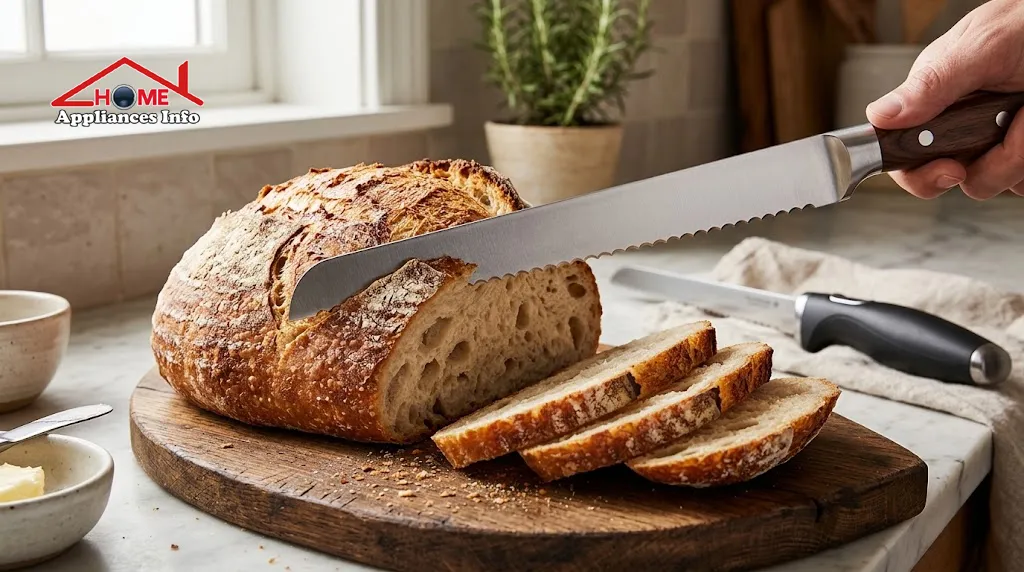
Few kitchen moments are as deflating as spending two days on a sourdough boule and then flattening it with the wrong knife. The crust skids, the crumb compresses, and the slice comes off ragged. A good bread knife prevents almost all of that. For most home bakers, the practical answer is a 9–10 inch serrated knife with a handle that sits above the cutting edge. The Mercer Culinary Millennia 10-inch is the value pick and the Victorinox Fibrox the dependable everyday option. An electric knife is worth considering only if repeated sawing is genuinely a problem for you.
This guide explains why those picks hold up, how manual and electric slicers compare, and how to cut a loaf without crushing it.
One note on method: the recommendations below draw on published testing from Food Network Kitchen and The Perfect Loaf, plus manufacturer details. They are not hands-on tests by this site.
Quick Picks: The Best Bread Knife at a Glance
- Best value: Mercer Culinary Millennia 10-inch wavy-edge knife
- Best everyday workhorse: Victorinox Fibrox 10¼-inch
- Best premium comparison: Wüsthof Classic
- Best luxury pick: Shun Classic 9-inch
- Worth comparing: Kai Wasabi 9-inch, a Japanese-style alternative
- Best electric starting points: Proctor Silex Easy-Slice (corded) or Elite Gourmet Cordless Easy-Slice
Food Network’s 2026 review of bread knives tested ten models on Roma tomatoes, crusty sourdough, soft challah, cantaloupe and watermelon. It named the Victorinox best overall, the Kai Wasabi another favorite, the Mercer best value and the Shun Classic best splurge. The Perfect Loaf, a long-running sourdough site, updated its main recommendation to the Mercer on June 23, 2026. Its previous pick, a Kai knife, had been repeatedly out of stock.
What Makes a Good Bread Knife?
A bread knife is a kitchen knife with a serrated edge, meaning a row of small teeth. Unlike a straight-edged chef’s knife, which chops down through food, it saws back and forth. The points bite into a firm crust, and the scooped gaps between them slice the softer crumb, so you don’t need much downward pressure.
Blade length and serration design
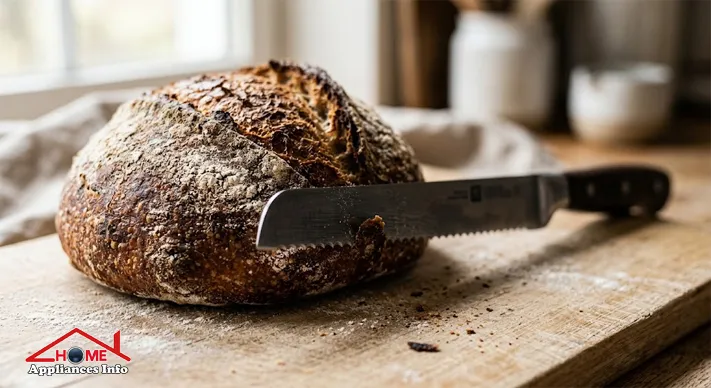
Blade length matters more than most buyers expect. A blade at least as long as the loaf is wide lets you cut across in long, steady strokes without twisting the knife mid-slice. The Perfect Loaf sets a minimum of about 7 inches and favors 8–9 inch blades. For large boules and wide artisan loaves, 9–10 inches is a sensible starting point. A shorter knife can work for small loaves or tight storage, but it makes you work harder on big ones.
Serration style is less settled. Food Network’s testers liked the Victorinox’s curved, rounded serrations because they cut smoothly without tearing. The Perfect Loaf prefers pointed teeth with scooped gaps, which bite crisp crusts well. No single tooth pattern wins for every loaf, so match it to the bread you bake most. Thick, hard crusts reward pointed teeth, while soft sandwich loaves are usually fine with gentler ones.
Steel, handle comfort, and balance
Good bread knives come in stainless and high-carbon stainless steel, and the steel type alone tells you little about quality. Edge retention, corrosion resistance and manufacturer specifications matter more, and so does sharpness out of the box.
The handle deserves as much attention as the blade. You’ll make dozens of sawing strokes per loaf, so a secure, non-slip grip is worth having. Also look for clearance: a handle set above the cutting edge, or an offset design, keeps your knuckles off the board when you cut through the bottom crust. The Perfect Loaf lists this as a must-have, and it is one of the cheapest ways to avoid scraped knuckles.
Best Bread Knife Recommendations for 2026
| Knife | Blade length | Role in this guide | Evidence |
|---|---|---|---|
| Mercer Culinary Millennia M23210 | 10 in. | Best value | Food Network best value; Perfect Loaf top pick (June 2026) |
| Victorinox Fibrox | 10¼ in. | Everyday workhorse | Food Network best overall |
| Wüsthof Classic | Varies by model | Premium comparison | Appears in other buying guides; not in Food Network’s top four |
| Kai Wasabi | 9 in. | Japanese-style alternative | Food Network “another favorite” |
| Shun Classic | 9 in. | Luxury pick | Food Network best splurge |
Prices change often, so check current retailer listings before buying.
Best value: Mercer Culinary Millennia
The Mercer is the knife to start with if you want sourdough-ready performance without paying premium-knife prices. It has a 10-inch wavy-edge blade made of high-carbon steel and a textured, non-slip handle. The Perfect Loaf says it offers sharp cutting, durability and an offset handle at a modest price, and it moved the knife to the top of its sourdough list in 2026.
The trade-off is polish. It is a plain working knife, and the handle won’t feel as refined as a forged premium blade.
Best everyday option: Victorinox Fibrox
Food Network’s testers found the Victorinox one of the most consistent knives in the group. Its 10¼-inch blade crossed wide loaves in single strokes, and the rounded serrations produced clean slices on crusty sourdough, soft challah and large fruit. The grip is comfortable, and the long blade suits boules and bâtards alike.
Choose it if you slice a mix of breads and want the least fuss. If your loaves have especially hard crusts, the pointed-tooth Mercer may bite in a little more eagerly.
Best premium option: Wüsthof Classic
Wüsthof’s Classic range is a traditional forged German design, and several buying guides include it among their leading premium picks. It makes sense for readers who value balance and long-term durability, and who treat a kitchen knife as a lasting purchase. Because it wasn’t among Food Network’s four finalists, treat it as a premium comparison rather than a proven winner. Many bakers will get equivalent results from the cheaper knives above.
Best luxury option: Shun Classic
Food Network named the Shun Classic 9-inch its splurge pick, praising wide, low serrations that cut tomatoes and crusty bread cleanly. It is the choice for people who care about refined construction and finish as well as slicing performance. The Perfect Loaf’s own upgrade pick is a different model, the Shun Premier 9-inch, so don’t treat the two as interchangeable when you shop.
The Kai Wasabi, also a 9-inch knife, is worth comparing if you prefer a Japanese-style design. Confirm the exact model and availability before ordering.
Best Bread Knife for Sourdough
Sourdough is a particular cutting challenge. It has a firm, sometimes very thick crust wrapped around a soft, irregular crumb with large air pockets. A knife that handles it well needs to bite into the crust without heavy pressure and glide through the interior without flattening it. It also has to be long enough to cross the loaf in manageable strokes, and comfortable enough to control through many cuts.
What to look for in a sourdough bread knife
Put together, that means a blade of roughly 9–10 inches, teeth that grip hard crust, a handle with knuckle clearance, and a secure grip. By those criteria, the Mercer 10-inch is the strongest all-round best bread knife for sourdough on the evidence available. The Victorinox is a close second, and the Shun and Kai suit buyers willing to pay more.
Choosing a knife for hard crusts and open crumb
Loaf shape matters too. A round boule benefits from a longer blade, since you’re cutting across a wide diameter. An elongated bâtard is narrower and slightly more forgiving. A baguette, with its thin crust and narrow profile, is manageable even with a shorter knife. A soft sandwich loaf puts the emphasis on sharpness, because a dull edge squashes tender crumb quickly. If you bake several styles, the 10-inch length covers them all.
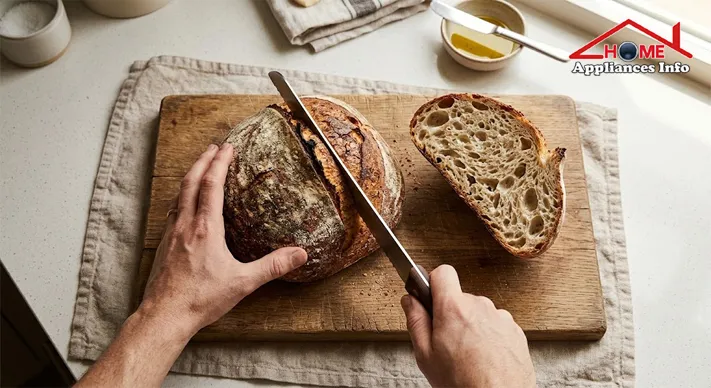
How to slice sourdough without crushing it
Technique helps as much as the knife. Let the loaf cool until the interior has set, because cutting hot bread makes the crumb gummy and compressible. Then follow this sequence:
- Set the board on a stable surface (a damp towel underneath stops it sliding).
- Hold the loaf lightly with your free hand, well away from the blade.
- Rest the knife on the crust and saw gently to make a shallow groove before cutting deeper.
- Keep sawing with light pressure and let the teeth do the work.
For boules and bâtards, The Perfect Loaf suggests cutting the loaf in half first, then slicing outward from the middle. The cut half can then be stored crumb-side down on the board, which also helps keep it fresh.
Manual vs. Electric Bread Knives
When a manual bread knife is the better choice
A manual knife is simple, quiet and portable. It gives you direct control over slice thickness, needs no cord or battery, and takes up little space. For most households, it is the right answer. Its main cost is physical: you have to saw.
When an electric bread knife makes sense
An electric knife uses a motor to move two serrated blades back and forth, which takes over the sawing. That can help people with limited hand strength or wrist pain, and anyone who slices large quantities of bread, such as for sandwiches or events.
Performance varies, though. Food Network’s electric-knife testing found the best models balanced power with control, and noted that one tested knife handled soft foods well but struggled with crusty bread. Its best overall, the Proctor Silex Easy-Slice, praised for sturdy blades and a long cord, has a finger guard that limits cuts all the way to the board. Its best cordless pick, the Elite Gourmet Cordless Easy-Slice, handled crusty bread and ripe tomatoes well in testing. The Perfect Loaf separately points to the Mueller Ultra-Carver for readers who find sawing difficult.
An electric carving knife is not automatically a better sourdough slicer. Blade design, motor action, crust thickness and your technique all affect the result. Treat these as candidates, and check the current model and manufacturer instructions before buying.
Features to compare before buying
| Feature | Manual | Electric |
|---|---|---|
| Best suited to | Most home bakers | Frequent or high-volume slicing |
| Control | Direct, by hand | Depends on motor, grip and blade |
| Effort | You do the sawing | Motor assists |
| Storage | Simple | Often bulkier |
| Upkeep | Sharpening considerations | Blade assembly cleaning, cord or battery care |
| Main trade-off | Physical effort | Noise, bulk, extra parts |
How to Choose the Right Bread Knife for Your Needs
Start with the loaves you bake most. If you make big boules, aim for 9–10 inches. If you mostly bake smaller loaves or sandwich bread, 8 inches is workable. Check the handle next: it should sit comfortably in your grip and keep your knuckles clear of the board. Then settle your budget. Compare durability, warranty and comfort alongside the sticker price, and remember that a $30 knife that cuts well beats a $150 knife you’re too nervous to use.
Left-handed bakers should also check whether a left-hand version exists, since some manufacturers offer one. And if sawing hurts your hand or wrist, an electric knife is a reasonable accommodation, as long as you pick a model that handles crust.
Bread Knife Maintenance, Cleaning, and Sharpening
Wash a bread knife by hand with warm water and mild soap, dry it right away, and store it on a magnetic strip or in a block. The Perfect Loaf advises against the dishwasher because heat and detergent can dull the edge and damage handles. Unless the manufacturer states otherwise, hand-washing is the safe default.
Sharpening is trickier than with a straight edge. Because the teeth are scalloped, you can’t run the blade along a standard whetstone or honing rod. The Perfect Loaf says home bread-knife sharpening tools often disappoint and suggests contacting the manufacturer, since some offer sharpening services. The Shun Premier, for example, comes with free lifetime honing. If you want to understand how everyday habits wear down edges, this site’s guide to what makes kitchen knives go dull explains the common culprits, from glass cutting boards to loose-drawer storage.
Frequently Asked Questions
Can I sharpen a serrated bread knife at home?
Usually not with standard tools. Bread knives have scalloped teeth that don’t suit whetstones or honing rods. Specialized serrated sharpeners exist but receive mixed reviews. A manufacturer sharpening service or a professional is the safer route.
Is a longer bread knife always better?
Not always. A blade slightly longer than the loaf’s width is ideal. Beyond that, extra length adds weight and needs more storage space. For a typical home baker, 9–10 inches is the sweet spot.
Can an electric knife replace a manual bread knife?
It can for some people, particularly those who slice a lot or struggle with sawing. But performance on crusty sourdough varies by model, so it works best as an addition rather than a replacement.
What else can a bread knife cut?
Quite a lot. The Perfect Loaf lists bagels, layer cakes, pies, laminated pastries, and thick-skinned produce such as tomatoes and citrus. Anything with a firm exterior and soft interior is a candidate.
Why does my sourdough still tear even with a serrated knife?
Common causes are cutting while the loaf is still warm, pressing down instead of sawing, or using a dull or too-short blade. Cool the loaf fully, use long, light strokes, and make a shallow groove first.
Conclusion
A well-chosen bread knife is a modest purchase that improves every loaf you bake. For most home cooks, the Mercer Culinary Millennia 10-inch offers the best balance of performance and price, with the Victorinox Fibrox as a dependable everyday alternative. Wüsthof, Shun and Kai suit buyers who prefer premium construction or a different feel in the hand. Electric knives deserve a look if sawing is a barrier, but check reviews for your specific model.
A practical next step is to measure your largest loaf, pick a blade length that comfortably crosses it, and then hold the shortlisted handles if you can. Pair that with the slicing technique above, and your sourdough should come off the board looking as good as it did out of the oven.
References
- Food Network Kitchen, “4 Best Bread Knives of 2026, Tested and Reviewed”: https://www.foodnetwork.com/how-to/packages/shopping/product-reviews/best-bread-knife
- Food Network Kitchen, “4 Best Electric Knives of 2026, Tested and Reviewed”: https://www.foodnetwork.com/how-to/packages/shopping/product-reviews/best-electric-knives
- The Perfect Loaf (Maurizio Leo), “The Best Bread Knife for Sourdough” (updated June 23, 2026): https://www.theperfectloaf.com/the-best-bread-knife-for-sourdough/

🍳 HOME & KITCHEN APPLIANCE EXPERT
Sidra Altaf
Home & Kitchen Specialist | Product Evaluator & Appliance Reviewer

🏠 Home Essentials
⚖️ Product Comparisons
⚡ Energy & Efficiency
Sidra Altaf is a seasoned expert in home and kitchen appliances with over 5 years of hands-on experience in the field. Passionate about helping families make smarter choices, she specializes in reviewing, comparing, and recommending appliances that bring convenience, efficiency, and innovation into everyday living. Her deep knowledge of product functionality, durability, and design makes her a trusted voice for anyone looking to upgrade their home.