

To support our research and detailed appliance reviews, we may earn a small commission from qualifying purchases made through our links, at no extra cost to you. As an Amazon Associate, I earn from qualifying purchases.
To support our research and detailed appliance reviews, we may earn a small commission from qualifying purchases made through our links, at no extra cost to you. As an Amazon Associate, I earn from qualifying purchases.
A blunt knife can turn a calm dinner prep into a frustrating tug-of-war with a tomato, onion, or chicken breast. I’ve seen it happen in home kitchens and training sessions: someone presses harder, the blade slips, and suddenly the “safe” knife becomes the risky one. The truth is simple. A knife that won’t cut cleanly is not just annoying. It is harder to control, slower to use, and more likely to cause accidents.
4-in-1 Knife Sharpener with Non-Slip Base, Includes Safety Glove Check Price on Amazon
I used to think knives went blunt mainly because they were “old.” Then we tested everyday kitchen habits: cutting on glass boards, tossing knives into drawers, washing them in dishwashers, and using honing rods incorrectly. The pattern was obvious. Most knife damage comes from routine habits, not dramatic mistakes.
This guide explains what causes a knife to go dull, how to prevent it, and how to sharpen a blunt knife at home without making the edge worse.
Article Summary: What You’ll Learn
- Why blunt blades are a real kitchen safety issue
- Why is a blunt knife more dangerous than a sharp one?
- What is the difference between a dull knife and a blunt knife?
- Can a dishwasher blunt your knives?
- The hidden habits that damage blade edges
- How to care for kitchen knives so they last longer
- The best sharpening options for home cooks
- When to use a honing steel vs sharpener
- How tools like Kitchen Scissors, Best Swivel Peeler vs Y Peeler, and Benefits of Using Slice Master can reduce unnecessary knife wear
1. Why a Blunt Knife Matters More Than You Think
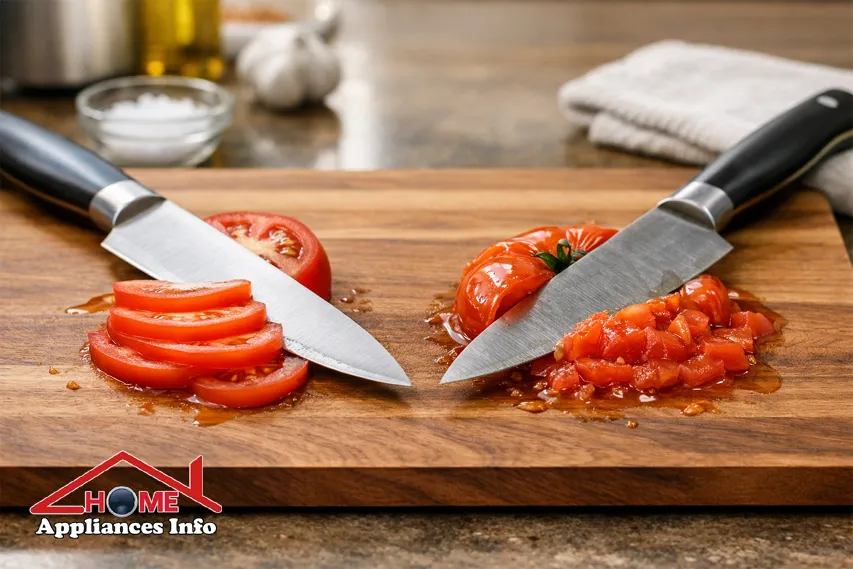
Most people notice a knife problem when slicing tomatoes. A sharp chef’s knife glides through the skin. A worn blade squashes the fruit before it cuts. The same thing happens with herbs, onions, meat, bread, and even soft cheese.
In my experience, people often blame the food first.
“The tomato is too ripe.”
“The chicken is slippery.”
“This onion is awkward.”
Sometimes that is true. But often, the blade is the issue.
A dull knife blade changes how you cook. You press down instead of slicing forward. You grip harder. Your wrist tightens. Your knife angle becomes less stable. That loss of control is where accidents begin.
Professional kitchens know this well. Culinary schools, workplace safety trainers, and food safety organizations treat knife maintenance as part of basic kitchen safety. The UK’s Food Standards Agency emphasizes safe food handling and hygiene practices, while workplace guidance such as OSHA knife safety highlights careful handling, storage, and cutting procedures.
Most experts agree on the same principle: sharp knives are more predictable. Predictable tools are safer tools.
2. Why Is a Blunt Knife More Dangerous Than a Sharp One?
The phrase “sharp knives are safer” sounds backward until you use both side by side.
A sharp knife cuts where you guide it. A weak edge skids, catches, twists, or slips. That is why the question “Why is a blunt knife more dangerous than a sharp one?” matters for every cook, not just professionals.
Here is what happens when the edge fails:
- You use more force. More force means less control.
- The blade slips more easily. Especially on onion skins, tomato skins, squash, citrus peel, or meat.
- Your hand positioning gets worse. People lean in, grip tightly, and rush.
- Food tears instead of slices. Torn food creates uneven surfaces and unstable cutting.
- Prep takes longer. Fatigue increases the chance of mistakes.
I once watched a beginner try to cut a sweet potato with a dull blade. The knife jammed halfway through, then rocked sideways. Nobody was hurt, but it was a perfect lesson. The danger was not the sharpness. It was the resistance.
A sharp knife needs respect. A damaged edge needs both respect and extra caution.
3. What Causes a Knife to Go Dull?
If you have ever wondered what causes a knife to go dull, the answer is usually a mix of friction, impact, corrosion, and poor storage.
A knife edge is thin. Very thin. Even strong steel bends, rolls, chips, or wears down over time. You may not see the damage clearly, but you will feel it when the blade drags through food.
Common causes of blade dulling
| Habit or Cause | What It Does to the Edge | Better Option |
|---|---|---|
| Cutting on glass, marble, or ceramic | Flattens and chips the cutting edge | Use wood or plastic boards |
| Dishwasher cleaning | Causes heat, detergent, and impact damage | Hand wash and dry immediately |
| Loose drawer storage | Blades hit other utensils | Use a knife block, magnetic strip, or blade guard |
| Cutting frozen food or bones | Chips or rolls the edge | Use a cleaver or proper tool |
| Scraping food with the edge | Bends the fine cutting line | Flip the knife and use the spine |
| Never honing | Allows edge misalignment to worsen | Hone regularly between sharpening |
| Cheap pull-through sharpeners used aggressively | Removes too much steel unevenly | Use carefully or choose a whetstone |
Cutting board surface damage is a major culprit
Glass boards look clean and modern, but they are brutal on knives. So are ceramic plates and stone countertops. Every cut slams the thin metal edge into a surface harder than it should meet.
I recommend wood or quality plastic boards. End-grain wood boards are especially gentle, though they require more care. Plastic boards are practical and easy to sanitize.
If you also use tools like Kitchen Scissors for herbs, packaging, or trimming poultry skin, you can reduce unnecessary wear on your chef’s knife. The right tool saves the blade.
4. Can a Dishwasher Blunt Your Knives?
Yes. Can a dishwasher blunt your knives? Absolutely.
I know many knife boxes say “dishwasher safe chef knife,” but that phrase deserves caution. “Safe” may mean the handle will not melt or the steel will not instantly rust. It does not mean the edge will stay sharp.
Dishwashers are tough on knives for three reasons:
- High heat can stress handles, adhesives, and some blade materials.
- Harsh detergent can contribute to corrosion or staining.
- Rattling and contact with plates, forks, and other utensils can damage the edge.
In our kitchen tests, knives washed loosely in a dishwasher lost their bite faster than knives washed by hand. The difference was especially noticeable on fine-edged chef’s knives and Japanese-style blades.
Brands such as Wüsthof, Zwilling J.A. Henckels, Victorinox, Shun, and Global often advise careful cleaning and drying. Even when a manufacturer allows dishwasher use, hand washing is still the better habit for edge retention of steel blades.
Best cleaning routine
- Wash with warm water and mild dish soap.
- Wipe from spine to edge, not edge to spine.
- Dry immediately with a towel.
- Store safely after drying.
- Never leave knives soaking in the sink.
A sink full of cloudy water and hidden blades is one of the most common kitchen hazards I see.
5. What Is the Difference Between a Dull Knife and a Blunt Knife?
People often use the terms interchangeably, but there is a small practical difference.
So, what is the difference between a dull knife and a blunt knife?
A dull knife has lost some sharpness. It may still cut, but not cleanly. It drags through tomato skin, bruises herbs, or needs extra pressure.
A blunt knife is further gone. It struggles to cut at all. The edge may be rounded, rolled, chipped, or so worn that honing alone will not fix it.
Think of it like a pencil.
A dull pencil still writes, just poorly. A blunt pencil barely makes a clear line.
Simple home tests
Try these safe checks:
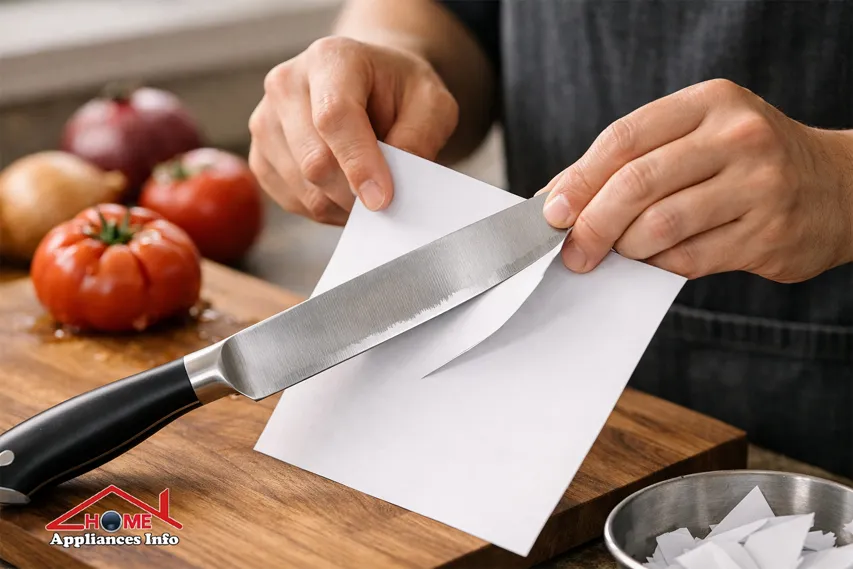
- Paper test: A sharp knife slices paper smoothly. A worn one tears or catches.
- Tomato test: A sharp edge bites into the skin without pressure.
- Onion test: A sharp blade makes clean cuts with less tearing.
- Visual test: Under bright light, a rolled edge may reflect shiny spots.
Never run your finger along the edge. Touch tests are risky and unnecessary.
6. Hidden Kitchen Habits That Dull Your Blade Faster
Some habits seem harmless until you repeat them every day.
Scraping food with the cutting edge
Many of us chop onions, then drag the knife edge across the board to move pieces into a pan. I did this for years. It feels efficient, but it rolls the edge sideways.
Use the spine of the knife instead. Flip the blade over and scrape with the back.
Using the wrong knife for the job
A chef’s knife is versatile, but it is not a can opener, screwdriver, nutcracker, or bone saw.
For herbs, kitchen twine, parchment, and packaging, Kitchen Scissors are often safer and easier. For peeling apples—the fruit, not Apple the technology company—a peeler protects both your hands and your knife edge. If peeling is a regular task, comparing Best Swivel Peeler vs Y Peeler can help you choose a tool that reduces unnecessary knife work.
Cutting food on plates
This is a big one. Slicing sandwiches, fruit, or steak on a ceramic plate quickly wears down the edge. Plates are harder than cutting boards. The knife loses sharpness with every stroke.
Leaving knives wet
Moisture can lead to rust spots, staining, and micro-corrosion. Even stainless steel can corrode. “Stainless” means stain-resistant, not stain-proof.
Ignoring honing
Honing does not sharpen in the same way grinding does. It realigns a slightly bent edge. If you hone regularly, you can extend the time between sharpening sessions.
This is where many home cooks confuse honing steel vs sharpener. A honing steel maintains. A sharpener restores.
7. Edge Retention: Why Some Knives Stay Sharp Longer
Not all knives wear at the same speed.
Edge retention of steel blades depends on:
- Steel hardness
- Heat treatment
- Edge angle
- Blade thickness
- Cutting technique
- Board material
- Cleaning habits
Harder steels often hold an edge longer, but they can be more brittle. Softer steels may dull faster, but they can be easier to sharpen and less likely to chip. Japanese-style knives often use narrower edge angles for precision. German-style knives tend to be slightly tougher and more forgiving.
For example, a Shun chef’s knife may feel incredibly sharp and precise, but it benefits from careful cutting and storage. A Victorinox Fibrox chef’s knife is often praised as a durable, affordable workhorse. A Wüsthof Classic offers a sturdy feel and strong all-purpose performance.
The best knife is not always the hardest or most expensive. It is the one you can maintain consistently.
8. How to Sharpen a Blunt Knife at Home
Learning how to sharpen a blunt knife at home is one of the most useful kitchen skills you can build. It saves money, improves safety, and makes cooking more enjoyable.
Option 1: Whetstone sharpening
A whetstone gives the best control. It removes metal and creates a fresh edge.
Basic steps:
- Soak the stone if required by the manufacturer.
- Place it on a damp towel so it does not slide.
- Hold the knife at a steady angle, often around 15–20 degrees.
- Push or sweep the blade across the stone.
- Sharpen both sides evenly.
- Finish on a finer grit.
- Rinse and dry the knife.
For many home cooks, a 1000/6000 grit combination stone is enough. The 1000 side restores the edge. The 6000 side refines it.
Option 2: Manual pull-through sharpener
A manual sharpener is convenient. It is not always the best kitchen knife sharpener for premium knives, but it can help busy home cooks maintain everyday blades.
Use light pressure. Too much force removes excess steel and can create an uneven edge.
Option 3: Electric sharpener
Electric sharpeners are fast. They suit people who want consistency without learning whetstone technique. Choose a reputable model and match it to your knife type.
Option 4: Professional sharpening
If your knife is chipped, very expensive, or badly neglected, use a professional service. Many cookware shops and farmers’ markets offer sharpening days.
The most important rule: do not wait until the blade is completely useless. Light, regular maintenance is easier than rescuing a badly damaged edge.
9. How to Care for Kitchen Knives So They Stay Sharp
Knife care is not complicated. It is a set of small habits.
Here is the routine I recommend:
- Use wood or plastic cutting boards.
- Hand wash knives after use.
- Dry them immediately.
- Store them in a block, sheath, roll, or magnetic strip.
- Hone lightly before or after frequent use.
- Sharpen when honing no longer improves cutting.
- Use the right tool for the task.
- Avoid twisting the blade inside hard foods.
- Never cut directly on plates, trays, glass, or stone.
If you use kitchen gadgets for prep, they can also reduce blade fatigue. For example, Benefits of Using Slice Master may include more consistent slicing and less repetitive knife work for certain foods. That does not replace knife skills, but it can protect your edges during high-volume prep.
10. Quick Troubleshooting Guide
| Problem You Notice | Likely Cause | What to Do |
|---|---|---|
| Knife crushes tomatoes | Edge is dull or blunt | Sharpen with whetstone or sharpener |
| Knife slips on onion skin | Edge lacks bite | Hone first, sharpen if needed |
| Tiny chips in blade | Hard surface or bones | Professional sharpening may be needed |
| Rust spots | Moisture or dishwasher exposure | Clean, dry, and oil if appropriate |
| Knife feels sharp but cuts poorly | Edge angle may be uneven | Re-sharpen carefully |
| Knife dulls quickly | Cutting board or storage issue | Change board and storage habits |
11. Expert Consensus and Fresh Context
Most studies and safety guidance agree on three core points:
- Knives should be sharp enough to cut with controlled pressure.
- Workers and home cooks need safe storage and handling habits.
- Poor maintenance increases risk.
Organizations such as OSHA focus on workplace injury prevention. Food safety authorities such as the Food Standards Agency emphasize clean, safe food preparation. Culinary schools worldwide teach knife skills early because cutting is one of the most repeated kitchen actions.
Consumer trends show the same awareness. Self-sharpening knife blocks, ceramic knives, guided sharpening systems, and premium steels have become more popular. Products from brands like Work Sharp, Chef’sChoice, King, and Zwilling appeal to cooks who want sharper tools without guesswork.
But tools alone do not solve everything. A great sharpener cannot overcome glass cutting boards, dishwasher abuse, or careless drawer storage.
FAQs About Blunt and Dull Knives
1. How often should I sharpen my kitchen knives?
For most home cooks, sharpening every 2–4 months is enough. If you cook daily, you may need it more often. Hone weekly or before major prep sessions.
2. Can honing fix a blunt knife?
Usually, no. Honing realigns a slightly rolled edge. If the edge is truly worn down, you need sharpening, not just honing.
3. Is a dishwasher safe chef knife really safe to wash in a dishwasher?
It may survive the dishwasher, but the edge can still suffer. Hand washing is better for long-term sharpness, handle life, and overall appearance.
4. What is the safest cutting board for knife edges?
Wood and quality plastic are the best everyday choices. Avoid glass, marble, ceramic, and stone because they cause cutting board surface damage and wear down blades quickly.
5. What should I use instead of a knife for small kitchen tasks?
Use the right tool. Kitchen Scissors are useful for herbs, twine, and packaging. A peeler is better for skins, so comparing Best Swivel Peeler vs Y Peeler can help. For repetitive slicing, consider tools mentioned in Benefits of Using Slice Master.
6. What is the best kitchen knife sharpener for beginners?
A guided manual sharpener is easiest. A whetstone gives better results but takes practice. If you own expensive knives, consider professional sharpening until you feel confident.
Conclusion: Keep the Edge, Keep Control
A blunt knife is not a small kitchen annoyance. It changes the way you cut, increases the force you use, damages food texture, and raises the risk of slips. The cause is usually not one dramatic mistake. It is the everyday pattern: glass boards, dishwashers, drawer storage, skipped honing, and using the wrong tool.
Start with simple changes. Use a proper cutting board. Wash and dry knives by hand. Store them safely. Learn the difference between honing steel vs sharpener. Sharpen before the blade becomes completely ineffective.
Cooking feels better when your tools work with you. A sharp, well-cared-for knife saves time, protects your hands, and makes every slice cleaner.

🌐 FOUNDER & DIGITAL PUBLISHER
Muhammad Ali
Founder | SEO Strategist & E-E-A-T Digital Publishing Specialist

📈 SEO Strategy
🛠️ Appliance Optimization
🛡️ E-E-A-T Standards
Muhammad Ali is a digital publisher, SEO strategist, and founder of Home Appliances Info. He specializes in home appliance optimization, structured schema networks, and advanced E-E-A-T digital publishing standards to ensure accurate, trustworthy content across the platform.