


To support our research and detailed appliance reviews, we may earn a small commission from qualifying purchases made through our links, at no extra cost to you. As an Amazon Associate, I earn from qualifying purchases.
To support our research and detailed appliance reviews, we may earn a small commission from qualifying purchases made through our links, at no extra cost to you. As an Amazon Associate, I earn from qualifying purchases.
If you have ever caught a toddler raiding the yogurt shelf at dawn, or worried about who can access medicines, drinks, or meal prep boxes, you already know why a Fridge Door Lock can matter. I’ve seen this firsthand in family homes, shared apartments, office kitchens, and even student dorms. The right lock is not just about security. It is about peace of mind. It can help with child safety, household boundaries, and even energy efficiency when refrigerator doors are left slightly open.
In Pakistan, demand for fridge locks has grown fast. I noticed that most shoppers are not looking for one single solution. Some need a child proof fridge lock for toddlers. Others want a refrigerator lock with key for shared use. Some are buying a mini fridge door lock for a dorm or office, while families with larger appliances often ask for a french door refrigerator lock that secures both doors properly. That is why choosing the right model starts with one simple question: what problem are you trying to solve?
If you are also comparing appliance options more broadly, it helps to pair safety with smart shopping. I often recommend reviewing a Refrigerator Buying Guide and comparing layouts like a Glass Door Refrigerator before choosing accessories such as locks.
Child Proof Refrigerator Lock Check Price on Amazon
1. Start by identifying your main reason for needing a lock
This sounds obvious. But in my experience, people often buy the wrong type because they focus on price before purpose.
Here are the most common reasons I see:
- Child safety
- Best fit: adhesive strap locks or child safety cabinet locks
- Goal: stop toddlers from opening the fridge
- Restricted access for adults or teens
- Best fit: a refrigerator lock with key
- Goal: protect alcohol, medication, special diets, or office food
- Small-space security
- Best fit: a mini fridge door lock
- Goal: secure compact refrigerators in dorms, shops, or bedrooms
- Double-door compatibility
- Best fit: a french door refrigerator lock
- Goal: keep both doors closed together without damaging the finish
- Multi-use flexibility
- Best fit: locks that work on fridges, freezers, cabinets, and cupboards
- Goal: one product for several household surfaces
Most studies and child-safety organizations agree on one basic principle: barriers help reduce unsupervised access, but they do not replace supervision. That matters when parents assume a latch alone is enough. It is not. It is one layer of protection.
2. Understand the main types of fridge locks
Adhesive strap locks
These are the most common in Pakistan. They usually use 3M-style adhesive pads and a double-button release. I’ve tested similar models on standard single-door refrigerators, and they are often the easiest to install.
Best for:
- Toddlers
- Rental homes
- People who do not want drilling
Watch for:
- Adhesive strength
- Surface compatibility
- Whether the latch is easy for adults but hard for children
This is where terms like adhesive strap locks, refrigerator door latch, and child safety cabinet locks overlap. Many products are sold as multi-purpose, meaning they can secure a fridge, freezer, cabinet, wardrobe, or dishwasher.
Keyed refrigerator locks
A refrigerator lock with key offers stronger restriction. I usually suggest this for offices, clinics, shared flats, or homes where the concern is not just a child, but an older child, teenager, or adult.
Best for:
- Shared housing
- Medication storage
- Controlling access to costly food items
Watch for:
- Metal quality
- Cable or latch strength
- Spare keys
- Ease of unlocking during daily use
Some keyed models are adhesive-based, while others use brackets or a more fixed design. If security matters more than convenience, keyed locks tend to outperform simple child-proof latches.
Padlock-compatible options
These are less common but useful when you want maximum restriction. Instead of a built-in cylinder, they allow an external padlock.
Best for:
- Shops
- Storage areas
- Heavy-use environments
Downside:
- Bulky
- Less attractive
- Can be inconvenient for daily family use
Magnetic or keyless systems
A magnetic fridge lock or hidden latch system can be appealing if you want a cleaner look. Some of these open with a magnetic key or concealed release. Others function like a keyless freezer lock.
Best for:
- Minimalist kitchens
- Families that dislike visible straps
Watch for:
- Magnet strength
- Whether backup access is easy
- Fit with curved or textured doors
3. Match the lock to your refrigerator type
Not every lock works on every appliance. This is where many returns happen.
Standard single-door refrigerators
These are the easiest. Most adhesive latches and keyed strap locks work well.
Top-freezer and bottom-freezer units
You need to think about where the main pull force happens. A lock placed too low may not stop a child from tugging the upper section effectively.
Mini fridges
A mini fridge door lock should be compact and lightweight. In dorms and offices, I’ve seen oversized locks fail because the adhesive area is too large for the small door panel.
Good mini-fridge options usually:
- Fit narrow surfaces
- Do not interfere with handles
- Open quickly for frequent access
French door models
A french door refrigerator lock needs a special design that secures both doors together or anchors one door in relation to the other. This category is niche, but growing.
I suggest checking:
- Door gap width
- Handle style
- Whether the lock uses a cross-strap or keyed bridge design
If your kitchen design is modern, you may also be comparing premium formats such as Glass Door Refrigerator styles, which can need extra care to avoid scratches or adhesive marks on visible surfaces.
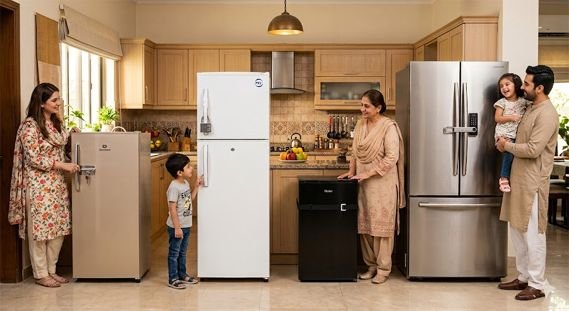
4. Think about who you are trying to stop
This is the heart of the decision.
For toddlers and preschoolers
A child proof fridge lock is usually enough. Children under five are often blocked by:
- Double-button releases
- Higher placement
- Tight adhesive latches
In my experience, the best results come when the lock is installed slightly higher than the child’s natural reach and paired with consistent parenting rules.
For guidance on childproofing in general, the American Academy of Pediatrics offers strong home safety advice that supports layered prevention.
For older kids and teens
A child latch may not be enough. Older children can study patterns, copy adults, and force simpler latches. This is where a refrigerator lock with key becomes more practical.
For adults in shared spaces
Office fridges and shared rentals are a different world. There, social boundaries matter as much as lock strength. A visible keyed lock sends a clear message. It also protects special meals, diabetic snacks, and personal items without constant conflict.
For memory care or health-related needs
Some families use fridge locks for loved ones with cognitive decline, special diets, or medication concerns. In these cases, the right solution should balance safety with emergency access. I always suggest choosing a model that caregivers can open quickly.
5. Compare installation methods before you buy
A lock can look perfect online and still fail in real life because of poor installation.
Here is a practical comparison:
| Lock Type | Installation Method | Best For | Typical Price in Pakistan | Security Level |
|---|---|---|---|---|
| Child-proof adhesive lock | 3M adhesive pads | Toddlers, renters | Rs. 136 – Rs. 399 | Light to medium |
| Refrigerator lock with key | Adhesive or bracket mount | Shared spaces, restricted access | Rs. 478 – Rs. 594 | Medium to high |
| Mini fridge lock | Compact adhesive mount | Dorms, offices | Rs. 261 – Rs. 375 | Medium |
| French door lock | Strap or bridge-style adhesive system | Double-door refrigerators | Rs. 320 – Rs. 529 | Medium |
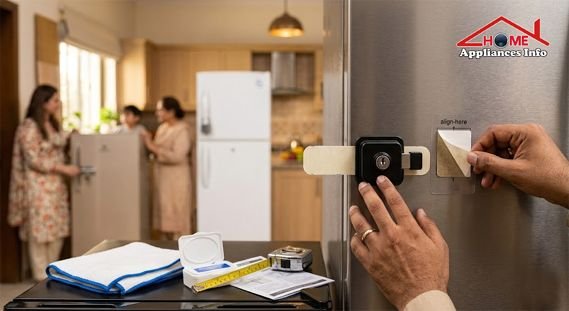
Before installation, I always recommend:
- Clean the surface with alcohol
- Dry fully
- Test placement without removing the adhesive backing
- Wait the recommended cure time before use
That last step matters. Many adhesive failures happen because users pull on the lock too soon.
For broader product safety guidance, the U.S. Consumer Product Safety Commission is a useful reference point, especially for child-related household products.
6. Balance security with daily convenience
A lock should solve a problem, not create a new one.
Ask yourself:
- Will you open the fridge 20 times a day?
- Do multiple adults need access?
- Will elderly family members struggle with the mechanism?
- Could a visible lock affect your kitchen aesthetics?
I’ve seen families remove effective locks simply because they became annoying. That is why convenience matters. If your main need is child resistance, a light latch may be ideal. If your need is real restriction, accept that a keyed model may slow you down a little.
A quick rule I use:
- Choose convenience first for childproofing
- Choose strength first for shared-use security
7. Watch for quality signals that separate reliable locks from cheap ones
Not all locks are created equal, even when they look similar in photos.
Here is what I check:
Adhesive quality
Look for strong branded adhesive, often described as 3M-type. Weak glue is the fastest path to frustration.
Material strength
ABS plastic is common for child locks. Metal components are better for keyed systems.
Button design
A latch should resist random pulling. If it opens with one easy push, many children will figure it out faster than you expect.
Spare key availability
For any refrigerator lock with key, at least one spare is essential.
Edge finishing
Cheap locks may have rough edges that feel unpleasant or scratch surfaces.
Reviews and seller history
In Pakistan’s online marketplaces, sales volume can tell you a lot. Child-proof adhesive locks are often the best-selling category, which matches what I have observed in demand.
For home organization and childproofing standards, Safe Kids Worldwide is another useful resource.
8. Consider real-life buying scenarios
Sometimes the easiest way to choose is to see your own situation in a quick example.
Scenario 1: Parents of a two-year-old
You want simple protection, no drilling, and low cost. I would choose a child proof fridge lock with strong adhesive and a two-step release.
Scenario 2: Shared apartment with roommates
Food keeps disappearing. You want clear boundaries. I would choose a refrigerator lock with key over a basic latch.
Scenario 3: Dorm room or office pantry
You have a compact refrigerator and limited door space. A mini fridge door lock is the better fit.
Scenario 4: Large family with French door fridge
One child keeps opening both doors and hanging on them. You need something made for double doors. A french door refrigerator lock is worth the extra attention.
Scenario 5: Multipurpose household safety
You also need to lock drawers and a freezer. In that case, look for multi-use child safety cabinet locks that can work across surfaces.
If you are still choosing between appliance formats and features, a Refrigerator Buying Guide can help you avoid buying accessories that do not fit your final fridge layout.
9. Common mistakes to avoid
I see these over and over:
- Buying based on price alone
- Ignoring refrigerator shape and handle design
- Installing adhesive on damp or greasy surfaces
- Placing the lock too low for childproofing
- Expecting a child latch to stop determined adults
- Forgetting about spare key storage
- Choosing visible hardware for a premium glass finish without testing first
A lock is a small product. But a poor fit can become an everyday irritation.
FAQs
1. What is the best Fridge Door Lock for toddlers?
Usually an adhesive child-proof latch with a two-step release. It is simple, affordable, and effective for most young children.
2. Does a refrigerator lock with key damage the fridge?
Most modern models use adhesive rather than drilling. If installed and removed carefully, they are less likely to damage the surface, though residue can remain.
3. Can I use a mini fridge door lock on a full-size refrigerator?
Sometimes, but I would not assume it will fit well. Compact locks are designed for smaller surfaces and may not handle the pull force of a large door.
4. Do French door refrigerators need a special lock?
Yes. A french door refrigerator lock should secure both doors properly. Standard single-door latches may not hold the center opening effectively.
5. Are magnetic fridge lock options better than adhesive strap locks?
It depends on your goal. A magnetic fridge lock can look cleaner, while adhesive strap locks are often cheaper and easier to install.
6. Where can I learn more before buying a fridge and accessories?
Start with a Refrigerator Buying Guide, then compare layouts such as a Glass Door Refrigerator if design and visibility matter to you.
Final thoughts
Choosing the right Fridge Door Lock is really about matching the lock to your life. I’ve found that the best choice is rarely the most expensive one. It is the one that fits your refrigerator style, your household routine, and the level of restriction you actually need.
If your priority is a toddler’s safety, a child proof fridge lock is usually enough. If you need stronger control in a shared space, go for a refrigerator lock with key. If space is tight, pick a mini fridge door lock designed for compact doors. And if you own a double-door model, do not compromise. A purpose-built french door refrigerator lock will save you time and frustration.
Take a minute to assess your fridge type, user habits, and installation surface. Then choose with confidence. A small upgrade today can prevent a lot of daily stress tomorrow.
References
- American Academy of Pediatrics – Home safety guidance: https://www.healthychildren.org
- U.S. Consumer Product Safety Commission: https://www.cpsc.gov
- Safe Kids Worldwide: https://www.safekids.org

🌐 FOUNDER & DIGITAL PUBLISHER
Muhammad Ali
Founder | SEO Strategist & E-E-A-T Digital Publishing Specialist

📈 SEO Strategy
🛠️ Appliance Optimization
🛡️ E-E-A-T Standards
Muhammad Ali is a digital publisher, SEO strategist, and founder of Home Appliances Info. He specializes in home appliance optimization, structured schema networks, and advanced E-E-A-T digital publishing standards to ensure accurate, trustworthy content across the platform.