

To support our research and detailed appliance reviews, we may earn a small commission from qualifying purchases made through our links, at no extra cost to you. As an Amazon Associate, I earn from qualifying purchases.
To support our research and detailed appliance reviews, we may earn a small commission from qualifying purchases made through our links, at no extra cost to you. As an Amazon Associate, I earn from qualifying purchases.
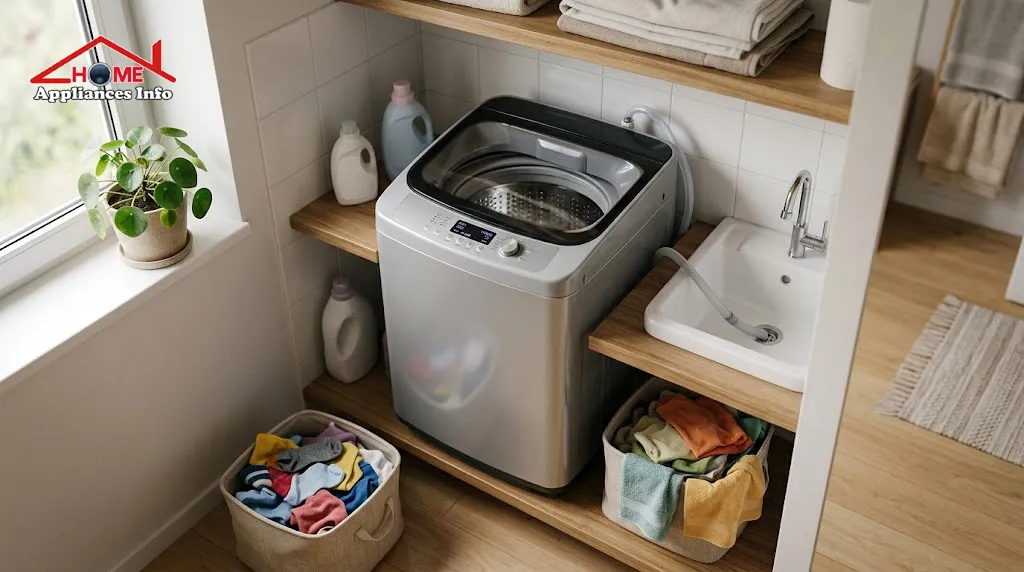
A portable mini washing machine can make laundry much easier when a full-size washer simply will not fit. Whether you live in a studio apartment, dorm, RV, tiny home, or rental property, a compact washer can give you a practical way to handle everyday clothes without dedicating an entire laundry room to one appliance.
The important part is choosing the right type. Some portable washers are fully automatic and work much like conventional top-load machines, while others use twin tubs, manual controls, or even no electricity at all. The seven options below cover that range rather than pretending that one machine is suitable for every household.
Giantex Washing Machine, 20Lbs Capacity Check Price on Amazon
Best Portable Mini Washing Machines in 2026
| Model | Type | Capacity | Best suited for | Key characteristic |
|---|---|---|---|---|
| BLACK+DECKER 0.9 Cu. Ft. Portable Washer | Automatic | 0.9 cu. ft. | Apartments and small spaces | Compact automatic operation |
| COSTWAY 12-Lb. Full-Automatic Washer | Automatic | 12 lb | Dorms and apartments | 10 programs and 8 water levels |
| Giantex Portable Twin-Tub Washer | Semi-automatic | 12-lb wash / 8-lb spin | Apartments, dorms, RVs | Separate wash and spin tubs |
| SUPER DEAL Compact Twin-Tub Washer | Semi-automatic | 8-lb wash / 5-lb spin | Budget-conscious users | Small twin-tub design |
| COMFEE 1.6 Cu. Ft. Portable Washer | Automatic | 11 lb | Apartments and RVs | Larger compact capacity |
| Yirego Drumi | Manual | Small loads | Travel and off-grid use | No electricity required |
| Scrubba Wash Bag | Manual | Very small loads | Travel and camping | Pocket-sized wash solution |
The models above should not be viewed as seven identical competitors. A twin-tub washer and a pocket-sized manual wash bag solve very different laundry problems.
1. BLACK+DECKER 0.9 Cu. Ft. Portable Washer — Best Compact Automatic Option
The BLACK+DECKER 0.9-cu.-ft. portable washer is aimed at people who want the convenience of an automatic machine without moving up to a full-size appliance.
The current product information lists five cycle selections: Heavy, Gentle, Normal, Rapid, and Soak. It also has three water-level choices and a stainless-steel tub. The listed dimensions are approximately 17.3 × 17.7 × 31.1 inches.
That combination makes this model particularly interesting for someone searching for a portable washing machine for small spaces. It is still a real appliance rather than a countertop wash bucket, but its smaller capacity means you should expect to do smaller loads more frequently.
Best for: apartment residents, students, and anyone prioritizing compact automatic operation.
Watch for: the 0.9-cu.-ft. capacity is much smaller than a conventional family washer, so bulky laundry is not its strong point.
2. COSTWAY 12-Lb. Full-Automatic Washer — Best for More Automatic Convenience
If you want a small washer but do not want to spend every laundry cycle manually transferring clothes between tubs, the COSTWAY 12-lb. full-automatic model is worth considering.
COSTWAY lists 10 washing programs, eight water-level selections, an LED display, a stainless-steel inner tub, a built-in drain pump, and automatic drainage. Its listed dimensions are 19 × 19 × 33.5 inches.
It is also a useful example of why the word “mini” can be misleading. This is compact compared with a conventional laundry appliance, but it is not a tiny countertop machine. Its 12-lb. capacity puts it closer to a small household washer.
Best for: people who want automatic operation in an apartment, dorm, or other space with limited room.
Watch for: measure the height carefully, especially if the machine will sit under shelving or inside a confined laundry area.
3. Giantex Portable Twin-Tub Washer — Best Twin-Tub Configuration
The Giantex portable twin-tub design takes a different approach. Instead of using one drum for the entire process, it has separate washing and spinning tubs.
The current 12-lb.-wash/8-lb.-spin version uses a 260W washing motor and 140W spinning motor. Giantex lists a footprint of approximately 25 × 15.5 × 29.5 inches and describes the machine for apartments, RVs, and dorms.
The separate tubs can be useful because washing and spinning are handled independently. You can also begin another washing step while a previous load is spinning, depending on how you organize your laundry.
The trade-off is involvement. A twin-tub machine is not the same as selecting a program on a fully automatic washer and walking away.
Best for: people comfortable with semi-automatic laundry and those who want both washing and spin extraction in a compact appliance.
Watch for: the spinner has an 8-lb. capacity, so you cannot necessarily transfer a completely full 12-lb. wash load into the spin tub at once.
4. SUPER DEAL Compact Mini Twin-Tub Washer — Best Budget-Oriented Design
The SUPER DEAL compact twin-tub washer represents the smaller, simpler end of the electric portable-washer market.
The commonly listed 13-lb. configuration divides capacity between an approximately 8-lb. washing tub and a 5-lb. spin tub. Its compact footprint is around 23 × 13.5 × 26 inches, making it suitable for environments such as dormitories, apartments, RVs, and other small spaces.
Its appeal is straightforward: you get separate washing and spinning functions without the size and complexity of a conventional washer.
However, the semi-automatic design requires more hands-on work. You may need to fill the machine, set the wash timer, drain it, move clothes to the spinner, and manage the rinse process yourself.
Best for: buyers who value a simple, compact washer and do not mind manual involvement.
Watch for: gravity-drain arrangements can restrict where you can operate the machine, so check the drainage setup before purchasing.
5. COMFEE 1.6 Cu. Ft. Portable Washing Machine — Best Larger Compact Option
Not everyone looking for a compact washing machine needs the smallest machine available. The COMFEE 1.6-cu.-ft. portable washer shows why capacity matters as much as physical size.
COMFEE lists an 11-lb. capacity, six wash programs, bottom wheels, a child lock, delay start, LED display, and one-touch operation. The listed dimensions are approximately 20.7 × 20.3 × 36.6 inches.
This makes it more substantial than the smallest portable washers. For a couple or someone who does regular laundry, that additional capacity can reduce the number of loads required.
At the same time, the taller body means you should measure the available space carefully. A machine can have a relatively small footprint while still requiring considerable vertical clearance.
Best for: apartments, RVs, and small households that want more capacity without moving to a conventional full-size washer.
Watch for: do not judge the machine only by floor area; check height, lid clearance, hose routing, and access around the appliance.
What Is a Portable Mini Washing Machine?
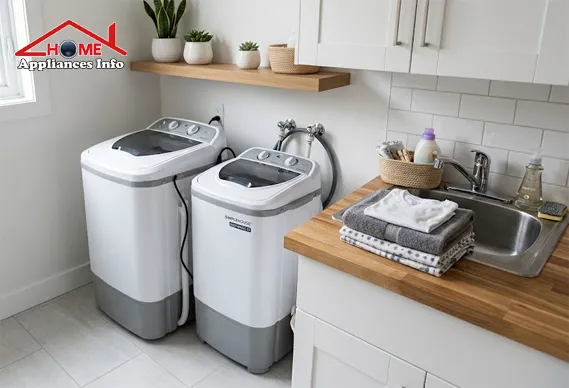
A portable mini washing machine is a smaller laundry appliance designed for relatively small loads while taking up less space than a conventional washer.
The category includes several different designs:
- Fully automatic washers
- Semi-automatic twin-tub machines
- Washer-and-spinner combinations
- Manual washing machines
- Non-electric travel washers
- Ultra-portable washing bags
That variety matters. A small automatic washer can replace much of the daily function of a conventional machine for a small household, whereas a Scrubba Wash Bag is intended for very small loads and travel.
In other words, “mini” describes the general size or intended use rather than one standardized machine specification.
How to Choose a Portable Washing Machine for Small Spaces
The right machine depends less on the word “mini” and more on how you actually do laundry.
Capacity
Start with the amount of laundry you normally wash.
A person living alone may be perfectly comfortable with a smaller machine. A couple may prefer something closer to 10–12 lb. or more. Families with frequent large loads may quickly find a portable washer restrictive.
Do not assume that a machine advertised as compact can handle the same loads as a full-size washer.
Also remember that twin-tub capacity can be split between washing and spinning. A machine advertised with a total capacity number may have substantially less usable capacity in its spinner.
Dimensions
Measure the location before ordering.
Check:
- Width
- Depth
- Height
- Lid-opening clearance
- Faucet access
- Hose space
- Drain location
- Storage space
Height is easy to overlook. A top-loading washer may physically fit into a narrow space but become unusable if a shelf prevents the lid from opening.
Water Connection
Some portable washers can connect to a faucet, while others require manual filling.
For renters, dorm residents, and RV owners, this can make a major difference. Check the manufacturer’s installation instructions rather than assuming a standard kitchen or bathroom faucet will automatically work.
A machine that requires manual filling may be perfectly practical for occasional small loads but less convenient if you intend to wash several loads every week.
Drainage
Drainage is another specification that can determine whether a machine actually works in your chosen location.
Look for information about:
- Gravity drainage
- Built-in drain pumps
- Drain-hose length
- Sink drainage
- Required drain height
A gravity-drain machine generally gives you fewer placement options than a model with a pump.
Automatic vs. Semi-Automatic Operation
Fully automatic machines generally require less intervention. You select a cycle and allow the washer to manage most of the process.
A twin-tub machine typically involves more steps:
- Fill the wash tub.
- Add detergent and clothes.
- Run the wash cycle.
- Drain the wash water.
- Rinse as required.
- Transfer clothes to the spin tub.
- Run the spin cycle.
That extra involvement is not necessarily a problem. Some buyers prefer simpler mechanical controls and the ability to control each stage themselves. Others will find automatic operation much more convenient.
Spin-Drying Performance
A spin tub does not equal a heated clothes dryer.
Spinning removes a substantial amount of water from wet clothes, which can shorten subsequent air-drying time. It does not normally make clothes completely dry in the way a heated or heat-pump dryer does.
This distinction becomes particularly important when shopping for a portable washer and dryer.
Noise and Vibration
Compact machines can still vibrate, particularly when laundry becomes unevenly distributed during the spin cycle.
Place the washer on a stable, level surface and follow the manufacturer’s instructions for balancing loads. If the machine is going into a bedroom, studio apartment, or other living area, noise should be part of your buying decision rather than an afterthought.
Portable Mini Washing Machine vs. Full-Size Washer
The basic trade-off is capacity versus flexibility.
A full-size washer makes more sense when you regularly handle large loads, towels, bedding, blankets, or clothing for several people. A portable model is more attractive when floor space, installation flexibility, or mobility matters more.
| Feature | Portable Mini Washer | Full-Size Washer |
|---|---|---|
| Floor space | Generally smaller | Generally larger |
| Typical load size | Small to moderate | Moderate to large |
| Portability | Often movable | Usually installed in one location |
| Installation | May be flexible | Usually requires dedicated connections |
| Small-space suitability | High | Lower |
| Bulky laundry | Often limited | Better suited |
| Manual options | Common | Less common |
| Large household loads | Less convenient | Generally more practical |
The choice is therefore about matching the appliance to the household rather than assuming a compact machine is automatically superior.
Portable Washer and Dryer: Do You Need Both?
The phrase “washer and dryer” can describe several different arrangements.
A washer-only machine cleans clothing but leaves you responsible for drying it.
A washer with a spin tub removes water mechanically. That can speed up air-drying, but it is not the same as heat drying.
A true washer-dryer combo can wash and dry clothing in one appliance. These machines can be attractive when floor space is extremely limited because one appliance performs both jobs.
There is also a fourth option: pairing a compact washer with a separate portable or ventless dryer.
If you are considering the drying side separately, our existing guide on [ventless dryers and how they work] provides useful context about condenser and heat-pump drying, installation requirements, drainage, and drying times.
For readers comparing integrated laundry appliances, the existing [Mijia washer-dryer guide] can also provide additional context on combination machines.
The key point is simple: spin drying and heated drying are not interchangeable terms.
How Much Laundry Can a Portable Mini Washing Machine Handle?
There is no single capacity for a portable washer.
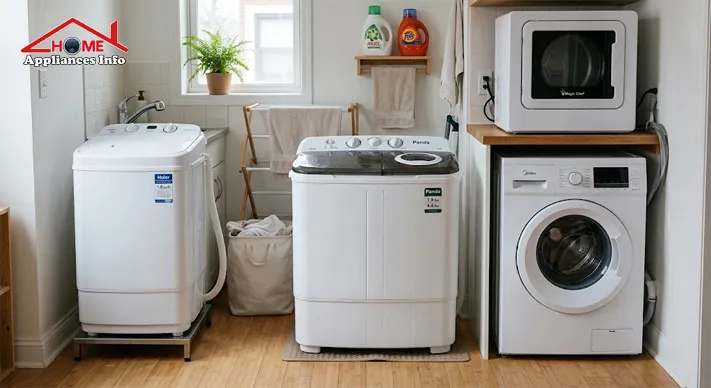
The models in this guide illustrate the range. The Giantex model discussed above has a 12-lb. washing tub and 8-lb. spinner. COSTWAY’s full-automatic model is rated for a 12-lb. wash/spin capacity, while COMFEE’s 1.6-cu.-ft. portable washer is rated at 11 lb.
The practical lesson is more useful than any one number: compare the capacity of the specific machine you are considering with your normal laundry load.
If you routinely wash towels, jeans, bedding, or bulky winter clothing, a very small machine may create more work rather than less.
Are Portable Mini Washing Machines Good for Apartments?
They can be a practical solution when the apartment does not have enough space or suitable hookups for a conventional washer.
They are particularly relevant for:
- Studio apartments
- Small apartments
- Dorm rooms
- RVs
- Tiny homes
- Rental properties
- Homes without conventional washer hookups
- Secondary laundry setups
They are less suitable when the household regularly needs to wash large quantities of laundry or bulky items.
Before buying, check your lease or building rules if applicable. Also confirm where water will enter the machine, where wastewater will go, and whether the electrical supply meets the manufacturer’s requirements.
For broader washing-machine maintenance, Home Appliances Info also has a guide covering [how to clean a washing machine with vinegar and baking soda]. That type of routine care matters for compact washers too, although the manufacturer’s own maintenance instructions should always take priority.
Advantages and Disadvantages
A compact washer can solve a genuine space problem, but it comes with compromises.
Advantages
- Space-saving: Smaller dimensions make these machines practical for tight rooms.
- Portability: Many models can be moved or stored when needed.
- Flexible installation: Some connect to a faucet rather than requiring a permanent laundry setup.
- Small-load convenience: They can be useful when you frequently wash a few clothes rather than waiting for a large load.
- Multiple configurations: Buyers can choose automatic, semi-automatic, or manual designs.
- Travel and RV usefulness: Certain models are specifically designed around portability.
Potential disadvantages
- Smaller capacity: Large loads may require multiple cycles.
- More frequent washing: Small drums can mean more laundry sessions.
- Manual work: Twin-tub and manual models require more involvement.
- Limited drying: Spin extraction is not the same as heated drying.
- Drainage restrictions: Gravity-drain models may limit placement.
- Vibration: Uneven loads can cause movement during spinning.
- Bulky-item limitations: Comforters and large blankets can exceed the practical capacity of small machines.
Who Should Buy a Compact Portable Washing Machine?
A compact portable washing machine makes the most sense when space and installation flexibility are major concerns.
It can suit:
- One-person households
- Couples with relatively small loads
- Apartment renters
- College students
- Dorm residents
- RV owners
- Tiny-home residents
- People without permanent washer hookups
- Travelers
- Households wanting a secondary washer
A full-size washer may be more appropriate if you have a large family, regularly wash bulky items, need large loads, or have enough room for a conventional installation.
Frequently Asked Questions
What is the best portable mini washing machine?
There is no single model that fits every use case. A fully automatic machine may suit someone who prioritizes convenience, while a twin-tub model may be better for someone comfortable with manual operation. Travelers may need something much smaller, such as a manual wash bag.
Do portable washing machines need a hookup?
It depends on the model. Some connect to a faucet, while others require manual filling. Drainage also varies, so check both water-inlet and wastewater requirements before buying.
Can a portable washing machine wash normal clothes?
Yes. Portable washers can handle ordinary clothing when the load is within the machine’s rated capacity. The main limitation is usually load size rather than the type of everyday clothing.
Can a portable washer also dry clothes?
Some machines include a spin tub, and some true washer-dryer combinations provide a drying cycle. A spin tub removes water but should not be confused with a heated or heat-pump dryer.
What size portable washing machine is best for one person?
A smaller machine can be sufficient for one person if laundry loads are light. The right size depends on how frequently you wash clothes and whether you regularly wash heavier items such as towels or bedding.
Do mini washing machines actually work?
Yes, but expectations matter. They are designed for smaller loads and different installation situations. They are not necessarily replacements for a full-size washer when a household needs large-capacity laundry.
Final Thoughts
The best portable mini washing machine is the one that matches your available space, laundry volume, water connection, drainage arrangement, and preferred level of hands-on control.
For automatic convenience, the BLACK+DECKER and COSTWAY models represent the small automatic end of the category, while the Giantex and SUPER DEAL twin-tub designs provide a more hands-on approach. COMFEE offers a larger compact format, while Yirego Drumi and the Scrubba Wash Bag demonstrate how far portability can go when electricity, space, or conventional installation is unavailable.
Before ordering, measure the space, check the water and drain requirements, compare the actual washing and spinning capacities, and decide whether you need washing only, spin extraction, or genuine drying.
That short checklist can prevent the most common mistake: buying the smallest machine simply because it looks convenient, then discovering that its capacity or installation requirements do not fit your laundry routine.
References
- U.S. Department of Energy — Consumer Clothes Washers
- COSTWAY — 12-lb. Full-Automatic Washing Machine with 10 Wash Programs
- Giantex — Portable Compact Twin-Tub Washing Machine, 12-lb. Wash / 8-lb. Spin
7 Best Selling Washing Machine Choices You Can’t Miss in India and USA

📱 SMART HOME TECHNOLOGY CONSULTANT & IOT SPECIALIST
Alfredo Torres
Technology Consultant | Smart Home Automation & IoT Specialist (Lima, Peru)

🌐 Matter Protocol & IoT
⚡ Energy Efficiency
🛠️ Future-Proofing Infrastructure
Alfredo Torres is a seasoned technology consultant based in Lima, Peru, specializing in the integration of next-generation IoT ecosystems and smart home automation. With over a decade of experience navigating the rapidly evolving tech landscape of the Global South, Alfredo brings a unique, practical perspective to homeappliancesinfo.com.
As a specialist in the 2026 Matter protocol rollout, Alfredo focuses on bridging the gap between legacy household infrastructure and modern connectivity standards. His consulting work centers on “future-proofing” homes—helping users select appliances that offer maximum durability, energy efficiency, and cross-platform compatibility without the burden of “app fatigue.”
Alfredo’s expert insights are grounded in real-world problem solving, from optimizing smart kitchen workflows to implementing cost-effective home maintenance solutions in emerging markets. When he isn’t benchmarking the latest AI-integrated appliances, he can be found exploring the intersection of sustainable architecture and digital living.