

To support our research and detailed appliance reviews, we may earn a small commission from qualifying purchases made through our links, at no extra cost to you. As an Amazon Associate, I earn from qualifying purchases.
To support our research and detailed appliance reviews, we may earn a small commission from qualifying purchases made through our links, at no extra cost to you. As an Amazon Associate, I earn from qualifying purchases.
If you need a clothes dryer but your home does not have a traditional exhaust duct, a ventless dryer can solve a major installation problem. Instead of sending hot, humid air outside through a wall vent, it removes moisture internally and either collects the resulting water or sends it to a drain. That makes this type of dryer especially useful in apartments, condos, compact laundry rooms, and other spaces where installing exterior ductwork is difficult.
But “ventless” does not automatically mean “heat pump,” and it does not mean every model dries clothes in exactly the same way. Condenser dryers and heat-pump dryers use different technologies, with different energy requirements, temperatures, prices, and drying times.
So, what is a ventless dryer, and is it right for your home? The answer depends largely on your available space, laundry habits, drying-speed expectations, and whether energy efficiency is a priority.
What Is a Ventless Dryer?
A ventless dryer is a clothes dryer that does not require a conventional exhaust duct leading outdoors.
A traditional vented dryer continuously sends warm, moisture-filled air out through an exhaust duct. A ventless model instead keeps the drying air within the appliance and removes moisture using condensation or heat-pump technology.
The moisture becomes liquid water, which is then either:
- Collected in a removable water tank
- Pumped or directed through a drain hose
- Handled by another drainage arrangement specified by the manufacturer
Whirlpool describes ventless dryers as systems that recirculate air through the drum, capture moisture from clothing, and condense that moisture through a heat exchanger.
That means “ventless” describes the way moisture-laden air is handled, not one specific internal technology.
The two main types are condenser dryers and heat-pump dryers.
For readers comparing laundry appliances more broadly, the Laundry Appliances category on Home Appliances Info also covers washers, dryers, and other laundry equipment.
How Does a Ventless Dryer Work?
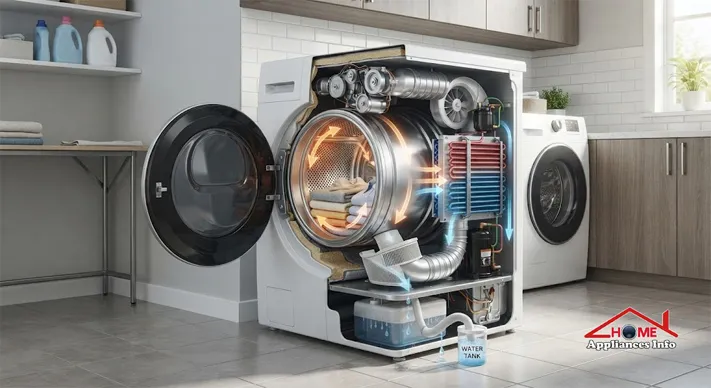
The simplest way to understand how ventless dryers work is to follow the moisture:
Wet clothes → warm air absorbs moisture → humid air passes through a heat exchanger → moisture condenses into water → drier air is reused
The exact process varies by design, but a typical cycle works like this:
- Air circulates through the rotating drum.
- The air becomes warm and absorbs moisture from the clothes.
- Humid air leaves the drum and moves through a condenser, evaporator, or heat-exchange system.
- Moisture is removed from the air and converted into liquid water.
- The water is collected or drained away.
- The air is processed and circulated back through the system.
- The cycle continues until the clothes reach the desired dryness.
A heat-pump dryer takes this closed-loop approach particularly far. ENERGY STAR explains that heat-pump dryers reuse air after moisture has been removed instead of continually exhausting heated air outdoors.
This is why a dryer without a vent can operate indoors without filling the room with the hot, humid exhaust associated with a conventional vented machine.
The Two Main Types of Ventless Dryers
1. Condenser Dryer
A conventional condenser dryer uses heat and a heat exchanger to remove moisture from the air.
The dryer warms air and sends it through the clothes. Moisture evaporates into the air, and the humid air then passes through a heat exchanger where water condenses out.
The condensed water is collected or drained.
This approach avoids the need for an exterior exhaust duct, but it generally does not recover heat as efficiently as a heat-pump system.
2. Heat-Pump Dryer
A heat-pump dryer uses refrigeration technology to move and reuse heat.
Instead of relying primarily on a conventional heating element, it circulates refrigerant through a heat-pump system. The humid air passes through an evaporator where moisture is removed. Heat can then be recovered and reused to warm the drying air.
ENERGY STAR describes heat-pump dryers as closed-loop systems and says certified heat-pump models can reduce energy use by at least 28% compared with standard dryers.
This distinction matters:
Ventless does not automatically mean heat pump.
A ventless condenser dryer and a ventless heat-pump dryer can both operate without an exterior vent, but their internal technology and energy performance are different.
Ventless Dryer Pros and Cons
Understanding the ventless dryer pros and cons is more useful than simply asking whether ventless technology is “better.” The right choice depends on how you use your laundry appliances.
Pros of a Ventless Dryer
No exterior exhaust vent
This is the biggest advantage. If your laundry room does not have an existing dryer duct, you can avoid creating a new opening through an exterior wall.
More installation flexibility
A ventless clothes dryer can be particularly practical in apartments, condos, interior laundry rooms, and compact utility areas where traditional venting is difficult.
Good option for apartments
Heat-pump models are specifically available in compact formats designed for smaller spaces. ENERGY STAR notes that compact heat-pump dryers can work well where conventional ventilation is unavailable.
Potentially lower energy use
This benefit is strongest with heat-pump technology. Because heat is recovered and reused, the appliance can use considerably less electricity than a conventional dryer.
Lower drying temperatures
Heat-pump dryers generally dry at lower temperatures. That can be gentler on fabrics and reduce unnecessary exposure to high heat.
Less heated air exhausted outdoors
Because the drying air remains within the appliance rather than being continuously exhausted, the system does not lose heated air in the same way as a conventional vented dryer.
Cons of a Ventless Dryer
Longer drying cycles
This is the trade-off many buyers notice first.
Consumer Reports’ recent testing of compact dryers found that vented models averaged a little over one hour for a 6-pound mixed load, while ventless compact dryers in its tests took roughly 1⅓ to 2½ hours. Actual times vary according to load size, fabric, moisture level, and dryer design.
Higher upfront cost on some models
Heat-pump systems are more technologically complex and can cost more initially. The potential operating savings need to be considered over the appliance’s useful life rather than looking only at the purchase price.
Water must be managed
The moisture removed from clothes becomes liquid water. Depending on the model, you may need to empty a tank or connect a drain hose.
Regular maintenance is still necessary
Lint filters, heat exchangers, condensers, and other components need attention according to the manufacturer’s instructions.
Some compact models have smaller capacities
Compact ventless machines can be excellent for small spaces, but their drum capacity may be less than that of a full-size conventional dryer.
Ventless Dryer vs Vented Dryer
The most useful vented vs ventless dryer comparison comes down to installation, drying speed, moisture handling, energy use, and maintenance.
| Feature | Ventless Dryer | Vented Dryer |
|---|---|---|
| Exterior exhaust duct | Not required | Required |
| Installation flexibility | Generally higher | More dependent on existing venting |
| Apartment suitability | Often suitable | Depends on building and vent access |
| Moisture removal | Condensation/heat exchange | Exhausted outdoors |
| Heat-pump technology | Common | Not used in traditional vented configuration |
| Drying speed | Often slower | Generally faster |
| Energy efficiency | Especially strong with heat pump | Varies by model and technology |
| Drying temperature | Often lower | Usually higher |
| Water handling | Tank or drain | Moisture exits through exhaust |
| Maintenance | Lint filter plus applicable heat exchanger/condenser | Lint filter and exhaust system |
| Exterior wall duct | No | Yes |
| Initial purchase price | Can be higher | Often lower, depending on model |
One important qualification is worth emphasizing: ventless and energy efficient are not interchangeable terms.
A heat-pump ventless dryer can be highly efficient, but the word “ventless” by itself does not guarantee the lowest energy consumption. ENERGY STAR’s current product information separately identifies ventless configuration and heat-pump technology.
Do Ventless Dryers Need a Vent?
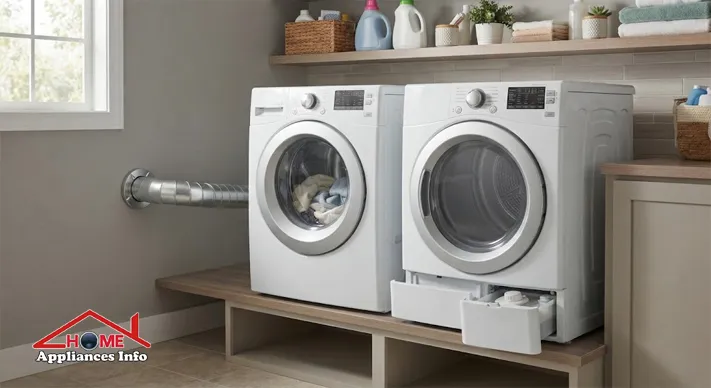
No. A properly designed ventless dryer does not require the conventional exterior exhaust duct used by a vented dryer.
However, ventless does not mean installation-free.
You still need to follow the manufacturer’s requirements for:
- Electrical connection
- Appliance clearance
- Room conditions
- Drainage or water collection
- Filter access
- Stacking, if applicable
ENERGY STAR notes that heat-pump dryers do not require ventilation because the drying air is not released through an exterior exhaust vent.
Always use the installation instructions for the specific model rather than assuming every ventless dryer has identical requirements.
Do Ventless Dryers Take Longer to Dry?
Generally, yes.
A vented dryer can continuously remove humid air and replace it with drier air. A ventless machine must remove moisture through its internal condensation or heat-pump system, which can make the process slower.
Recent Consumer Reports testing illustrates the difference in compact machines, but there is no universal drying time for all ventless dryers.
Drying time can also change depending on:
- Load size
- Fabric thickness
- Washer spin speed
- Remaining moisture after washing
- Dryer capacity
- Selected cycle
- Moisture sensors
- Filter cleanliness
- Ambient conditions
A practical way to improve drying performance is to avoid overloading the drum and use an appropriate spin speed in the washer. Removing more water before the clothes enter the dryer gives the dryer less moisture to remove.
If you’re also considering a washer-dryer combination, Home Appliances Info’s Mijia washer-dryer guide discusses the space-saving characteristics and wash-and-dry convenience of combo appliances.
Where Does the Water Go?
This is one of the most common questions about a non vented dryer.
When moisture is removed from the air, it becomes liquid water. The appliance then has to do something with it.
Most systems use one of two approaches.
Water collection tank
The water is stored in a removable reservoir. You empty the tank when it becomes full or according to the appliance’s instructions.
Drain hose
Some models can send condensed water directly into a drain through a hose. This reduces the need to empty a reservoir manually.
ENERGY STAR notes that heat-pump dryers can use a drain hose or a holding tank, depending on the model and installation arrangement.
Before buying, check exactly how the model handles condensate. A dryer that requires manual tank emptying may be less convenient if you run several loads every day.
Are Ventless Dryers Energy Efficient?
Many ventless heat-pump dryers are highly energy efficient, but the technology matters.
Heat-pump dryers recover and reuse heat instead of repeatedly generating heat and exhausting it outside. ENERGY STAR says certified heat-pump dryers can use at least 28% less energy than standard dryers.
That does not mean every household will save the same amount of money. Actual savings depend on electricity prices, laundry frequency, load size, cycle selection, appliance efficiency, and how long the machine is used.
The distinction is therefore simple:
Ventless = no conventional exterior exhaust duct.
Heat pump = a particular technology that can improve energy efficiency by recovering and reusing heat.
A dryer can be ventless without being a heat-pump model.
Are Ventless Dryers Good for Apartments?
A ventless dryer can be a practical solution for an apartment when a conventional exhaust duct is unavailable or difficult to install.
This is especially relevant for:
- Apartments
- Condos
- Studio homes
- Interior laundry closets
- Small utility rooms
- Basement laundry areas
- Homes where exterior wall modifications are undesirable
The absence of an exhaust duct can simplify installation, but apartment residents should still check building rules, electrical requirements, drainage, available clearances, and appliance restrictions.
If space is your main concern, a washer-dryer combo is another option. Home Appliances Info’s portable washing machine and dryer combo guide covers compact laundry arrangements that can be useful in smaller homes.
How Much Maintenance Does a Ventless Dryer Need?
Ventless technology does not eliminate maintenance. In fact, keeping airflow and heat-exchange components clean is important for maintaining performance.
Follow the specific manufacturer’s schedule, but typical care can include:
- Cleaning the lint filter regularly
- Checking the condensate tank when applicable
- Inspecting the drain hose
- Cleaning the condenser or heat exchanger when required
- Cleaning moisture sensors when instructed
- Keeping the area around the appliance clear
ENERGY STAR recommends regular filter maintenance to help heat-pump dryers operate efficiently.
The exact cleaning procedure varies considerably between brands and models, so avoid treating a generic maintenance schedule as universal.
For broader dryer-care information, you can also explore the site’s existing Electrolux dryer guide, which discusses dryer features such as moisture sensors, fabric-care settings, and routine lint-filter cleaning.
What to Look for When Buying a Ventless Dryer
If you’re shopping for a ventless laundry dryer, focus on the specifications that affect everyday use rather than simply choosing the machine with the longest feature list.
Drying technology
Determine whether the appliance is a conventional condenser model or a heat-pump dryer.
Capacity
Choose a drum size that matches your normal laundry loads. A compact machine may fit beautifully in a small room but become frustrating if your household regularly washes bulky loads.
Drying time
Look at the manufacturer’s published cycle information and independent testing where available. Do not assume that two ventless machines will dry at the same speed.
Energy efficiency
Look for ENERGY STAR certification where available and compare the appliance’s energy-use information.
Water drainage
Check whether the dryer uses a removable tank, drain hose, or both.
Maintenance access
A filter or heat exchanger that is difficult to reach can make routine cleaning unnecessarily inconvenient.
Electrical requirements
Installation requirements differ by appliance and market. Confirm the required voltage, outlet, circuit, and installation conditions before purchasing.
Stacking compatibility
If floor space is limited, confirm that the dryer is specifically approved for stacking with the washer you intend to use.
Who Should Consider a Ventless Dryer?
A ventless model may fit your situation particularly well if you:
- Live in an apartment or condo
- Do not have an exterior dryer vent
- Want to avoid installing new ductwork
- Have a compact or unusual laundry space
- Prefer lower-temperature drying
- Want a heat-pump dryer
- Run enough laundry for energy savings to matter
On the other hand, a conventional vented dryer may be more appealing if your main priority is fast drying and you already have a properly installed exhaust duct.
Neither setup is universally right for every household. The decision becomes much easier when you compare the actual constraints of your laundry room with your normal laundry habits.
Frequently Asked Questions
What is a ventless dryer?
A ventless dryer is a clothes dryer that removes moisture without exhausting hot, humid air through a conventional exterior dryer duct. It typically uses condensation or heat-pump technology.
How does a ventless dryer work?
It circulates warm air through wet clothes, removes the resulting moisture through an internal condensation or heat-pump system, collects or drains the water, and recirculates the processed air.
Are ventless dryers slower than vented dryers?
Generally, yes. Ventless models often have longer drying cycles, although actual performance varies by model, load, fabric, capacity, and technology.
Are ventless dryers energy efficient?
Heat-pump ventless dryers can be highly efficient. ENERGY STAR says certified heat-pump dryers can reduce energy use by at least 28% compared with standard dryers.
Can you install a ventless dryer in an apartment?
Often, yes. The lack of a conventional exterior exhaust duct makes ventless models useful in apartments and other compact spaces, provided the building and appliance installation requirements are satisfied.
Do ventless dryers need maintenance?
Yes. Regular lint-filter cleaning and model-specific condenser, heat-exchanger, sensor, tank, or drain maintenance may be required.
Conclusion
A ventless dryer is essentially a solution to one specific problem: drying clothes without sending humid exhaust air through a conventional exterior duct.
Its biggest strengths are installation flexibility, suitability for compact spaces, and—when heat-pump technology is used—potentially strong energy efficiency. Its main compromises are usually longer drying cycles, water management, maintenance requirements, and sometimes a higher purchase price.
For an apartment or laundry room without an existing vent, the absence of ductwork can make a ventless model especially practical. If energy consumption is a major concern, pay close attention to heat-pump technology, rather than assuming every ventless machine has the same efficiency.
Before buying, compare capacity, drying time, drainage, maintenance access, electrical requirements, and energy information. That approach will tell you much more than the word “ventless” alone.
References
- ENERGY STAR — Heat Pump Dryer — information on closed-loop drying, energy savings, installation flexibility, water drainage, and maintenance.
- Whirlpool — What Is a Ventless Dryer? — explanation of condenser and heat-pump ventless drying systems and moisture collection.

📱 SMART HOME TECHNOLOGY CONSULTANT & IOT SPECIALIST
Alfredo Torres
Technology Consultant | Smart Home Automation & IoT Specialist (Lima, Peru)

🌐 Matter Protocol & IoT
⚡ Energy Efficiency
🛠️ Future-Proofing Infrastructure
Alfredo Torres is a seasoned technology consultant based in Lima, Peru, specializing in the integration of next-generation IoT ecosystems and smart home automation. With over a decade of experience navigating the rapidly evolving tech landscape of the Global South, Alfredo brings a unique, practical perspective to homeappliancesinfo.com.
As a specialist in the 2026 Matter protocol rollout, Alfredo focuses on bridging the gap between legacy household infrastructure and modern connectivity standards. His consulting work centers on “future-proofing” homes—helping users select appliances that offer maximum durability, energy efficiency, and cross-platform compatibility without the burden of “app fatigue.”
Alfredo’s expert insights are grounded in real-world problem solving, from optimizing smart kitchen workflows to implementing cost-effective home maintenance solutions in emerging markets. When he isn’t benchmarking the latest AI-integrated appliances, he can be found exploring the intersection of sustainable architecture and digital living.