

To support our research and detailed appliance reviews, we may earn a small commission from qualifying purchases made through our links, at no extra cost to you. As an Amazon Associate, I earn from qualifying purchases.
To support our research and detailed appliance reviews, we may earn a small commission from qualifying purchases made through our links, at no extra cost to you. As an Amazon Associate, I earn from qualifying purchases.
A failing RV refrigerator can turn a calm travel day into a food-safety emergency. I’ve seen it happen in hot campgrounds, roadside pull-offs, and storage yards where the freezer was still cold but the fresh-food cabinet sat at 55°F. That is why motorhome fridge repairs start with a clear process, not guesswork. Most RV refrigerators are not like home fridges. Many Dometic and Norcold models use an absorption cooling system powered by propane, 120V AC shore power, and 12V DC control power.
If you are wondering how to fix an RV refrigerator that is not cooling, this guide walks through practical checks, gas-versus-electric diagnosis, repair costs, and the common motorhome fridge problems and solutions we see most often.
Before you replace parts, also review related basics like How to Clean Refrigerator Coils, refrigerator not cooling checklist, and 12V RV electrical troubleshooting. Small maintenance issues can mimic major failures.
Quick Answer: What Usually Goes Wrong?
In my experience, most RV refrigerator failures fall into five buckets:
- The RV is not level enough for the absorption system.
- 12V DC power is missing at the control board.
- The propane burner is dirty or not igniting.
- The 120V AC heating element has failed.
- The cooling unit has leaked or become blocked.
Most industry guidance agrees on one core point: absorption RV refrigerators need heat, gravity, and ventilation to work properly. If one of those is missing, cooling drops fast.
1. Understand How an RV Absorption Refrigerator Works
Most traditional RV refrigerators do not use a compressor. Instead, an RV absorption refrigerator cooling unit heats a chemical mixture, usually ammonia, water, hydrogen gas, and corrosion inhibitor. Heat comes from either a propane flame or an electric heating element.
That heat starts a circulation process inside sealed tubing. The refrigerator then removes heat from the freezer and fresh-food cabinet.
Simple version:
- Propane mode uses a small flame.
- Electric mode uses a 120V AC heating element.
- The control board usually needs 12V DC power in both modes.
- The fridge must be reasonably level.
- Heat must escape through the rear vent area.
This is why rv fridge troubleshooting gas and electric should always include both power and airflow checks. A fridge may look “on” at the display but still fail because the control board, burner, vent fan, or heater is not doing its job.
For model-specific documentation, I like checking manufacturer manuals before ordering parts. Start with Dometic and Norcold RV fridge troubleshooting guidance and compare it with your exact model number.
2. Common Motorhome Fridge Problems and Solutions
Here is a field-style table I use when diagnosing motorhome fridge repairs. It keeps the process grounded and prevents expensive part-swapping.
| Problem | Likely Root Cause | Practical Fix |
|---|---|---|
| Fridge not cooling at all | RV unlevel, blown fuse, failed cooling unit, blocked vent | Level the RV, check fuses, inspect rear compartment, look for yellow residue or ammonia odor |
| Works on electric, fails on gas | Dirty burner, clogged orifice, no propane flow, bad igniter | Purge propane line, clean burner, inspect spark electrode |
| Works on gas, fails on electric | Bad outlet, tripped breaker, failed 120V heating element | Test outlet, check breaker, perform resistance test |
| Freezer cold, fridge warm | Poor airflow, bad thermistor placement, overloaded shelves | Move food away from fins, check fan, adjust thermistor |
| Food freezing in fridge | Thermistor slipped or control board issue | Reposition thermistor; test sensor if problem continues |
| Frost buildup | Leaky door gasket, frequent door opening, humid air | Perform gasket seal test and defrost |
| Error code on display | Control fault, ignition lockout, sensor issue | Check manual and compare with E4 Error Code troubleshooting |
I once inspected a Class C motorhome where the owner was ready to buy a new refrigerator. The issue was a slipped thermistor clipped too low on the cooling fins. We moved it, cleaned the rear vent, and the fridge returned to safe temperatures by the next morning.
3. How to Fix an RV Refrigerator That Is Not Cooling
When someone asks me how to fix an RV refrigerator that is not cooling, I follow this order.
Step 1: Verify the RV Is Level
Absorption refrigerators rely on gravity. If the RV is badly unlevel for hours, the cooling solution may not circulate properly. That can cause overheating and long-term damage.
Place a bubble level on the freezer shelf, not just the floor. Level the rig front-to-back and side-to-side. Some newer fridges tolerate slight off-level operation better than older models, but level operation remains the safest baseline.
Step 2: Confirm 12V DC Power
Even when plugged into shore power, many RV refrigerators need 12V DC power for the eyebrow display board, ignition module, and control circuits.
Check:
- House battery voltage
- 12V fuse at the RV distribution panel
- Wiring at the rear control board
- Corroded terminals
The RV fridge 12V DC eyebrow control board can cause confusing symptoms. The display may blink, show an error, or refuse to switch modes. If your RV also has lights dimming or fans slowing, review battery voltage drop testing and 12V RV electrical troubleshooting before blaming the fridge.
Step 3: Check Airflow Inside the Cabinet
Do not pack food tightly against the rear cooling fins. Cold air needs room to circulate. I recommend leaving a small gap behind containers and using a battery fan in hot weather.
If the freezer works but the fridge compartment stays warm, airflow is often the issue.
Step 4: Inspect RV Refrigerator Thermistor Placement
The thermistor senses cabinet temperature. It is usually clipped to one of the metal fins inside the fresh-food compartment.
For many models:
- Moving the thermistor higher can make the fridge colder.
- Moving it lower can make the fridge warmer.
- A loose or disconnected thermistor can cause erratic temperatures.
This small part is often overlooked in motorhome fridge repairs, but RV refrigerator thermistor placement can make a real difference.
Step 5: Look for Cooling Unit Failure
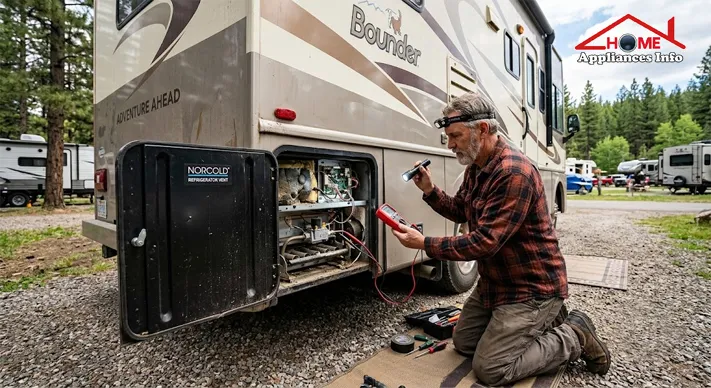
Open the exterior access panel and inspect carefully.
Warning signs include:
- Strong ammonia smell
- Yellow powdery residue
- Loud gurgling or boiling
- Heat at the boiler but no cooling
- Repeated overheating shutdowns
If you see yellow sodium chromate residue or smell ammonia, stop operating the refrigerator. A leaking cooling unit is not a cleaning job. It usually means replacement or a rebuilt cooling unit.
4. RV Fridge Troubleshooting Gas and Electric
The fastest way to isolate a problem is to test each operating mode separately. This is the heart of rv fridge troubleshooting gas and electric.
Electric Mode: 120V AC and Heating Element Checks
First, confirm the outlet behind the refrigerator has power. I usually plug in a small lamp or use a multimeter.
Then check:
- RV breaker panel
- GFCI outlet, if connected
- Refrigerator glass fuse
- Control board output
- Heating element resistance
A 120V AC heating element resistance test helps confirm whether the electric heater is open. Always disconnect power first. If the multimeter reads infinite resistance, the element has likely failed.
This repair is common and usually less expensive than replacing the refrigerator.
Propane Mode: Burner, Orifice, and Ignition
Propane mode needs fuel, spark, air, and flame sensing. If one is missing, the fridge locks out.
Try this sequence:
- Light the RV stove for 30–60 seconds to purge air from the propane line.
- Turn the fridge to gas mode.
- Listen for clicking at the burner.
- Look for a steady blue flame.
- Watch whether the flame shuts off after a few seconds.
A dirty burner is extremely common. Propane RV refrigerator burner cleaning should be done carefully. Use compressed air around the burner area, remove loose rust, and keep the flue clean. Do not push a metal pin into the brass orifice. It can enlarge the jet and create unsafe combustion.
5. Door Seals, Frost, and Ventilation Problems
Not every warm fridge has a failed part. Sometimes the refrigerator is fighting heat and humidity.
RV Fridge Door Gasket Seal Test
Use the dollar bill test. Close the door on a dollar bill and pull gently.
- Firm resistance means the seal is likely good.
- Little resistance means the gasket may be leaking.
- Repeat around all sides of the door.
A weak seal lets humid air enter. That causes frost, longer cooling times, and poor temperature recovery after meals.
The RV fridge door gasket seal test is simple, but it can save a service call. If your site has a related article, this is also a natural place to mention refrigerator door seal replacement guide.
Rear Vent and Chimney Airflow
Absorption refrigerators reject heat through the rear cabinet and roof or side vent. If the vent path is blocked by nests, dust, insulation, or debris, cooling suffers.
Check:
- Lower intake vent
- Upper roof or side exhaust vent
- Cooling fans
- Baffles behind the refrigerator
- Dust and insect nests
This is similar in spirit to How to Clean Refrigerator Coils, although RV absorption units do not have the same exposed condenser coils as many home refrigerators.
6. Mobile RV Refrigerator Repair Cost
The mobile RV refrigerator repair cost depends on the failure, travel distance, parts availability, and whether the fridge must be pulled from the cabinet.
In many areas, the mobile RV technician service call cost alone ranges from about 150to150to250. Labor and parts are added after diagnosis.
| Repair Service | Typical Parts & Labor Cost | Notes |
|---|---|---|
| Thermistor or thermal fuse replacement | 200–200–410 | Often quick if parts are available |
| Burner cleaning and combustion tune-up | 180–180–350 | Common propane-side service |
| Gas igniter or electrode replacement | 250–250–410 | Fixes many no-light issues |
| 120V heating element replacement | 310–310–480 | Common electric-mode failure |
| Control board replacement | 450–450–760 | Varies by Dometic/Norcold model |
| Cooling unit rebuild/replacement | 1,500–1,500–3,200 | Requires removal and several hours of labor |
| Full refrigerator replacement | 2,200–2,200–4,500+ | Best for old, damaged, or obsolete units |
In my experience, the decision point is age. If the fridge is relatively new and the cabinet is in excellent condition, a cooling-unit repair may make sense. If the refrigerator is old, has damaged doors, cracked plastic, and obsolete boards, replacement may be smarter.
For certification and technician standards, mobile RV technician service call cost discussions are often clearer when you work with trained RV service professionals.
7. When DIY Is Safe—and When to Stop
Some motorhome fridge repairs are reasonable for careful owners. Others are not.
DIY-friendly tasks:
- Leveling the RV
- Checking fuses and breakers
- Cleaning light debris from vents
- Testing door gaskets
- Adjusting thermistor placement
- Defrosting the fridge
- Confirming outlet power
Call a technician for:
- Propane leaks
- Ammonia smell
- Yellow cooling-unit residue
- Control board replacement if wiring is unclear
- Repeated ignition failures
- Overheating boiler area
- Fridge removal from cabinetry
Never keep operating an absorption refrigerator that smells like ammonia or shows yellow residue. That is a failed sealed system.
8. A Practical Road-Test Cooling Routine
After repairs or maintenance, I like to test the fridge before loading food.
Use this routine:
- Park level.
- Start the refrigerator 12–24 hours before travel.
- Use a fridge thermometer, not guesswork.
- Pre-chill food at home.
- Avoid opening the door often.
- Confirm freezer temperature first.
- Switch between electric and propane to verify both modes.
Safe food storage generally requires the fresh-food compartment to stay at or below 40°F. The freezer should remain near 0°F for frozen food quality.
This simple routine catches weak cooling before you are three hours from the nearest parts counter.
FAQs About Motorhome Fridge Repairs
Why is my RV fridge freezer cold but the refrigerator warm?
Usually it is an airflow, thermistor, or door-seal issue. Check food placement, fan operation, and RV refrigerator thermistor placement before assuming the cooling unit has failed.
How long should an RV absorption fridge take to cool?
Many absorption fridges need 8–24 hours to stabilize, especially in hot weather. Pre-cooling overnight is best.
Can I drive with the RV refrigerator on propane?
Rules vary by location, tunnels, ferries, and fuel stations. Many owners do, but propane must be turned off where required. Follow your RV manual and local regulations.
What does an E4 code mean on an RV refrigerator?
It depends on the brand and model. Check the manual first, then compare symptoms with E4 Error Code troubleshooting and control-board diagnostics.
Is it worth replacing an RV refrigerator cooling unit?
Sometimes. If the fridge is newer and doors, seals, and boards are in good shape, a rebuilt cooling unit can be cost-effective. For older units, replacement may offer better long-term value.
How often should I clean the burner area?
At least once a season, or sooner if the flame is yellow, ignition is unreliable, or cooling is weak on propane. Add it to your RV refrigerator maintenance checklist.
Conclusion: Fix the Simple Things First
Most RV refrigerator failures are easier to diagnose when you slow down and test one system at a time. Start with levelness, 12V DC power, airflow, thermistor position, propane ignition, and electric heating. Then look deeper.
The best motorhome fridge repairs are not rushed. They are methodical. A slipped thermistor, dirty burner, weak door gasket, or tripped breaker can look like a major failure. But if you smell ammonia, see yellow residue, or suspect propane trouble, stop and call a qualified technician.
Before your next trip, check How to Clean Refrigerator Coils, review your refrigerator not cooling checklist, and keep a thermometer inside the fridge. Small habits protect your food, your budget, and your travel plans.
References

🌐 FOUNDER & DIGITAL PUBLISHER
Muhammad Ali
Founder | SEO Strategist & E-E-A-T Digital Publishing Specialist

📈 SEO Strategy
🛠️ Appliance Optimization
🛡️ E-E-A-T Standards
Muhammad Ali is a digital publisher, SEO strategist, and founder of Home Appliances Info. He specializes in home appliance optimization, structured schema networks, and advanced E-E-A-T digital publishing standards to ensure accurate, trustworthy content across the platform.