

To support our research and detailed appliance reviews, we may earn a small commission from qualifying purchases made through our links, at no extra cost to you. As an Amazon Associate, I earn from qualifying purchases.
To support our research and detailed appliance reviews, we may earn a small commission from qualifying purchases made through our links, at no extra cost to you. As an Amazon Associate, I earn from qualifying purchases.
A baking sheet tray is one of those kitchen tools that can quietly become indispensable. It handles cookies and pastries, but a sturdy rimmed version can also roast vegetables, cook chicken, prepare potatoes, and turn a collection of ingredients into a complete sheet-pan dinner. The names can be confusing, too: baking sheet, baking tray, cookie sheet, and sheet pan are often used interchangeably even though their designs are not always identical.
The right choice depends on more than appearance. Baking sheet sizes, material, rim design, thickness, coating, and oven fit all affect how useful a tray will be in your kitchen. This guide explains the differences, common sizes, practical uses, and the features worth considering before you buy one.
What Is a Baking Sheet Tray?
A baking sheet tray is a shallow, rectangular piece of oven cookware designed to provide a broad cooking surface. Depending on the style, it may have raised edges on all four sides or a mostly flat surface with minimal edges.
A rimmed baking sheet is particularly versatile because its raised sides help keep food, oil, juices, and smaller ingredients contained. That makes it useful for both sweet and savory cooking.
A traditional cookie sheet is generally flatter, which can make it easier to slide cookies off after baking. A rimmed tray, meanwhile, is more practical for foods that release liquid or need to be tossed during roasting.
Penn State Extension describes baking sheets and cookie sheets as related but distinct tools and notes that material, coating, and construction can affect cooking performance.
The terminology also varies by country. In American recipes, you will often see sheet pan or baking sheet, while baking tray is common in British and international usage. Because product names are not standardized, the actual dimensions and construction matter more than the label on the package.
Baking Sheet vs Baking Tray: What’s the Difference?
For everyday cooking, baking sheet vs baking tray is often less a question of two completely different products and more a matter of terminology.
| Term | Typical design | Common uses |
|---|---|---|
| Baking sheet | Flat or rimmed | Baking, roasting, reheating |
| Baking tray | Usually shallow and rimmed | Baking and general oven cooking |
| Sheet pan | Usually rimmed | Roasting, baking and sheet-pan meals |
| Cookie sheet | Usually flat or minimally rimmed | Cookies and delicate baked goods |
There are exceptions, so don’t assume every product follows these descriptions exactly.
A rimmed sheet pan is generally the more flexible option for a home kitchen. Its edges can contain roasting juices and help keep vegetables from sliding off when you stir or turn them.
A flatter cookie sheet can have an advantage for cookies because the lack of a tall rim makes it easier to slide baked goods onto a cooling rack.
Cookie Sheet vs Baking Sheet
The distinction becomes especially useful when you are deciding what to buy.
A cookie sheet is designed primarily around baked goods that need a relatively unobstructed surface. A baking sheet or sheet pan with raised sides can handle a wider range of foods.
If you mostly bake cookies, biscuits, or similar items, a flatter design may be convenient. If you want one tray for vegetables, chicken, potatoes, pastries, and cookies, a rimmed model is usually the more versatile choice.
Types of Baking Sheet Trays
Different designs serve different cooking needs. You don’t necessarily need every type, but understanding the differences can help you avoid buying a tray that doesn’t suit your oven or recipes.
1. Rimmed Baking Sheet
A rimmed baking sheet has raised edges around its perimeter. It is arguably the most useful all-purpose design for many home kitchens.
The rim helps contain:
- Roasting juices
- Cooking oil
- Marinades
- Small vegetables
- Loose ingredients
- Batters that spread during cooking
It is also useful for sheet-pan meals because the edges make it easier to move the tray in and out of the oven without food sliding off.
2. Flat or Rimless Cookie Sheet
A traditional cookie sheet has little or no raised edge on most sides.
Its relatively open design is convenient for cookies and some pastries. You can also move baked goods from the pan to a cooling rack more easily.
The trade-off is containment. A rimless sheet is not the ideal baking tray for oven recipes that produce a lot of oil, sauce, or liquid.
3. Aluminum Baking Sheet
An aluminum baking sheet is popular because aluminum conducts heat efficiently and is relatively lightweight.
Aluminum trays are commonly used for cookies, pastries, roasted vegetables, and other everyday oven cooking. Penn State Extension identifies aluminum as a practical and economical material with good heat conduction, while also noting that it can be more susceptible to scratches and dents than some alternatives.
One consideration is food reactivity. If you frequently cook strongly acidic foods, using parchment or another suitable liner can be a practical way to reduce direct contact with the metal.
4. Stainless-Steel Baking Sheet
Stainless steel emphasizes durability and resistance to corrosion. However, stainless steel generally conducts heat less efficiently than aluminum.
Some pans combine different metals to balance durability with heat performance. When comparing products, look beyond the material name and check the construction and thickness.
5. Nonstick Baking Tray
A nonstick baking tray has a coated surface designed to make food release easier and cleanup more convenient.
This can be useful for sticky pastries, cookies, roasted foods, and everyday baking. However, nonstick coatings require appropriate care. Always follow the manufacturer’s temperature and cleaning instructions, particularly if the coating becomes scratched, damaged, or worn.
For people who prefer a simple, low-maintenance option, nonstick can be appealing. For maximum versatility and long-term simplicity, an uncoated metal tray may be preferable.
Baking Sheet Sizes: Which One Fits Your Kitchen?
Size is one of the most important considerations because a tray that doesn’t fit your oven is not useful, no matter how well it is made.
Common commercial-style sheet pan categories include full, half, quarter, and eighth sheets. Exact dimensions can vary by manufacturer.
| Sheet type | Approximate size | Typical use |
|---|---|---|
| Full sheet | 26 × 18 inches | Commercial kitchens and very large batches |
| Half sheet | 18 × 13 inches | Home baking, roasting and sheet-pan meals |
| Quarter sheet | 13 × 9 inches | Small batches and side dishes |
| Eighth sheet | About 9 × 6 inches | Small portions and compact cooking |
| Jelly roll pan | Around 15 × 10 inches | Jelly rolls and shallow baked dishes |
A half sheet pan around 18 × 13 inches is particularly common for home cooking. Penn State Extension similarly identifies the 13-by-18-inch pan as a common sheet-pan size for home cooks.
The dimensions above should be treated as approximate rather than universal specifications. Manufacturers may use slightly different measurements.
Why Oven Measurements Matter
Before buying a large tray, measure the oven itself rather than relying on the phrase “standard size.”
Check:
- The width between the oven walls or rack supports.
- The usable rack depth.
- The oven door opening.
- The position of heating elements or fans.
- Whether the tray can slide in and out without catching on the door.
Remember that a tray’s outside dimensions include its rim. A product advertised as 18 inches wide may have a slightly different usable cooking surface.
For a compact oven, a quarter sheet may be much more practical than a large half sheet. If you regularly cook for several people, however, a larger tray can save time by allowing you to roast more food in one batch.
What Can You Cook on a Baking Sheet Tray?
The versatility of a baking sheet is its biggest advantage.
Cookies and Pastries
A baking sheet can handle many everyday baked goods, including:
- Chocolate-chip cookies
- Biscuits
- Pastries
- Croissants
- Breadsticks
- Granola
- Certain flatbreads
For cookies, leave adequate space between portions so they can spread without merging.
Roasted Vegetables
A rimmed tray is excellent for roasting vegetables such as:
- Potatoes
- Carrots
- Broccoli
- Cauliflower
- Brussels sprouts
- Bell peppers
- Zucchini
Spread the food in a reasonably even layer rather than piling everything into the center. Better spacing allows hot air to circulate around the ingredients and encourages browning.
Meat, Poultry and Fish
A sturdy rimmed tray can also be used for chicken pieces, sausages, fish fillets, and other oven-cooked proteins.
For meat and poultry, however, don’t rely on appearance alone to judge whether the food is safely cooked. Use an appropriate food thermometer and follow recognized food-safety guidance. The USDA recommends using a food thermometer to verify safe cooking temperatures.
Sheet-Pan Meals
This is where the sheet pan becomes especially useful.
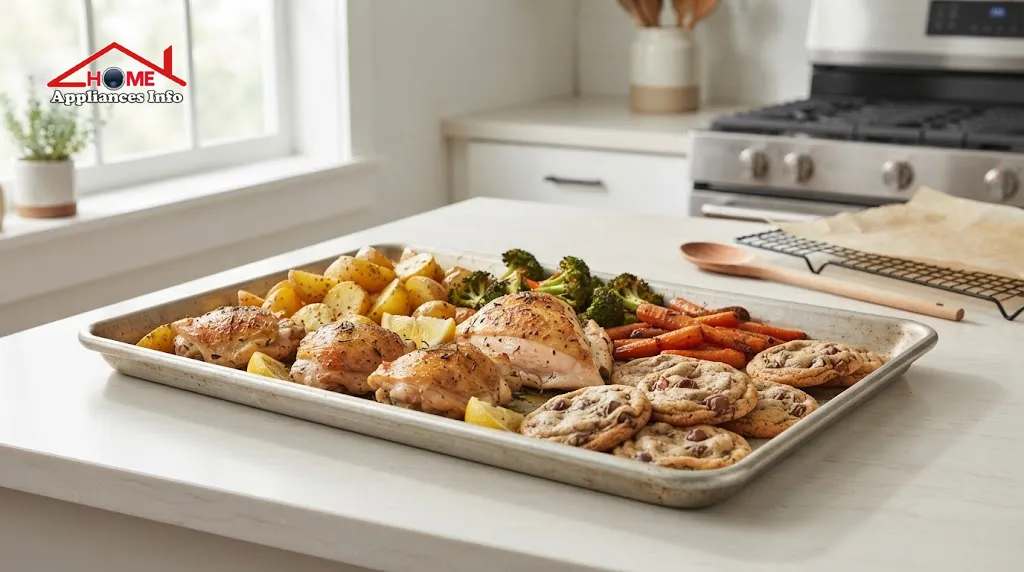
You can arrange a protein and vegetables on the same tray, season them together, and roast them in the oven. For example, chicken thighs can be paired with potatoes, carrots, and onions.
The key is timing. Ingredients that cook slowly should be cut smaller or started earlier, while quick-cooking foods can be added later.
The result is not simply fewer dishes. It can also make meal preparation more organized because the main components cook together.
Small-Batch Cooking and Reheating
A baking tray is useful for more than full meals. It can reheat pizza, crisp leftover roasted vegetables, toast nuts, warm bread, or roast a small quantity of ingredients.
For these jobs, a smaller tray can be more convenient because you are not heating or washing a much larger pan than necessary.
How to Choose the Right Baking Sheet Tray
There is no single tray that is perfect for every kitchen. Think about what you actually cook.
1. Choose the Right Size
Measure your oven before buying.
For many households, an 18 × 13-inch half sheet is a practical general-purpose size. A smaller quarter sheet can complement it for side dishes, small batches, or foods that need to cook separately.
If storage is limited, consider whether the tray can fit vertically or nest with other cookware.
2. Consider the Material
Think about the type of cooking you do most often.
Aluminum: Good heat conductivity and relatively light.
Stainless steel: Durable and resistant to corrosion, but generally not as thermally conductive as aluminum.
Coated metal: Easier food release and cleanup, but requires more careful handling.
Thickness matters, too. Very thin trays can be more prone to bending or warping, while sturdier construction tends to feel more stable.
3. Decide Whether You Need a Rim
If you roast vegetables, meat, or foods containing oil and juices, choose a rimmed model.
If your primary goal is baking cookies and you value easy food removal, a flatter cookie sheet may be more suitable.
For one-pan versatility, the rimmed design usually offers more flexibility.
4. Check the Temperature Rating
Never assume that every baking sheet is suitable for every oven temperature.
Check the manufacturer’s instructions for maximum temperature, broiler use, dishwasher compatibility, and any restrictions related to parchment, silicone mats, or cooking sprays.
This is particularly important with coated pans.
5. Think About Cleaning
An uncoated metal tray may tolerate more vigorous cleaning than a delicate coated surface, but stubborn baked-on residue can still be annoying.
Parchment paper or a suitable silicone baking mat can make cleanup easier for many recipes. Always make sure the liner is rated for the cooking temperature and used according to its instructions.
Common Baking Sheet Mistakes to Avoid
A few simple habits can make a noticeable difference.
Buying without measuring the oven: A tray can be labeled as a standard size and still be too large for your particular oven.
Overcrowding food: Too many ingredients packed together can reduce browning and encourage steaming.
Using a flat cookie sheet for liquid-heavy food: Without a substantial rim, juices and oil can run over the edge.
Ignoring the material: Different materials transfer and retain heat differently, so two trays can produce somewhat different results.
Using damaged nonstick cookware: If a coating is visibly deteriorating, check the manufacturer’s replacement guidance rather than continuing to use it indefinitely.
Cutting directly on the tray: Knives can scratch or damage coated surfaces and leave marks on some metal pans.
How to Clean and Maintain a Baking Sheet
Let the tray cool before washing it. A sudden temperature change can be hard on some cookware, and handling a hot metal tray also creates an obvious burn risk.
For ordinary cleaning:
- Remove loose food particles.
- Wash with warm water and suitable dish soap.
- Use a non-abrasive sponge when appropriate.
- Soak stubborn residue rather than immediately scraping aggressively.
- Dry the tray thoroughly before storing it.
If the tray has a nonstick coating, follow the manufacturer’s cleaning instructions rather than assuming that abrasive pads or harsh cleaners are acceptable.
For uncoated aluminum, discoloration does not necessarily mean the pan has become unusable. Appearance and cooking performance are different considerations.
A Useful Tip for Oven Cooking
If you frequently prepare foods on baking trays, don’t judge the tray in isolation. The oven itself affects the result.
Oven temperature can vary from the displayed setting, and hot spots can affect browning. An oven thermometer can help identify temperature differences if your baked foods consistently cook faster or slower than expected.
The USDA also recommends checking oven temperature with an oven thermometer when accuracy is a concern.
That can be more useful than repeatedly changing recipes to compensate for an oven whose actual temperature differs from its setting.
Baking Sheet Tray FAQs
Is a baking sheet the same as a baking tray?
Usually, the terms refer to the same general category of shallow oven cookware. Regional terminology differs, and individual products can have different designs. Check the dimensions, rim, material, and intended use rather than relying only on the name.
Is a sheet pan the same as a baking sheet?
Often, yes. In American cooking, “sheet pan” commonly refers to a shallow, rimmed baking pan. However, manufacturers may use the terms differently, so checking the actual product dimensions remains important.
What is the most useful baking sheet size for a home oven?
An approximately 18 × 13-inch half sheet is a common choice for home cooking because it offers a useful balance of cooking area and capacity. Your oven’s actual interior dimensions should determine the final choice.
Is aluminum or stainless steel better for a baking sheet?
They have different strengths. Aluminum generally provides stronger heat conductivity and is lightweight, while stainless steel emphasizes durability and corrosion resistance. The thickness and construction of the specific tray also matter.
Can I use a baking sheet for roasting vegetables?
Yes. A rimmed baking sheet is particularly suitable for roasting vegetables because its raised edges help contain oil and ingredients. Spread vegetables out rather than overcrowding them for better browning.
Can I put a baking sheet in the broiler?
Only if the manufacturer specifically states that the tray is broiler-safe. High direct heat can exceed the limits of some coatings or materials, so check the product instructions before using it under a broiler.
Conclusion
A baking sheet tray can be much more than a pan for cookies. The right one can become a reliable everyday tool for roasting vegetables, cooking proteins, preparing pastries, reheating food, and making complete sheet-pan meals.
For most home kitchens, start by thinking about oven fit and intended use. A rimmed half-sheet-size pan offers broad versatility, while a smaller quarter sheet can be useful for compact ovens and smaller portions. Aluminum is valued for its heat conductivity, stainless steel for durability, and coated surfaces for easier food release.
You don’t necessarily need an expensive collection of trays. A well-sized, sturdy pan that matches your cooking habits can cover a surprisingly wide range of recipes. Measure your oven, compare construction and material, and choose the design that makes the foods you cook most often easier to prepare.
Related Reading
If you also use specialty oven tools for snacks and baked foods, you may find our guide to silicone oven tray samosa molds and other samosa-making tools useful, particularly for understanding how tray-style molds are used in an oven.
References
- Penn State Extension — “The Sheet Pan: A Multiuse Kitchen Tool” — Used for information about sheet-pan designs, common home sizes, materials, coatings, and typical uses.
- USDA Food Safety and Inspection Service — “Keep Food Safe! Food Safety Basics” — Used for general food-safety guidance concerning cooking and temperature measurement.
- USDA Food Safety and Inspection Service — “Appliance Thermometers” — Used for guidance concerning oven-temperature verification.

🍳 HOME & KITCHEN APPLIANCE EXPERT
Sidra Altaf
Home & Kitchen Specialist | Product Evaluator & Appliance Reviewer

🏠 Home Essentials
⚖️ Product Comparisons
⚡ Energy & Efficiency
Sidra Altaf is a seasoned expert in home and kitchen appliances with over 5 years of hands-on experience in the field. Passionate about helping families make smarter choices, she specializes in reviewing, comparing, and recommending appliances that bring convenience, efficiency, and innovation into everyday living. Her deep knowledge of product functionality, durability, and design makes her a trusted voice for anyone looking to upgrade their home.