

To support our research and detailed appliance reviews, we may earn a small commission from qualifying purchases made through our links, at no extra cost to you. As an Amazon Associate, I earn from qualifying purchases.
To support our research and detailed appliance reviews, we may earn a small commission from qualifying purchases made through our links, at no extra cost to you. As an Amazon Associate, I earn from qualifying purchases.
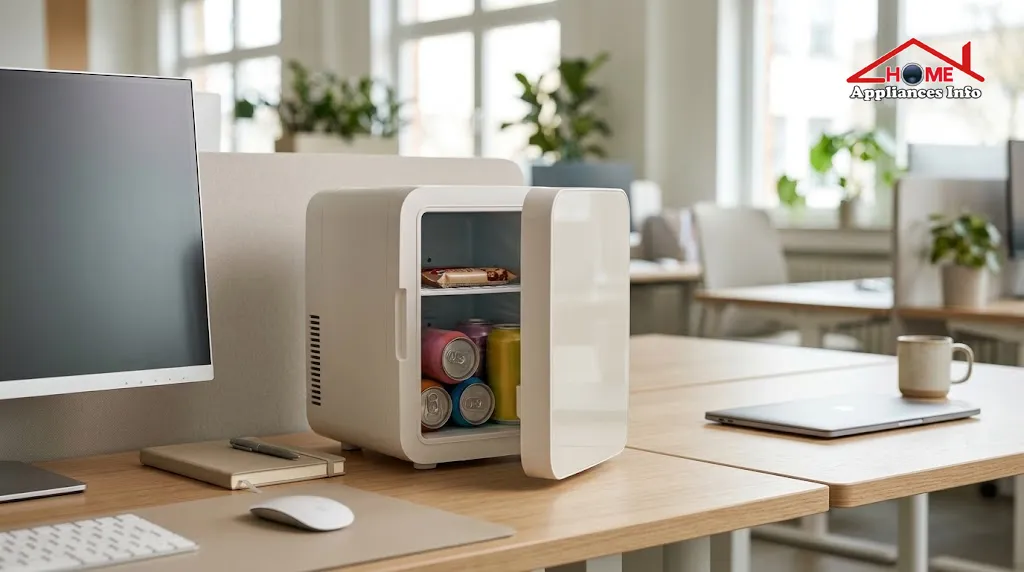
A desk mini fridge for office use can be surprisingly useful when you want a cold drink, snack, fruit, or personal food within easy reach without walking to a shared kitchen. But there is an important distinction to understand before buying: the tiniest personal fridges are usually thermoelectric coolers, while larger mini refrigerators typically use compressors.
That difference affects cooling performance, noise, portability, capacity, and even what foods you should safely store inside.
For a quiet workstation, the compact thermoelectric models are usually the most convenient. The Cooluli Classic 4L and AstroAI 4L, for example, are designed around small personal storage and can accommodate roughly six cans. Larger Cooluli models provide more space while retaining thermoelectric cooling. If you need refrigerator-style temperature control for meals and perishables, a compressor model such as the VEVOR 3.2-cu-ft refrigerator is a different category altogether.
Here are seven options worth considering in 2026, followed by the key differences that should guide your choice.
Quick Comparison: 7 Office Mini Fridges
Mini Fridge Comparison Chart
Compare capacities, cooling technology, and key features side-by-side.
| Model | Capacity | Cooling Type | Best Suited For | Standout Feature |
|---|---|---|---|---|
| Cooluli Classic 4L | 4L / 6 cans | Thermoelectric | Very small desks | AC/DC and USB power |
| AstroAI 4L/6-Can | 4L / 6 cans | Thermoelectric | Budget-conscious desk users | Compact AC/DC design |
| AstroAI 6L/8-Can 2.0 | 6L / 8 cans | Thermoelectric | More drinks in a small footprint | Larger capacity |
| Cooluli Classic 10L | 10L | Thermoelectric | Personal office storage | More room without compressor bulk |
| Cooluli Infinity 10L | 10L / 12 cans | Thermoelectric | Stylish office setups | Cooling and warming |
| Cooluli Infinity 15L | 15L / 18 cans | Thermoelectric | More snacks and drinks | Larger portable capacity |
| VEVOR 3.2 Cu. Ft. | 90L / 3.2 cu. ft. | Compressor | Under/next-to-desk refrigeration | Adjustable refrigerator temperature |
Specifications and prices can vary by region, retailer, and current promotion. Manufacturer pages should be checked before purchase.
1. Cooluli Classic 4L — Best for a Very Small Desk
If your priority is keeping the refrigerator as small as possible, the Cooluli Classic 4L is one of the most desk-oriented choices in this group.
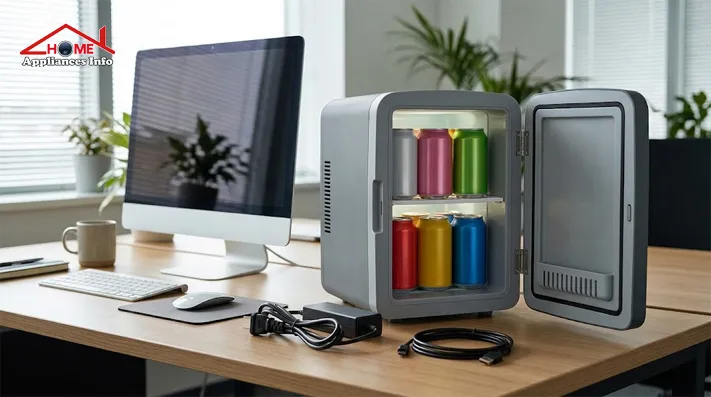
Cooluli lists the Classic 4L as a compact cooler/warmer capable of holding up to six 12-ounce cans. The manufacturer also supports AC and DC operation, while its FAQ says the Classic 4L can be powered through a suitable USB power bank in ECO mode.
That combination makes it particularly interesting for a home office, cubicle, bedroom workstation, or anyone who occasionally wants to move the unit between an office and vehicle.
The cooling system is thermoelectric rather than compressor-based. Cooluli says its thermoelectric units are designed for quiet operation and can cool contents approximately 35–40°F below ambient temperature under normal cooling operation.
That last point matters. If your office is 75°F, “35–40°F below ambient” does not mean the refrigerator independently maintains a fixed refrigerator temperature under every condition. Its performance depends on the surrounding temperature.
Why consider it: Extremely compact, portable, and well suited to a six-can setup.
Watch out for: USB ECO mode provides less cooling than normal operation, according to Cooluli, so it should not automatically be treated as equivalent to a conventional refrigerator.
2. AstroAI 4L/6-Can — Best Small Budget-Style Option
The AstroAI 4L/6-Can follows the same basic concept but gives shoppers another compact option to compare.
Current AstroAI specifications list a 4-liter capacity with room for six 330-ml cans. The manufacturer also lists AC/DC operation and a compact footprint of about 69.6 square inches.
This is the type of appliance that makes sense if you primarily want cold beverages or a few small snacks rather than a replacement for the refrigerator in your kitchen.
Its compact dimensions are particularly relevant if your desk has limited depth. A small personal cooler can sit on a sturdy desk, side table, or nearby shelf without taking up the floor space required by a conventional mini refrigerator.
For shoppers searching specifically for a 6 can mini fridge for desk, 4-liter models are the most natural category to investigate because their storage is intentionally built around a handful of cans rather than full meal containers.
Why consider it: Small footprint, six-can capacity, and AC/DC portability.
Watch out for: Like other thermoelectric coolers, it should not be assumed to provide the same temperature control as a compressor refrigerator.
3. AstroAI 6L/8-Can 2.0 — More Capacity Without a Big Jump in Size
Need a little more room but still want something portable? The AstroAI 6L/8-Can is a logical step up.
AstroAI currently specifies an 8-can capacity using 355-ml cans, a 6-liter internal capacity, thermoelectric cooling, and AC/DC operation. Its listed dimensions are approximately 25 × 18.5 × 31 cm on one current version.
That extra capacity can make a noticeable difference if your daily office routine involves several drinks, yogurt-sized snacks, fruit, or other compact items.
It is also useful for people who want one unit that can move between a workplace and vehicle. You get more internal space than a 4L cooler without moving into the physical size of a traditional under-desk refrigerator.
Why consider it: A practical middle ground between a six-can personal cooler and a much larger refrigerator.
Watch out for: The taller body needs more vertical clearance, so measure your available space rather than judging size from the capacity alone.
4. Cooluli Classic 10L — More Office Storage While Staying Compact
The Cooluli Classic 10L is aimed at shoppers who have outgrown the tiny 4L format.
Cooluli’s current product listings place the Classic 10L in its Classic Series alongside the 4L and 15L models.
A 10-liter personal refrigerator is better suited to someone who wants more than a few drinks but still does not want a full-size appliance underneath the desk. It can be useful for snacks, beverages, fruit, small food containers, or personal items that need cooling.
It is still important to remember the cooling category. The Classic line is based on thermoelectric cooling, so the unit should be viewed as a personal cooler rather than a miniature version of a compressor refrigerator.
That makes this format particularly attractive in offices where low noise and portability are more important than maximum temperature precision.
Why consider it: More storage than the smallest desktop models without jumping to a 90-liter refrigerator.
Watch out for: Make sure the available clearance around the unit is sufficient for airflow.
5. Cooluli Infinity 10L — A Stylish Portable Office Cooler
The Cooluli Infinity 10L is another 10-liter option, but it places more emphasis on appearance and portability.
Cooluli lists capacity for up to 12 twelve-ounce cans, AC 100–240V and DC 12V/5A power, a foldaway carry handle, and both cooling and warming functions. It does not use a compressor; Cooluli describes the Infinity series as using its EcoMax thermoelectric system.
The manufacturer says the unit can cool approximately 35–40°F below ambient temperature and warm contents to as much as 149°F.
The warming function may be useful for certain office situations, but it should not be confused with a food-heating appliance designed to cook meals.
The Infinity 10L also has a secure-lock door handle and is explicitly positioned for offices, bedrooms, and dorm rooms.
Why consider it: Good fit for a visible office setup where appearance, portability, and additional storage all matter.
Watch out for: It is substantially larger than a 4L desktop cooler, so measure your intended location first.
6. Cooluli Infinity 15L — For a Larger Personal Storage Area
If your definition of a personal office fridge includes considerably more food and drinks, the Cooluli Infinity 15L moves into a larger category while retaining thermoelectric cooling.
Cooluli states that the 15L model can hold up to 18 twelve-ounce cans. It uses AC 100–240V and DC 12V/5A power, has a foldaway handle, and provides cooling and warming functions.
The manufacturer lists exterior dimensions of approximately 10.5 × 14.8 × 13 inches and a weight of about 10.7 pounds.
That makes it much more suitable beside or underneath a desk than directly on a small workstation.
Cooluli also notes that the Infinity 15L produces a slight fan sound during operation. The company still classifies its thermoelectric system as quiet, but “quiet” should not be interpreted as completely silent.
Why consider it: A useful choice when 4L or 6L personal coolers simply do not provide enough storage.
Watch out for: It is portable, but it is no longer a tiny desktop appliance.
7. VEVOR 3.2 Cu. Ft. — Best If You Need a True Refrigerator
The VEVOR 3.2-cu-ft mini refrigerator is fundamentally different from the first six choices.
Its 90-liter cabinet uses a compressor and has a manufacturer-listed refrigerator temperature range of approximately 30.2–50°F. VEVOR also lists noise of up to 35 dB, adjustable shelves, and a reversible door.
This is the type of small under desk fridge for work to consider when you want to store actual meals, dairy products, leftovers, or a larger quantity of food rather than just a few drinks.
It is also much bigger than a 4L or 6L personal cooler. In practice, that means you should think of it as a compact office refrigerator that happens to fit beneath or beside a desk—not as a desktop beverage cooler.
For readers comparing conventional refrigerator categories, the refrigerator buying guide on Home Appliances Info provides additional information about capacity, temperature control, cooling technology, storage, and maintenance.
Why consider it: Real refrigerator-style cooling and substantially more storage.
Watch out for: Larger footprint, less portability, and compressor operation.
Thermoelectric vs. Compressor: Which Type Should You Buy?
This is arguably the most important decision in the entire comparison.
Thermoelectric mini fridges
Thermoelectric appliances use a semiconductor-based cooling system rather than a conventional compressor. They are particularly useful when compact size, portability, and relatively quiet operation are priorities.
Typical advantages include:
- Very small footprints
- AC/DC operation on many models
- Easy movement between rooms or vehicles
- Cooling and, on some models, warming
- Lower mechanical complexity than compressor refrigerators
- Good suitability for drinks and snacks
The major limitation is temperature control. Cooluli explains that its thermoelectric units cool relative to ambient temperature rather than simply maintaining one fixed refrigerator temperature.
Compressor refrigerators
Compressor models are closer to what most people think of as a refrigerator.
They are generally better suited to:
- Perishable foods
- Larger meals
- Dairy products
- Leftovers
- Longer-term cold storage
- More controlled refrigerator temperatures
They are also larger and less convenient to carry around.
If your priority is a quiet mini fridge for office desk use, thermoelectric technology may make more sense. If food safety and controlled refrigerator temperatures are the priority, a compressor model deserves much more attention.
Can You Safely Store Food in a Tiny Desk Fridge?
This is where shoppers should be careful with the word “fridge.”
The USDA recommends keeping refrigerators at 40°F (4°C) or below. Perishable foods should not simply be placed in a cooler that happens to feel cold and assumed to be safely refrigerated.
That distinction matters because a thermoelectric cooler’s performance changes with the surrounding temperature.
For example, a personal cooler might be perfectly convenient for unopened drinks during the workday. But if you plan to store meat, dairy, cooked leftovers, or other highly perishable foods for extended periods, use a refrigerator that can reliably maintain a safe temperature and verify it with an appliance thermometer.
The USDA specifically recommends using an appliance thermometer to verify refrigerator temperature.
For more refrigerator-care information, you can also see this guide on cleaning refrigerator coils, particularly if you eventually choose a compressor-powered mini refrigerator.
What to Look For Before Buying
1. Measure your space
Do not shop by liters alone. Measure the width, depth, and height of the exact location, then check the manufacturer’s exterior dimensions.
A 4L unit may fit comfortably on a desk while a 15L model could become awkward. A 3.2-cu-ft refrigerator needs a completely different amount of space.
2. Consider noise
In a private office, even a modest fan can become noticeable after several hours.
Thermoelectric models are often attractive for this reason, but they are not necessarily silent. Cooluli, for example, notes that a slight fan sound is normal on its Infinity models.
3. Check the power system
If the fridge will remain at work, AC power may be all you need.
If you want a portable mini fridge for office and car, look for a model with both AC and DC support. Never assume that a USB connection provides the same cooling performance as a wall outlet.
Cooluli specifically recommends disconnecting its vehicle-powered units when the engine is off because continued operation can drain the vehicle battery.
4. Leave ventilation space
A compact appliance still needs to release heat.
Cooluli recommends at least two inches of clearance around its units for airflow and circulation.
This is especially important when placing a cooler under a desk or inside a confined cabinet.
5. Think about what you actually store
For six cans and a few small snacks, 4L can be enough.
For a combination of drinks and lunch items, 6–10L gives you more flexibility.
For family-sized meal containers or several days of perishable food, a compressor refrigerator is the more appropriate category.
Which Size Makes Sense for an Office?
A simple way to narrow the choice is to start with your daily routine.
Choose around 4L if: you mainly want drinks, small snacks, or a personal beverage cooler.
Choose around 6L: if you want slightly more capacity without giving up portability.
Choose around 10–15L: if you need room for several drinks plus food containers and want a personal refrigerator-style appliance.
Choose around 90L/3.2 cu. ft.: if you need genuine refrigerator storage and controlled temperatures rather than a tiny personal cooler.
That is why there is no single perfect model for every office. A person working at a small desk has very different requirements from someone who wants to keep lunch, dairy products, and leftovers cold throughout the workday.
FAQs
Is a 4L mini fridge big enough for a desk?
For drinks and small snacks, usually yes. Current 4L models from Cooluli and AstroAI are designed around approximately six cans, making them particularly suitable for personal use rather than large meal storage.
What is the quietest type of mini fridge for an office?
Thermoelectric models are generally the category to investigate when low noise is important. They avoid the conventional compressor used by larger refrigerators, although many still use a fan and therefore are not completely silent.
Can I use a mini fridge in my car?
Some compact thermoelectric models support 12V DC vehicle power. Cooluli and AstroAI both list AC/DC options on relevant models. However, follow the manufacturer’s vehicle-power instructions and disconnect the unit when the vehicle is off if recommended.
Can a thermoelectric mini fridge keep food safely refrigerated?
Not necessarily. The key issue is whether the appliance can reliably maintain 40°F or below, the USDA’s recommended refrigerator temperature. If it cannot, do not treat it as a conventional refrigerator for long-term storage of perishable foods.
Is a compressor mini fridge better for storing lunch?
If your lunch contains perishable foods that need reliable refrigeration, a compressor model with controlled temperature is generally the more appropriate category. The trade-off is greater size, weight, and less portability.
How much clearance does a small office fridge need?
Follow the manufacturer’s installation instructions. As one example, Cooluli recommends at least two inches of clearance for airflow around its thermoelectric units.
Final Verdict: Which Desk Mini Fridge Fits Your Workspace?
The right desk mini fridge for office use depends less on the word “mini” and more on what you expect the appliance to do.
For a genuinely tiny personal setup, the Cooluli Classic 4L and AstroAI 4L/6-Can are the most closely aligned with the six-can desktop concept. The AstroAI 6L gives you a little more room without abandoning portability.
If you want more storage while keeping a compact personal-cooler format, the Cooluli Classic 10L, Infinity 10L, and Infinity 15L move progressively upward in capacity. They are particularly useful when drinks and snacks are the main purpose.
The calculation changes when you need reliable refrigerator temperatures. A compressor model such as the VEVOR 3.2-cu-ft refrigerator is substantially larger, but its temperature-control approach makes it much more appropriate for perishable foods.
In short, choose thermoelectric for compactness, quiet personal cooling, and portability; choose a compressor refrigerator when controlled temperature and genuine food storage matter more than portability. Measuring your available space and deciding what you will store before buying will usually lead to a better choice than simply choosing the largest capacity that fits your budget.
References
- Cooluli — Classic Series / Product Information and FAQ: specifications, power options, thermoelectric cooling behavior, ventilation, noise, and vehicle-use guidance.
- AstroAI — 4L/6-Can and 6L/8-Can Mini Fridge Product Pages: capacity, dimensions, cooling method, and AC/DC specifications.
- USDA Food Safety and Inspection Service — Refrigeration & Food Safety: recommended refrigerator temperature and guidance for safely storing perishable foods.

📱 SMART HOME TECHNOLOGY CONSULTANT & IOT SPECIALIST
Alfredo Torres
Technology Consultant | Smart Home Automation & IoT Specialist (Lima, Peru)

🌐 Matter Protocol & IoT
⚡ Energy Efficiency
🛠️ Future-Proofing Infrastructure
Alfredo Torres is a seasoned technology consultant based in Lima, Peru, specializing in the integration of next-generation IoT ecosystems and smart home automation. With over a decade of experience navigating the rapidly evolving tech landscape of the Global South, Alfredo brings a unique, practical perspective to homeappliancesinfo.com.
As a specialist in the 2026 Matter protocol rollout, Alfredo focuses on bridging the gap between legacy household infrastructure and modern connectivity standards. His consulting work centers on “future-proofing” homes—helping users select appliances that offer maximum durability, energy efficiency, and cross-platform compatibility without the burden of “app fatigue.”
Alfredo’s expert insights are grounded in real-world problem solving, from optimizing smart kitchen workflows to implementing cost-effective home maintenance solutions in emerging markets. When he isn’t benchmarking the latest AI-integrated appliances, he can be found exploring the intersection of sustainable architecture and digital living.