

To support our research and detailed appliance reviews, we may earn a small commission from qualifying purchases made through our links, at no extra cost to you. As an Amazon Associate, I earn from qualifying purchases.
To support our research and detailed appliance reviews, we may earn a small commission from qualifying purchases made through our links, at no extra cost to you. As an Amazon Associate, I earn from qualifying purchases.
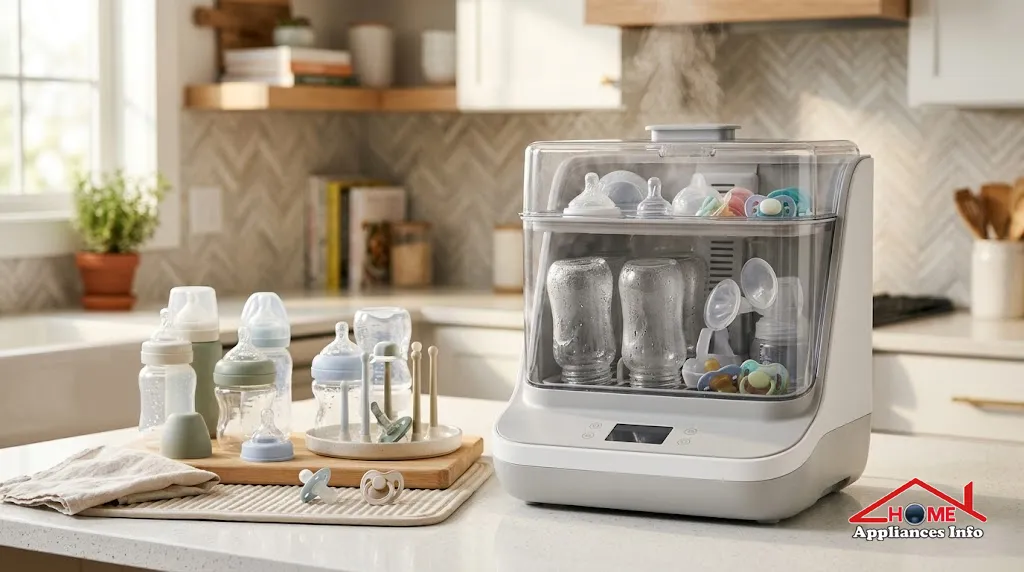
For exhausted parents, the bottle pile seems to grow when the rest of the house finally gets quiet. I know why an all-in-one bottle washer and sterilizer is so appealing: instead of scrubbing nipples, valves, pump parts, and bottles one by one, you can load the machine and let it handle much of the repetitive work. In 2026, these machines have become more capable, but the best choice is not simply the one with the longest feature list. Cleaning performance, drying, capacity, drainage, maintenance, compatibility, noise, and everyday convenience matter more.
I reviewed current 2026 hands-on testing alongside manufacturer specifications and CDC guidance. Babylist’s March 2026 testing placed the Momcozy KleanPal Pro first overall, followed by Papablic, GROWNSY, and Baby Brezza for different use cases.
The result is a shortlist that focuses on how these machines fit into real feeding routines—not just how impressive their specifications look on a product page.
2026 Quick Ranking
| 🏆 Rank | 🍼 Model | 🎯 Best for | 💪 Standout strength | ⚠️ Main drawback |
|---|---|---|---|---|
| 1 | Momcozy KleanPal Pro | Best overall | Strong balance of cleaning, drying, capacity and quiet operation | Requires sink drainage |
| 2 | Papablic Bottle Washer Sterilizer Dryer | High-volume feeding | Large capacity and shorter full cycle | Large footprint; needs drainage |
| 3 | GROWNSY All-in-One | Ease of use | Clear controls and flexible loading | Requires sink drainage |
| 4 | Baby Brezza Bottle Washer Pro | No-sink setup | Separate clean/dirty tanks and flexible placement | Larger and noisier |
1. Momcozy KleanPal Pro — Best Overall
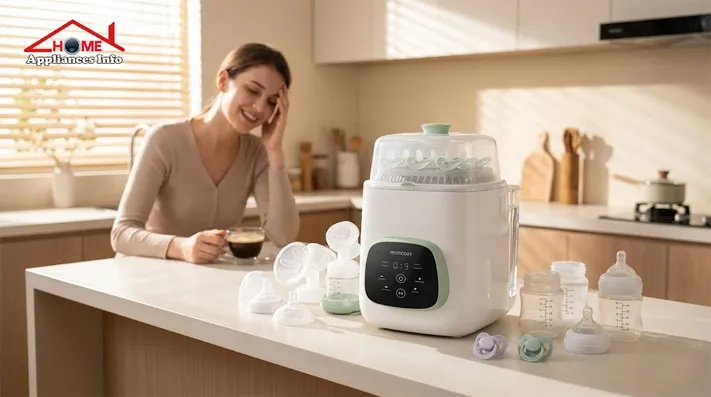
The Momcozy KleanPal Pro earns my top spot because it strikes the best overall balance for a typical bottle-feeding household.
Babylist’s hands-on tester also selected it as the overall winner, praising its intuitive design, flexible loading, cleaning performance, size, and noise level. The machine handles bottles, pump parts, pacifiers, and other feeding accessories, while its waste water drains directly through a hose.
What stands out?
Momcozy lists a 2.5-liter water requirement, steam sterilization, HEPA-filtered drying, and storage for up to 72 hours. Its rated capacity is four bottles plus accessories, although the practical load changes when larger pump parts are included.
Babylist’s testing measured:
- 19-minute rapid wash
- About 99 minutes for the full wash, sterilize, and dry cycle
- Approximately 2.5 liters of water
- Flexible rack configuration
- Strong performance with bottles and accessories
That combination is important. A machine can have impressive cleaning technology but still become frustrating if loading it is awkward.
I particularly like the workflow here. You can load the bottles, position the smaller parts, start the cycle, and move on to something else. For a parent dealing with several feeds a day, removing those repeated hand-washing steps can be more valuable than shaving ten minutes from a cycle.
Best for: Parents who want the best overall baby bottle washer and sterilizer dryer and have convenient access to a sink.
2. Papablic Bottle Washer Sterilizer Dryer — Best for Capacity
If your kitchen counter regularly looks like a small bottle factory, Papablic deserves serious consideration.
Babylist ranked its Papablic model second overall and highlighted its XL capacity, flexible racks, relatively short full cycle, and three-year warranty. Its testing found room for up to eight bottles or combinations of bottles, pump parts, and accessories.
The full cycle was approximately 84 minutes in Babylist’s testing, compared with about 99 minutes for the Momcozy. Both used approximately 2.5 liters of water in that comparison.
That difference may not sound dramatic. But imagine waiting for bottles before the next feed. Fifteen minutes can suddenly feel very significant.
The larger interior is particularly attractive for exclusive pumpers or families washing several feeding components at once.
Pros
- Large loading area
- Up to eight bottles according to testing
- Flexible rack arrangement
- 19-minute rapid wash
- Approximately 84-minute full cycle
- 2.5-liter water use in Babylist testing
- Three-year warranty cited by Babylist
Cons
- Takes up considerable counter space
- Requires sink drainage
- May be unnecessary for parents using only one or two bottles daily
Best for: Exclusive pumpers, formula-feeding families, and anyone who needs to wash a large batch of feeding equipment.
3. GROWNSY All-in-One — Easiest to Use
The GROWNSY All-in-One Baby Bottle Washer, Sterilizer and Dryer is the choice I would make for parents who value straightforward controls over flashy features.
Babylist named it the easiest to use after hands-on testing. The reviewer specifically liked its clearly labeled controls, detailed quick-start instructions, and flexible racks.
It also offers a 19-minute quick wash and approximately 99-minute full wash, sterilize, and dry cycle in Babylist’s testing.
The practical advantage is simple: you should not need to study a complicated manual every time you want to wash a bottle.
That matters at 3 a.m.
Pros
- Clear controls
- Helpful setup instructions
- Flexible loading
- Good bottle and accessory capacity
- 2.5-liter water use in testing
- Strong washing and drying performance
Cons
- Requires sink drainage
- Slightly deeper than some competitors
- Full cycle is not especially short
Best for: Parents who want an automatic baby bottle washer that feels uncomplicated from the first use.
4. Baby Brezza Bottle Washer Pro — Best No-Sink Option
The Baby Brezza Bottle Washer Pro takes a different approach. Instead of requiring a drain hose, it uses separate clean- and dirty-water tanks.
That makes it much easier to position away from a kitchen sink.
Babylist named it the best bottle washer for a non-kitchen setup, while Baby Brezza says the machine uses 20 high-pressure spray jets, steam sterilization, HEPA-filtered hot-air drying, and six cleaning settings.
The manufacturer lists capacity for up to four bottles plus accessories and says the machine can operate anywhere in the home because of its removable water tanks.
This is where layout becomes more important than specifications.
If your sink is across the kitchen from your preferred bottle station, a drain hose can be a nuisance. Baby Brezza solves that problem.
Pros
- No sink connection
- Separate clean and dirty tanks
- Built-in wheels
- 20 spray jets
- Three rinse cycles
- Steam sterilization
- HEPA-filtered drying
- Six cleaning modes
Cons
- Larger footprint
- Louder in Babylist’s testing
- Uses more water than the leading 2.5-liter models
- Compatibility should be checked with your specific bottles and pump parts
Best for: Parents who need a baby bottle cleaning machine that can work in a nursery, utility room, or another location without direct drainage.
Baby Brezza Bottle Washer vs Momcozy: Which Is Better?
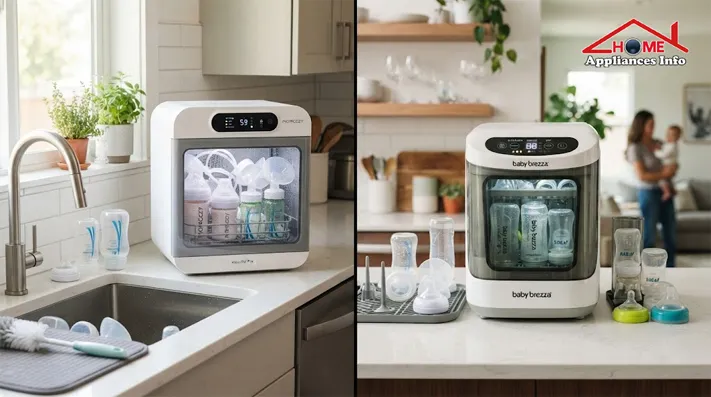
The baby brezza bottle washer vs momcozy debate comes down to one key question: do you value placement flexibility or overall balance?
| ⚙️ Feature | 🍼 Baby Brezza Bottle Washer Pro | ✨ Momcozy KleanPal Pro |
|---|---|---|
| 💦 Spray system | 20 high-pressure jets | 26 multi-angle jets |
| 🍾 Rated bottle capacity | Up to 4 + accessories | Up to 4 + accessories |
| ⚡ Rapid wash | 19 minutes | 19 minutes |
| ⏱️ Full cycle | About 95 minutes in Babylist testing | About 99 minutes |
| 💧 Water use | Higher in Babylist testing | About 2.5 L |
| 🚰 Drainage | No sink required | Sink drainage required |
| ♨️ Sterilization | Steam | Steam |
| 💨 Drying | HEPA-filtered hot air | HEPA-filtered drying |
| 📦 Storage | Up to 72 hours claimed | Up to 72 hours claimed |
| 🏆 Best advantage | Location flexibility | Overall balance |
Babylist’s direct comparison found Baby Brezza slightly faster overall, while its broader 2026 testing still favored Momcozy because of its combination of performance, size, noise, loading flexibility, and water efficiency.
Choose Baby Brezza if:
- You cannot place a washer beside your sink.
- You want removable water tanks.
- You expect to move the machine.
- You value multiple rinse cycles.
- You prefer a tank-based system.
Choose Momcozy if:
- You have convenient sink access.
- Lower water use matters.
- You want quieter operation.
- Flexible loading is important.
- You like the 72-hour storage feature.
My verdict: Momcozy is the better all-rounder. Baby Brezza is the better solution to a specific problem: no convenient drain.
What Should You Look for in the Best Bottle Washer for Baby Bottles?
The best bottle washer and sterilizer is not necessarily the machine with the most spray jets. I would judge it using seven practical questions.
1. Does it clean before it sterilizes?
This is fundamental.
Sterilization does not magically remove dried milk. Feeding equipment must be properly cleaned first. The CDC recommends taking bottles apart, rinsing their components, washing them with soap and water, rinsing again, and allowing them to dry thoroughly.
2. Does it dry completely?
Moisture is the enemy of clean storage.
A good baby bottle sterilizer and dryer should leave components genuinely dry rather than merely warm. Drying is especially useful when bottles need to be stored between feeds.
3. Can it handle pump parts?
For an exclusive pumper, a baby bottle washer for pump parts may be more valuable than bottle capacity alone.
Check whether your valves, membranes, flanges, collection cups, and wearable-pump components fit without blocking spray coverage.
4. How much can it hold?
Four bottles may be enough for a modest routine. Eight bottles or a larger mixed load can make much more sense for twins, exclusive pumping, or formula feeding.
5. Where does the dirty water go?
This sounds boring until you use the machine every day.
A sink-drain system reduces the need to empty a waste tank. A tank-based machine gives you more freedom about placement.
6. What does maintenance involve?
Every machine needs maintenance. Mineral buildup, detergent residue, filters, spray arms, and water tanks all need attention.
7. Are your bottles compatible?
Never assume “universal” means every bottle and pump component will fit perfectly. Check the manufacturer’s compatibility information before buying.
For parents also comparing other kitchen equipment, countertop space matters. A large washer can compete for room with items such as Best Glass Bowl Sets or Best Omelette Pans. It is worth measuring first.
How to Descale a Bottle Washer and Sterilizer
If you live in an area with hard water, limescale can become one of the least glamorous parts of owning a washer.
Momcozy currently recommends descaling the KleanPal Pro every 20 cycles using its citric-acid-based descaling tablets. Its instructions call for placing a tablet in fresh water, running a standard wash cycle, soaking overnight for heavy buildup when needed, and completing a final rinse with fresh water.
For a more detailed manufacturer’s walkthrough, see how to descale a bottle washer and sterilizer.
The key lesson is not to copy a generic vinegar recipe from another appliance. Different machines use different pumps, heating elements, seals, and materials. Follow the instructions for your exact model.
A simple maintenance routine
- Empty and rinse removable components regularly.
- Clean spray arms and residue collectors.
- Follow the manufacturer’s descaling interval.
- Use the recommended detergent.
- Check filters where applicable.
- Rinse thoroughly after descaling.
- Inspect bottles and pump parts for damage.
Are Electric Bottle Sterilizers Safe?
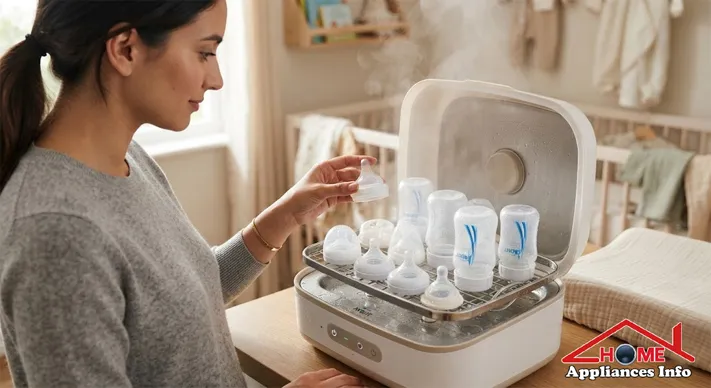
In normal use, an electric baby bottle sterilizer or steam sterilizer can be a safe way to sanitize heat-compatible feeding equipment when you follow the appliance and bottle manufacturer’s instructions.
The important distinction is that sterilizing is not a substitute for cleaning.
The CDC recommends cleaning feeding items after every feeding. It also says daily sanitizing is especially important for babies younger than two months, babies born prematurely, or babies with weakened immune systems.
You can read the CDC’s current guidance on are electric bottle sterilizers safe.
Steam also deserves respect. Keep hands away from escaping steam, allow hot components to cool, and keep electrical connections dry.
Do You Need to Sterilize Bottles After Every Use?
Not necessarily.
This is one area where product marketing can make the issue sound more complicated than it is.
The CDC recommends cleaning bottles after every feeding. For healthy older babies, daily sanitizing may not be necessary when feeding equipment is cleaned carefully. Daily sanitizing is particularly recommended for babies under two months, babies born prematurely, or babies with weakened immune systems.
If your pediatrician has given you different instructions because of your baby’s health, follow that advice.
For occasional bottle users, a standalone steam sterilizer for baby bottles may therefore make more sense than paying for a full washing machine.
Are Bottle Washer and Sterilizer Combos Worth It?
For many families, yes—but frequency of use is the deciding factor.
If you’re washing six to ten bottles and a collection of pump parts every day, an all-in-one machine can remove a repetitive chore from your routine.
It is particularly useful for:
- Exclusive pumpers
- Formula-feeding households
- Parents washing multiple bottles daily
- Families with twins
- Parents frequently cleaning pump components
- Anyone who wants automated washing and drying
If you use one bottle occasionally, however, a conventional dishwasher or hand-washing setup may be perfectly adequate.
This is where I think shoppers should resist the temptation to buy the most expensive appliance simply because it looks convenient. The right machine is the one that solves a problem you actually have.
And if you’re organizing a larger kitchen setup, related buying guides such as Best Insulated Coffee Mugs, Best Glass Bowl Sets, and Best Omelette Pans can help you think about the same question: how much valuable counter space is each appliance earning?
FAQs
What is the best bottle washer and sterilizer in 2026?
For the best overall balance, the Momcozy KleanPal Pro is my top pick, based on current 2026 hands-on testing and its combination of cleaning, drying, flexible loading, water efficiency, and noise performance.
Is Baby Brezza better than Momcozy?
Not universally. Baby Brezza wins if you need a no-sink setup. Momcozy has the stronger overall balance for a typical kitchen installation.
Can bottle washers clean breast pump parts?
Yes, many are designed for pump parts. However, always check compatibility with your exact pump, particularly wearable pumps, valves, membranes, and unusually shaped components.
Does a bottle washer replace hand-washing?
An all-in-one washer is designed to automate the washing process, but proper loading and maintenance still matter. You should also follow the specific instructions for your bottles, pump parts, detergent, and washer.
Is a bottle sterilizer and dryer enough?
If you already wash bottles by hand or in a dishwasher and only want sanitizing and drying, a sterilizer-dryer may be enough. If your goal is to eliminate much of the washing work, choose a full washer, sterilizer, and dryer combination.
Do I need a bottle washer if I use only two bottles?
Probably not. If you wash only one or two bottles per day, the cost and counter space may not justify a dedicated appliance. The value becomes much clearer as daily bottle and pump-part volume increases.
Final Verdict: Which Bottle Washer Should You Buy?
The best bottle washer and sterilizer for 2026 depends less on flashy specifications and more on your daily feeding routine.
Best overall: Momcozy KleanPal Pro
Best high-capacity option: Papablic Bottle Washer Sterilizer Dryer
Easiest to use: GROWNSY All-in-One
Best no-sink option: Baby Brezza Bottle Washer Pro
If I were choosing for a standard kitchen with convenient sink access, I would start with Momcozy. If I needed maximum capacity, I would look closely at Papablic. If simple controls mattered most, GROWNSY would move up my list. And if the machine needed to live away from the sink, Baby Brezza would become the obvious contender.
The larger lesson is simple: cleaning comes first, sterilizing is an additional step when appropriate, and completely drying feeding equipment matters. The CDC’s guidance supports that basic sequence.
For most parents, the best machine is not the one with the longest specification sheet. It is the one that reliably turns a pile of bottles and pump parts into clean, dry equipment with the least friction.
Trusted References
- baby bottle washer and sterilizer dryer — Babylist’s 2026 hands-on bottle washer testing.
- How to Clean, Sanitize, and Store Infant Feeding Items — Current CDC guidance for infant feeding hygiene.
- how to descale a bottle washer and sterilizer — Manufacturer guidance on bottle washer descaling.

🌐 FOUNDER & DIGITAL PUBLISHER
Muhammad Ali
Founder | SEO Strategist & E-E-A-T Digital Publishing Specialist

📈 SEO Strategy
🛠️ Appliance Optimization
🛡️ E-E-A-T Standards
Muhammad Ali is a digital publisher, SEO strategist, and founder of Home Appliances Info. He specializes in home appliance optimization, structured schema networks, and advanced E-E-A-T digital publishing standards to ensure accurate, trustworthy content across the platform.