


To support our research and detailed appliance reviews, we may earn a small commission from qualifying purchases made through our links, at no extra cost to you. As an Amazon Associate, I earn from qualifying purchases.
To support our research and detailed appliance reviews, we may earn a small commission from qualifying purchases made through our links, at no extra cost to you. As an Amazon Associate, I earn from qualifying purchases.
When a washer stops mid-cycle with an F05 alert, stress follows fast. I’ve seen it happen in busy family homes, rental units, and small laundry rooms where one machine does all the work. The confusing part is this: Whirlpool washer F05 error code troubleshooting is not the same for every model. On many North American Whirlpool-built machines, F05 often points to a water temperature sensor issue. On some UK and European platforms, it usually signals a drain or waste-water problem. That split matters. If you chase the wrong fault, you can lose hours, buy the wrong part, and still stare at the same flashing control panel display.
In this guide, I’ll walk through both paths clearly. I’ll also show you where the Whirlpool washer F05 error code overlaps with the Whirlpool Duet washer f05 error code, why Whirlpool washer not draining F05 can sometimes be a false clue, and How to manually drain a Whirlpool front load washer without turning your laundry area into a shallow pond. If you’re also maintaining the rest of your laundry setup, I’d pair this with How to Clean Washing Machine with Vinegar and Baking Soda to prevent buildup that can make diagnostics harder later.
1. First, understand what F05 means on your specific Whirlpool platform
This is the biggest mistake I see. People search one code, find one answer, and assume it applies to every Whirlpool-built machine.
In practice, it doesn’t.
North American models: often a temperature sensor or thermistor fault
On many electronic Whirlpool, Maytag, Amana, and Kenmore front-load platforms sold in the U.S. and Canada, F05 usually relates to the water temperature sensor circuit. That sensor is often called a thermistor. It works with the heating element and the central control unit (CCU) to monitor wash temperature.
If the CCU gets a resistance value that makes no sense, or loses communication with the sensor entirely, it may stop the cycle.
That can create a weird side effect: the washer appears stuck, and users assume the pump is dead.
UK and European models: often a drainage fault
On some UK/EU Whirlpool machines, F05 commonly points to a drain problem. Water stays in the drum. The door may remain locked. The drain pump impeller may be jammed, or the filter or waste hose may be blocked.
That’s why the same code causes so much confusion online.
My rule before touching anything
I always start by checking:
- The model number
- The tech sheet, if available
- The region the machine was built for
- Whether the drum is full of water
- Whether the cycle stopped during heating, rinsing, or draining
If the machine is under a Whirlpool family brand badge, the same logic often applies to some Maytag, Amana, and Kenmore units too. That crossover alone makes this topic trickier than it looks.
2. Start with the fastest check: do a hard reset
Before opening panels or grabbing an ohm meter, I do a basic reset.
Hard reset steps
- Unplug the washer.
- Leave it disconnected for at least 2 minutes.
- Plug it back in.
- Try a drain/spin or rinse cycle.
I’ve seen control glitches clear after a power cycle, especially after a power outage or interrupted wash.
If the code comes back right away, move on.
What I look for after reset
- Does the drum try to drain?
- Does the machine lock and do nothing?
- Does the control panel display flash immediately?
- Do you hear the pump hum?
- Is there hot-water or temperature-related behavior before the code returns?
These clues help you decide whether you’re chasing a sensor fault or a drainage fault.
3. If you have a North American model, inspect the temperature sensor circuit
For many U.S. Whirlpool front-load machines, this is the core of the repair.
Why the thermistor matters
The thermistor reads water temperature and reports it to the central control unit (CCU). If it sends a bad reading, the machine may stop the cycle as a protective measure.
In my experience, that can mimic a pump problem. The washer may never advance to the next command, which is why some owners describe it as Whirlpool washer not draining F05 even when the drain path is technically clear.
Common symptoms of a thermistor-related F05
- Cycle stops mid-wash
- F05 appears after filling
- Drain seems delayed or absent
- Water temperature acts strangely
- Machine behaves inconsistently across cycles
Visual wire audit
Unplug the machine first.
Then inspect the wiring harness near the sensor, heating element area, or lower tub section depending on your model. On some machines, access may be from the rear panel. On others, you may need the lower access area or front toe panel.
Look for:
- Corroded terminals
- Frayed wires
- Loose connectors
- Burn marks
- Mineral buildup around the sensor body
I once found a washer with a perfectly healthy sensor but a partly backed-out connector. The owner was close to ordering a control board they didn’t need.
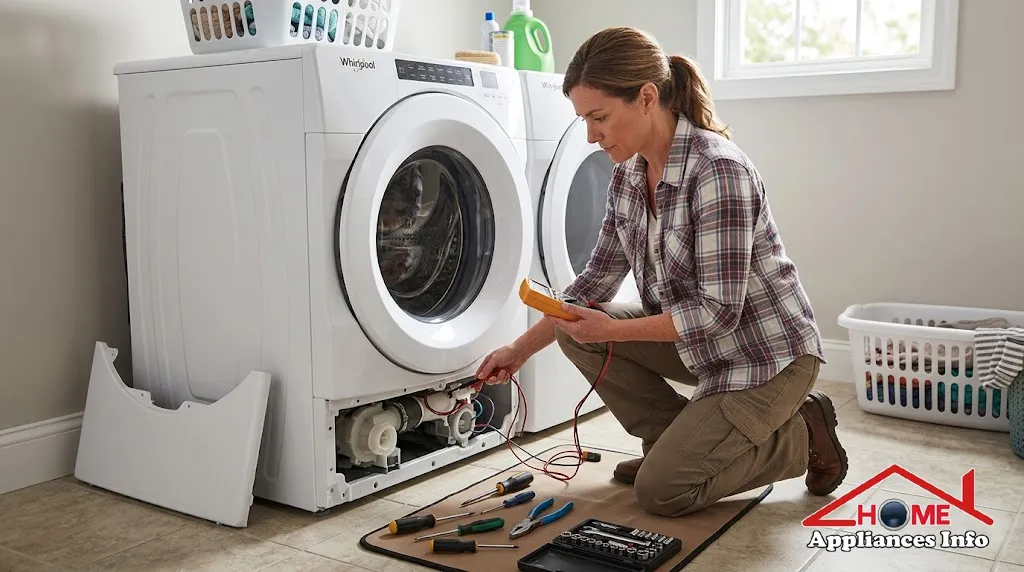
Run a multimeter or continuity test
This is where a basic ohm meter helps.
A continuity test can tell you if the circuit is broken. A resistance test tells you whether the thermistor value is in range.
Important note: not every Whirlpool thermistor has the exact same room-temperature resistance. Some read around 10k ohms at roughly 77°F/25°C. Others may differ. That’s why I always recommend checking the machine’s tech sheet for the exact chart.
Still, as a practical rule:
- If the sensor reads open line/infinite resistance, it’s bad
- If it reads far outside the expected range, it’s suspect
- If the value changes smoothly with temperature, that’s a good sign
For the Whirlpool Duet washer f05 error code, this resistance check is often one of the most useful tests you can do before replacing parts.
Don’t ignore scale on the sensor
Hard-water scale can insulate the sensor tip. It won’t always trigger failure, but I’ve seen it distort readings enough to cause erratic behavior.
If the sensor tip is coated:
- Remove it carefully
- Wipe debris off
- Soak the tip in white vinegar briefly
- Reinstall and retest
That simple cleaning step is often skipped. It shouldn’t be.
4. Why F05 sometimes looks like a drain problem even when it isn’t
This is one of the most valuable distinctions in real-world diagnostics.
If the control board stops the cycle because of a sensor fault, the washer may never complete its normal drain sequence. To the user, it looks like a pump failure. But the drain pump impeller may be perfectly fine.
I call this the “false drainage” trap.
Signs of a false drainage trigger
- Pump and hose are clear
- Filter is clean
- F05 returns before a full drain cycle starts
- Sensor readings are unstable
- No obvious blockage in the standpipe or trap
This is why I never tell people to replace the pump first just because there’s standing water. The machine logic matters as much as the mechanics.
If your appliance maintenance list is growing, this same process mindset helps with other jobs too, like Smart Samsung Appliance Repair Hacks or even Learn Microwave Oven Repair when a symptom looks simple but has an electrical root cause.
5. If your model treats F05 as a drain fault, clear the water safely
Now let’s shift to the UK/EU-style meaning, or any machine that is clearly full of water and unable to drain.
How to manually drain a Whirlpool front load washer
This is the cleanest field method I use.
- Unplug the washer.
- Place towels around the front base.
- Use a shallow pan, baking tray, or wet/dry shop vac.
- If the drain hose is accessible, lower it into a low container to start a gravity drain.
- If little or no water comes out, open the lower access area and prepare to loosen the filter slowly.
If you need to tilt the machine slightly for a better angle, unplug it first and have a second person steady it. A washer full of water is heavier than most people expect.
Gravity drain technique
This method works well if the hose itself is not blocked.
I usually:
- Pull the drain hose from the standpipe
- Lower it below tub level
- Guide water into a shallow bin
- Empty and repeat
If the water flow is weak, there may be a clog at the pump, filter, or internal sump hose.
Open the pump filter carefully
On many front-load models, the filter is behind the lower front toe panel or kick plate.
Turn the cap slowly counterclockwise. Do not yank it open all at once.
Expect:
- Water rush
- Lint mats
- Coins
- Bobby pins
- Pet hair clumps
- Fabric strings
I’ve removed everything from baby socks to drywall screws from these traps.
Check the drain pump impeller
After the filter is out, inspect the impeller chamber with a flashlight.
The drain pump impeller should spin with slight resistance, not seize solid and not wobble loosely. If it’s jammed by debris, clear it. If it’s broken or detached, the pump likely needs replacement.
Inspect the external drain path
Also check:
- Corrugated drain hose for kinks
- Under-sink waste connection if applicable
- Standpipe for blockage
- Air gap or plumbing restriction nearby
- Pressure switch hose if water-level sensing seems inaccurate
A blocked pressure switch hose can sometimes confuse the machine about whether water remains in the tub.
6. Use this quick diagnosis table before buying parts
Here’s the fast comparison I wish more guides included.
| Symptom | More Likely Cause | Best First Test | DIY Difficulty |
|---|---|---|---|
| F05 appears early in cycle | Thermistor/sensor issue | Resistance check with ohm meter | Moderate |
| Drum full of water, door locked | Drain blockage or pump fault | Manual drain and filter inspection | Easy to Moderate |
| Pump hums but no water moves | Clogged filter or jammed impeller | Open pump filter and inspect chamber | Easy |
| Machine stops randomly, then shows F05 | Wiring or CCU/sensor communication fault | Wire audit and continuity test | Moderate |
| Water drains fine after reset, then code returns | Intermittent sensor or control issue | Thermistor resistance and harness check | Moderate |
| No spin, no drain, no progression | Control interruption or false drainage trigger | Sensor circuit plus pump path check | Moderate to Advanced |
7. Know when a part replacement makes sense
Not every F05 repair needs a technician. But not every case is beginner-friendly either.
Typical part and service cost range
| Part or Service | Estimated Cost | Notes |
|---|---|---|
| Thermistor / temperature sensor | 20–20–50 | Usually a manageable DIY repair |
| Drain pump assembly | 150–150–300 | Worth DIY only if access is reasonable |
| Central control unit (CCU) | 150–150–300+ | Better after confirmed diagnosis |
| Professional diagnosis and labor | 150–150–250 | Helpful if fault is electrical or intermittent |
My personal threshold for calling a pro
I usually recommend professional help if:
- The CCU is suspected
- Wiring damage is extensive
- The machine has repeat failures after part replacement
- You’re uncomfortable using a meter
- The unit must be disassembled deeply to reach the sensor or pump
A wrong board replacement is expensive. So is a damaged harness.
8. Practical tips I’ve learned from repeat service cases
After seeing multiple versions of the Whirlpool washer F05 error code, a few patterns stand out.
Tip 1: Don’t diagnose by code alone
Always combine the code with behavior. Was the water hot? Was the tub full? Did the pump run? That context is everything.
Tip 2: Check for maintenance issues that create misleading symptoms
Heavy detergent residue, scale, and trapped lint can make a washer act more broken than it is. Basic upkeep matters. If your machine has odor or residue problems too, How to Clean Washing Machine with Vinegar and Baking Soda is a smart companion read.
Tip 3: Look beyond the Whirlpool badge
Many of these repairs apply to Whirlpool-built Maytag, Amana, and Kenmore machines with similar architecture.
Tip 4: Don’t skip the tech sheet
If your unit still has its folded tech sheet behind the kick panel or inside the console, use it. It often includes exact error logic and resistance charts.
FAQs
What does the Whirlpool washer F05 error code usually mean?
It depends on the model platform. On many North American machines, it points to a thermistor or temperature sensor circuit fault. On many UK/EU models, it indicates a drain or pump blockage issue.
Can a bad sensor cause Whirlpool washer not draining F05 symptoms?
Yes. I’ve seen a faulty temperature sensor stop the cycle before the machine reaches a proper drain sequence. That creates a false impression that the pump is the main problem.
How to manually drain a Whirlpool front load washer without a mess?
Unplug the unit, lower the drain hose into a shallow container if possible, then slowly open the pump filter behind the lower access area or front toe panel while using towels and a low pan to catch water.
Do I need an ohm meter for Whirlpool Duet washer f05 error code diagnosis?
If your model likely uses F05 as a thermistor fault, yes, an ohm meter is extremely useful. It helps verify resistance range and can support a continuity test before you replace parts.
Could the pressure switch or control board cause F05?
Less commonly, yes. A bad pressure switch, damaged wiring, or failing central control unit (CCU) can interrupt cycle logic and mimic a more obvious sensor or drain fault.
Are these steps useful for other appliances or brands?
Yes, especially Whirlpool-built Maytag, Amana, and Kenmore washers. And if you troubleshoot across the house, guides like Smart Samsung Appliance Repair Hacks and Learn Microwave Oven Repair follow the same logic-first approach.
Conclusion
The smartest approach to Whirlpool washer F05 error code troubleshooting is to stop treating F05 as one universal failure. It isn’t. In one machine, it can mean a thermistor problem tied to the heating element and central control unit. In another, it can mean trapped water, a blocked filter, or a jammed drain pump impeller. I’ve found that once you separate those two meanings, the repair path becomes much calmer and much cheaper.
Start simple. Reset the washer. Check whether water is trapped inside. Inspect the filter and drain path. If your model aligns with the North American definition, test the sensor with an ohm meter and inspect the harness before buying bigger parts. If your machine is overdue for general maintenance, pair this repair with How to Clean Washing Machine with Vinegar and Baking Soda so future symptoms are easier to read.
If the code keeps returning after these steps, that’s the point where a skilled appliance tech can save time and prevent guesswork. But in many cases, a careful homeowner can solve it.
References

🌐 FOUNDER & DIGITAL PUBLISHER
Muhammad Ali
Founder | SEO Strategist & E-E-A-T Digital Publishing Specialist

📈 SEO Strategy
🛠️ Appliance Optimization
🛡️ E-E-A-T Standards
Muhammad Ali is a digital publisher, SEO strategist, and founder of Home Appliances Info. He specializes in home appliance optimization, structured schema networks, and advanced E-E-A-T digital publishing standards to ensure accurate, trustworthy content across the platform.
3 Comments
Pingback: Why Is My Brita Filter Blinking Red? (And How to Reset It)
Pingback: How to Unclog a Kitchen Sink: 6 Easy DIY Methods
Pingback: How to Clean Refrigerator Coils: Easy Step-by-Step Expert Guide